|
GM. This is The Financial Darwin Awards, where your worst trade is someone else's content. On Monday the S&P 500 rose 4.73% to 7,237.17. It was a good day to own the US market. Our four composites still found a way to lose $123,381.34, and the Darwin Award went to a company that paid with its own holders' shares. Into that tape walked a cybersecurity buyer paying in its own shares, a British outsourcer with a new chief executive, an Indian steelmaker paying above the market and a silver short placed at the bottom of a bad week. This issue covers the US session of Monday 23 November 2026, plus the London and Indian closes of the same Monday. Invented traders, real numbers. Here's what we've got today:
THIS WEEK'S DAMAGE REPORT 📊
The first number is the sum of the four stories below: $30,705.00 + £21,960 (about $28,710.50) + ₹3,000,000 (about $32,285.84) + $31,680.00 = $123,381.34. The second is the S&P 500 at Monday 23 November's close, up 4.73% on the day. For context: that is the market the four positions were swimming in. Only one of them traded in New York, and it fell 8.92% on a day the index rose 4.73%. The index rose 4.73%. The four positions still lost $123,381.34, because each one was standing next to a decision someone else made that morning.
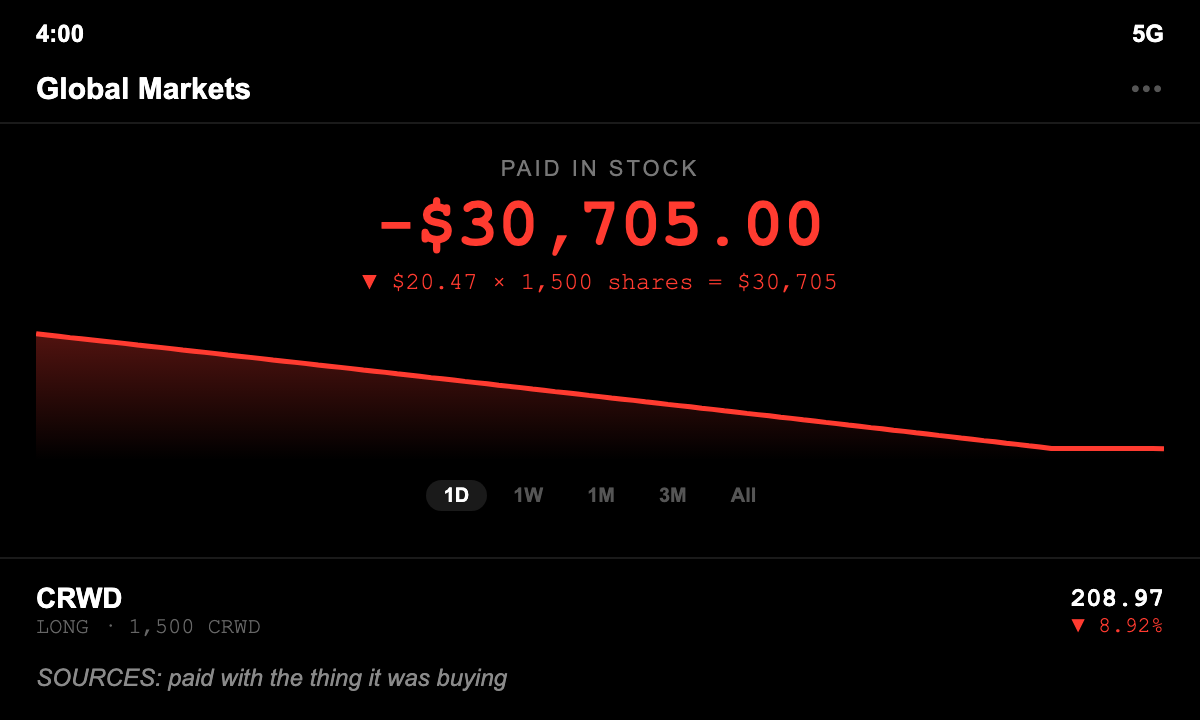
DARWIN AWARD OF THE WEEK 🏅 This week's award goes to a CrowdStrike long who watched the company buy its biggest rival and pay for it with the long's own shares. Here's the setup. u/paper_is_cheap_currency bought 1,500 CrowdStrike Holdings (Nasdaq: CRWD) shares at Friday 20 November's close of $229.44. That is $344,160 of the endpoint security company. The thesis: a record quarter was coming, and record quarters go up. On Monday 23 November, before the US open, CrowdStrike delivered the record quarter. In the same morning it agreed to buy Zscaler (Nasdaq: ZS) in an all-stock deal with an enterprise value of about $43.9 billion. Here's what stood out in the deal terms: • Exchange ratio: 1.135 CrowdStrike shares for every Zscaler share. • Friday's math: at Friday's closes of $229.44 and $194.82, that is $260.41 a Zscaler share, a premium of 33.7%. • Ownership: CrowdStrike holders would own about 84.1% of the combined company, Zscaler holders about 15.9%. • Timing: closing is expected in the second half of CrowdStrike's fiscal 2028. The outside date is 23 November 2027, extendable to 23 February 2028 if only antitrust or foreign-investment reviews remain. • Debt: Zscaler carries $1.725 billion of convertible notes due 2028, which is why the headline is an enterprise value. And the quarter, filed the same morning: • Revenue: $1.58 billion, up 28%. • Total annual recurring revenue: $6.26 billion, up 27%. • Net new annual recurring revenue: a record $419 million. One problem: the market read the deal before it read the quarter. Let's run through the tape. Monday 23 November on the Nasdaq: • Friday's close: $229.44. • Monday's open: $218.45. • Monday's close: $208.97, down $20.47 or 8.92%. • Volume: 42,046,743 shares, against 12,280,832 on Friday. Now the part that makes this a Darwin Award. In an all-stock deal, the buyer's share price is the price of the deal. On Friday, 1.135 CrowdStrike shares were worth $260.41. At Monday's close the same 1.135 shares were worth $237.18. Translation: the currency carrying the bid lost $23.23 per Zscaler share in a single session. That is 8.9% of the price CrowdStrike had just promised, gone before anyone signed a proxy. Zscaler rose about 18% on the day. It still traded a few dollars below the value of the paper it is being bought with, which is the market's polite way of saying it is not sure the deal closes at that price either. $20.47 a share on 1,500 shares is $30,705. CrowdStrike promised Zscaler holders $260.41 a share in CrowdStrike stock. By the close, its own shares had cut that promise by $23.23.
Here's the thing. Paying in stock costs the buyer nothing in cash and a great deal in share price. Every CrowdStrike holder, including this one, is now paying for 15.9% of a combined company. The bill for Monday alone was $30,705.
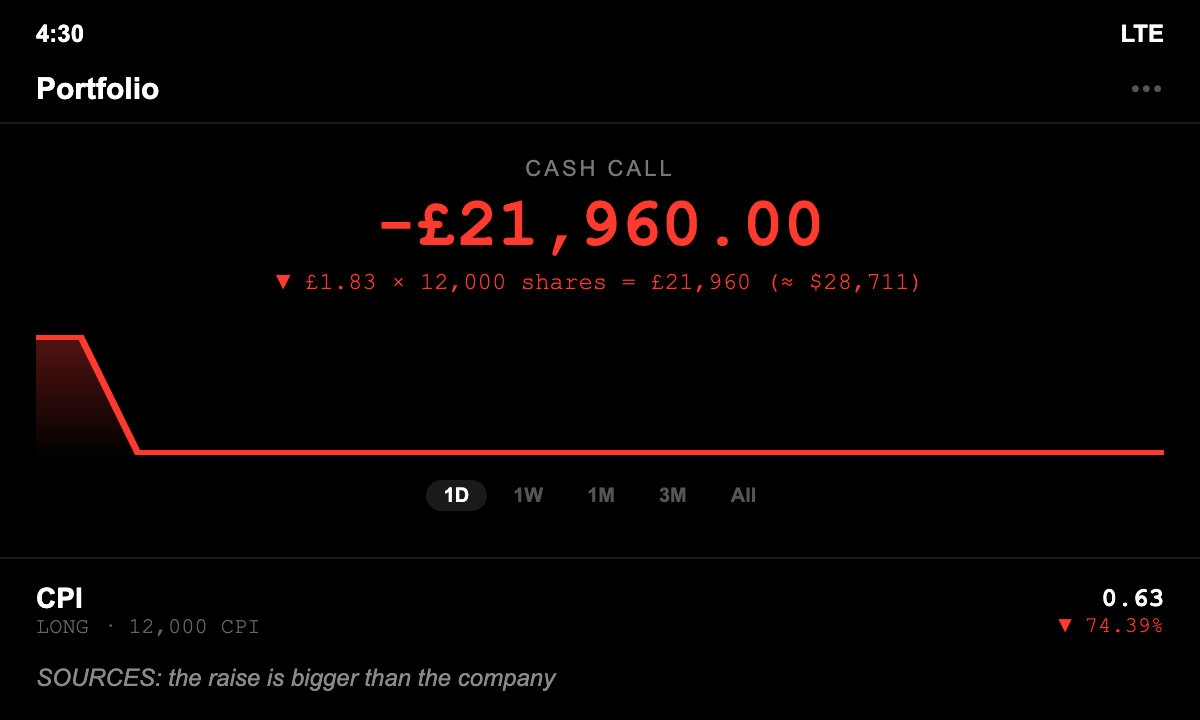
THIS WEEK'S CASUALTIES ☠ The first casualty owned Capita and lost £21,960 on a morning statement that changed the chief executive, the profit outlook and the share count. Here's the setup. Capita is the British outsourcer that runs the payment operations behind the Civil Service Pension Scheme, which has 1.7 million members. u/priced_for_disaster bought 12,000 Capita (London: CPI) shares at Friday 20 November's close of £2.46. That is £29,520 of stock. On Monday 23 November, before the London open, Capita put out one statement with three pieces of news: • The chief executive: Adolfo Hernandez stepped down with immediate effect, by agreement with the board, and stays available until 31 December for the handover. Finance chief Pablo Andres becomes chief executive, and group financial controller Gemma Bate-Williams becomes finance chief. • The profit: 2027 adjusted operating profit will be £85 million to £95 million below the previous expectation. • The cash call: a proposed raise of about £190 million of new equity in the first half of 2027. Read the profit line twice. The previous view was a reduction of up to £40 million, so the new hole is bigger than the whole hit the company had already owned up to. The company also said it had "not delivered" for members of the pension scheme. Monday 23 November on the London Stock Exchange: • Friday's close: 246 pence. • Monday's low: 60 pence. • Monday's close: 63 pence, down 183 pence or 74.39%. That is the lowest the shares have traded since October 1991. On 120.8 million shares, 63 pence values the entire company at about £76 million. The raise it wants is about two and a half times that. 183 pence a share on 12,000 shares is £21,960, about $28,711 at 1.3074 US dollars to the pound. Capita asked for £190 million of new equity. By the close, the market valued the whole company at about £76 million.
Translation: the worst case in the numbers was up to forty million. The new one is up to ninety-five. It turned out you can fall 183 pence from 246 pence, in a single session.
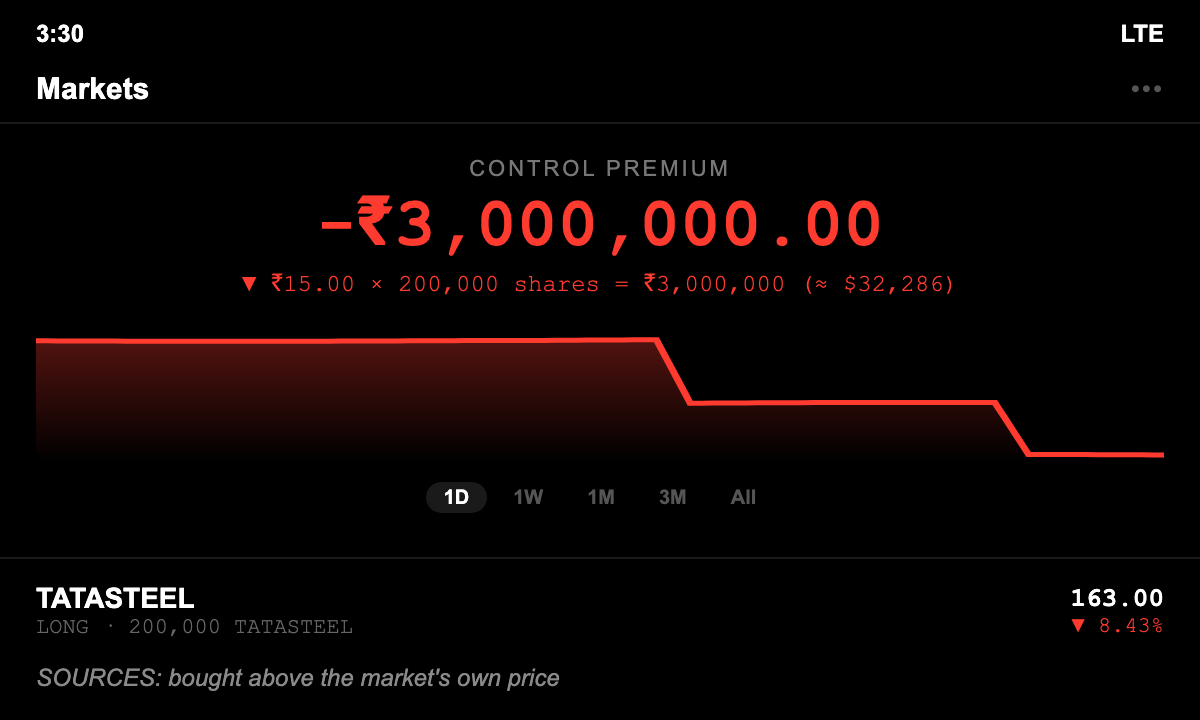
The next casualty owned Tata Steel and lost ₹3,000,000 on the day the company bought into a tube maker at a price the tube maker's own shares had already left. Here's the setup, which arrived over two days. • Sunday 22 November: APL Apollo Tubes (NSE: APLAPOLLO) agreed to buy Tata Steel's tubes business in a slump sale for ₹11,700 crore, plus 100% of Tata Steel Colors, for an aggregate of up to ₹28,000 crore. • Monday 23 November: Tata Steel's board approved buying up to 26.38% of APL Apollo from the promoter group entity S Gupta Holding at ₹2,100 a share, about ₹15,510.61 crore, in three tranches. • The first tranche: 2.77 crore shares, or 9.91%, went through a morning block deal at ₹2,100, worth ₹5,825 crore. • The open offer: the stake purchase triggers a mandatory offer for a further 26% at ₹2,301.40 a share, up to ₹16,755.66 crore, which would take Tata Steel to 52.38% if fully accepted. Total cash outlay if the offer is fully accepted: up to ₹32,266 crore, about $3.48 billion. Tata Steel said the transaction monetizes existing assets at an implied enterprise value to EBITDA of about 24.8 times. u/steel_buys_the_dip bought 200,000 Tata Steel (NSE: TATASTEEL) shares at Friday 20 November's close of ₹178.00. That is ₹35,600,000 of stock. Monday 23 November on the National Stock Exchange: • Open: ₹173.70, with a high of ₹173.80. • Low: ₹160.50. • Close: ₹163.00, down ₹15.00 or 8.43%, on 168,843,913 shares against 46,172,019 on Friday. So here's the question: what did the market think APL Apollo was worth that afternoon? The answer? ₹1,658.90, down 21.8%, a 52-week low. That puts the ₹2,301.40 open offer 38.7% above the market's own price for the same shares. The ₹2,100 promoter price is 26.6% above it. The rest of the market did not help. The Sensex fell 1,483.72 points or 1.77% to 82,435.99, and the Nifty Metal index fell 3.68%. ₹15.00 a share on 200,000 shares is ₹3,000,000, about $32,286 at ₹92.92 to the dollar, where the rupee settled on Monday, down 30 paise. Tata Steel committed to pay ₹2,301.40 a share for stock that closed at ₹1,658.90 the same afternoon.
Here's the thing: the 24.8 times was the price Tata Steel received, and the 38.7% premium is the price it pays. The market netted the two in a single session and sent the bill to Tata Steel holders: ₹15.00 a share.
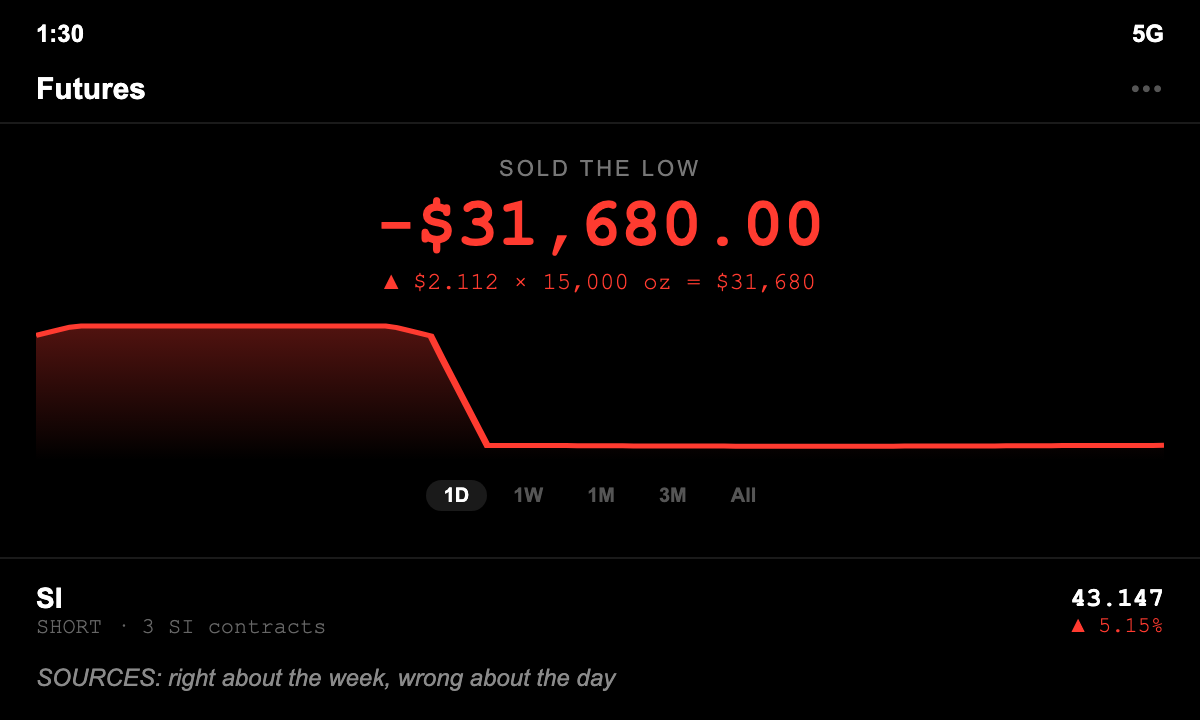
The last casualty shorted silver and lost $31,680 on the first session after a very good week for silver shorts. Here's the setup. Silver fell 16.4% the week before, its worst week in months. u/sixteen_percent_is_enough sold three front-month Comex silver contracts at Friday 20 November's settlement of $41.035 an ounce. At 5,000 troy ounces a contract, that is 15,000 ounces and $615,525 of notional. The thesis: a 16.4% week means the trend has room to run. One problem: Monday was the bounce. The dollar eased, Treasury yields came off, and Treasury Secretary Scott Bessent warned the Fed against tightening too far. Monday 23 November on Comex: • Friday's settlement: $41.035 an ounce. • Monday's settlement: $43.147 an ounce, up $2.112 or 5.15%. $2.112 an ounce on 15,000 ounces is $31,680. Translation: the short was sold at the bottom of the slide with perfect timing, then held into the first green day. The trader was right about the week and wrong about the day, and only the day was on the position.
It did not reverse the whole 16.4%. It reversed $2.112 of it, and on 15,000 ounces that was enough. The short has one consolation: it was early to the bottom, which on a futures exchange is the same thing as being wrong about it.
THIS WEEK BY THE NUMBERS 🔢 Four numbers, each read off a company statement, an exchange or a price series. No composite was involved in any of them.
The wider tape on Monday 23 November: the S&P 500 closed at 7,237.17, up 4.73%. In Mumbai the Sensex fell 1.77% to 82,435.99 and the Nifty Metal index fell 3.68%. The rupee settled at 92.92 to the dollar, down 30 paise. Comex silver settled at $43.147 an ounce, up 5.15%, and CrowdStrike traded 42,046,743 shares, more than three times Friday's volume. Three of the four losses came from a company's own announcement. The fourth came from betting a bad week would have a bad Monday.
BITE-SIZED COPIUM FOR THE ROAD 💊 The comments section, saved at the exact moment of maximum conviction. • "Stock deals are accretive eventually." Eventually starts after the outside date, 23 November 2027. (u/accretive_eventually) • "A new chief executive is a fresh start." The fresh start came with a £190 million invoice. (u/rights_issue_is_bullish) • "Control is worth paying up for." Up 38.7%, to be exact, over that afternoon's ₹1,658.90. (u/control_is_worth_it) • "One green day is just noise." The noise settled at $43.147 an ounce. (u/one_bounce_is_noise)
DUMB MEMES 🐸 The meme desk read one exchange ratio and one cash call. Two entries.
POV: you paid for the house with the house
POV: the invoice is bigger than the business Four trades, one Monday, and an S&P 500 up 4.73% in the background. Every number came from a company statement, an exchange or a price series. So did every loss. See you next issue. The exchange ratio is real. The traders are not. Traders and P&L screenshots are satirical composites. Market data, price moves and quotations are real and dated 20 November 2026 to 23 November 2026. Not financial advice. Obviously. Look at us.
Stay liquid,
|
CrowdStrike paid in its own stock. It fell 8.92%.
The $43.9B deal repriced itself by the open