|
GM. This is The Financial Darwin Awards, your portfolio's support group, 4x a week. Alstom had told investors its free cash flow would be positive this year. On Monday it guided to minus €1.5 billion, and the stock fell 26.06% in Paris. The biggest loss of the day came from a trader who owned the order book and never asked when the trains would be paid for. Four longs, one Monday, and only one of the four losses came with a results release. Plus a takeover premium paid in a falling currency, a share sale announced five days in advance, and a soybean long that met the harvest. Invented traders, real tape. Here's what we've got today:
THIS WEEK'S DAMAGE REPORT 🧮
The first number is the sum of the four stories below: $41,507 (€37,080 at $1.1194 to the euro) + $39,075 + $29,770 + $26,250 = $136,602. The second is Bloomberg Intelligence data as of Monday: 308 S&P 500 companies had reported third-quarter results, and 83% beat estimates. 83% of reporters beat. Our four traders lost money to a guidance cut, a deal, a share sale and a harvest instead.
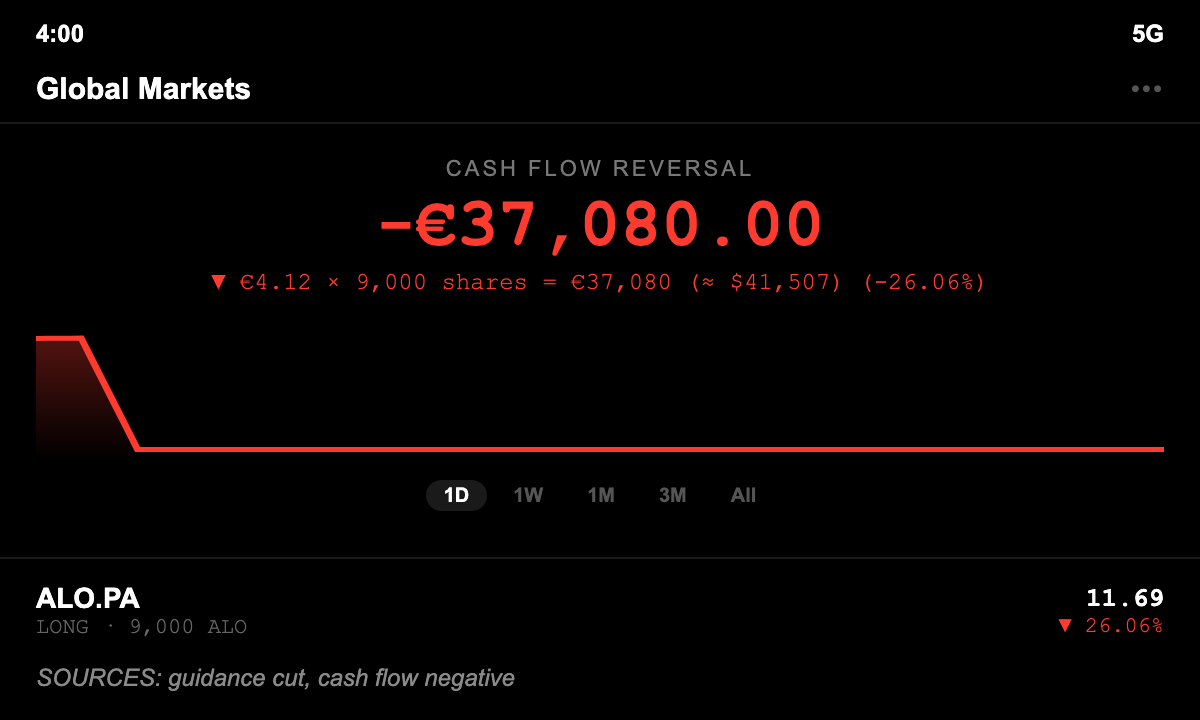
DARWIN AWARD OF THE WEEK 🏆 This week's award goes to someone who bought a train maker for its order book and lost €37,080 to its cash flow statement. Here's the setup. u/homologation_pending bought 9,000 Alstom shares at Friday's close of €15.81 in Paris, about €142,290 of stock. The thesis: €11.0 billion of orders in a single half, a book-to-bill above 1, and a chief executive, Martin Sion, who only took the job in April. The backlog was the floor. On Monday morning Alstom published preliminary first-half results and cut its full-year outlook for the second time in 2026. • First-half revenue: up about 3% to €9.3 billion, on €11.0 billion of orders. • First-half margin: adjusted EBIT margin of around minus 4%, against 6.4% in the first half a year earlier. • First-half cash: free cash flow of minus €1,248 million. One problem: the full-year guide moved further than the half did. • Margin guide: adjusted EBIT margin of around 1%, down from 6.5%. • Cash guide: free cash flow of minus €1.5 billion, where the previous guide said "Positive." • Production: about 4,000 rail cars, down from 4,400 to 4,500. • Growth: organic sales growth now low-to-mid single digit, from about 5%. Book-to-bill above 1, unchanged. • The repair kit: a plan to cut debt by about €2 billion, and management said it is considering asset sales. The cause has a name: Coradia Max, a regional-train platform. Development was paused for extra testing, homologation timelines stretched, deliveries slipped and contractual penalties landed. The company described a "domino effect" on other German projects. Chief financial officer Bernard Delpit said the Coradia project's gross margin is now negative. Before the open, Citi estimated that the negative cash flow guide was equivalent to roughly 20% of Alstom's market value. Paris closed at €11.69, down €4.12 or 26.06%, after an intraday low of €10.90. It was the worst session since October 2023 and the biggest fall in the SBF 120. €4.12 a share on 9,000 shares is €37,080, about $41,507. The margin cut was the headline. The cash flow was the trade.
Here's the thing. A margin falling from 6.5% to around 1% means each train earns less. Free cash flow going from positive to minus €1.5 billion means somebody has to fund the gap. That is why the same morning brought a €2 billion debt-reduction plan and talk of asset sales. Translation: the shares were not repricing a weaker year. They were repricing a funding question worth about a fifth of the company, by Citi's count. For context: Monday was the second guidance cut of 2026, and the stock is now down more than half this year. Total damage: €37,080, about $41,507, for owning the order book on the day the test track sent the invoice.
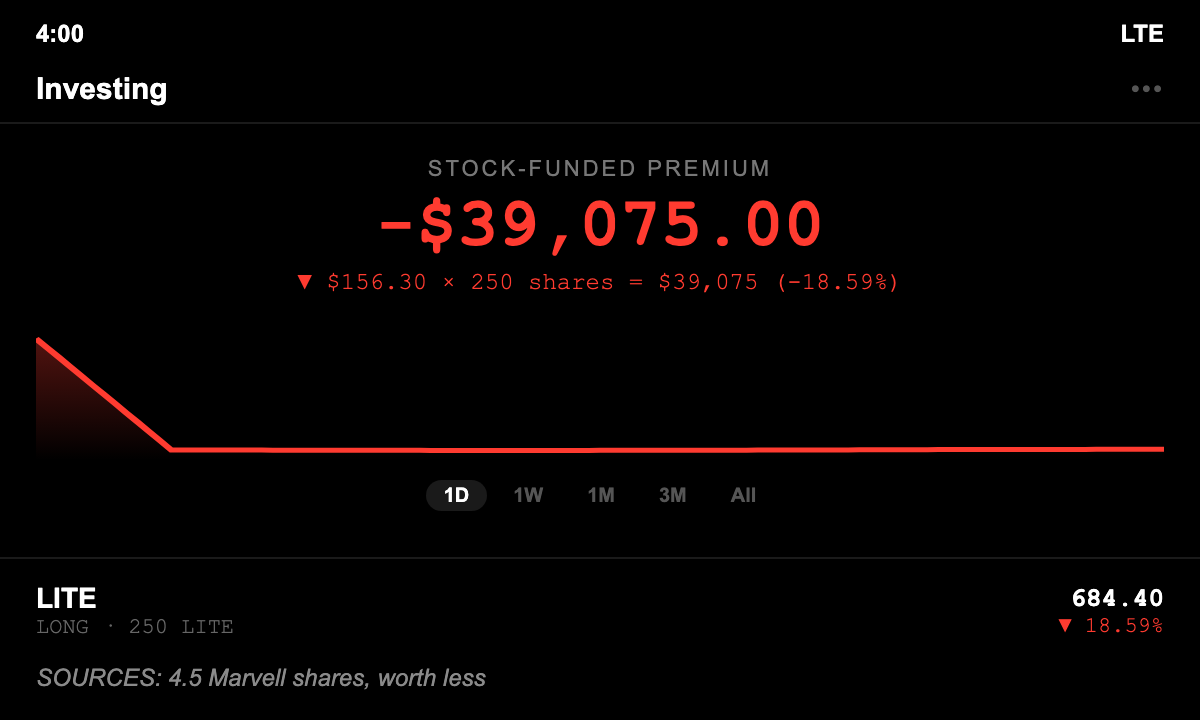
THIS WEEK'S CASUALTIES ⚰️ Casualty one held a takeover target at a 23.9% premium and lost 18.59% on the day the premium was announced. u/fixed_ratio_floating_price bought 250 Lumentum shares at Friday's close of $840.70, about $210,175 of stock. The thesis: Lumentum makes optical components, the parts that move data center traffic as light, and sooner or later a strategic buyer would pay up for them. On Monday a buyer did. • The deal: Marvell Technology agreed to buy Lumentum in an all-stock deal at a fixed ratio of 4.500 Marvell shares for each Lumentum share. • The headline: an implied enterprise value of $115 billion, described by both companies as about $1,132 a Lumentum share, a premium of about 23.9% to the unaffected close of $913.95 on October 28. • The split: Marvell holders get about 67% of the combined company, Lumentum holders about 33%. • The calendar: closing expected in the first half of calendar 2028, with Marvell paying Lumentum $3.2 billion if regulators block it. One problem: the premium was paid in Marvell shares, and Marvell closed at $171.41, down 12.7%, its worst three-day stretch since October 2000. Four and a half Marvell shares at Monday's close were worth about $771. Lumentum's own Friday close was $840.70. Lumentum closed at $684.40, down $156.30 or 18.59%, on 15,257,200 shares. It was the worst performer in the S&P 500 on the day. $156.30 a share on 250 shares is $39,075. The headline did not change. The currency did.
That's the part worth understanding. At Friday's close, four and a half Marvell shares were worth more than one Lumentum share. At Monday's close they were worth 8.25% less than Lumentum's Friday price, and Lumentum traded below even that, with closing not expected until 2028. Total damage: $39,075, for reading the premium in dollars when the contract was written in shares.
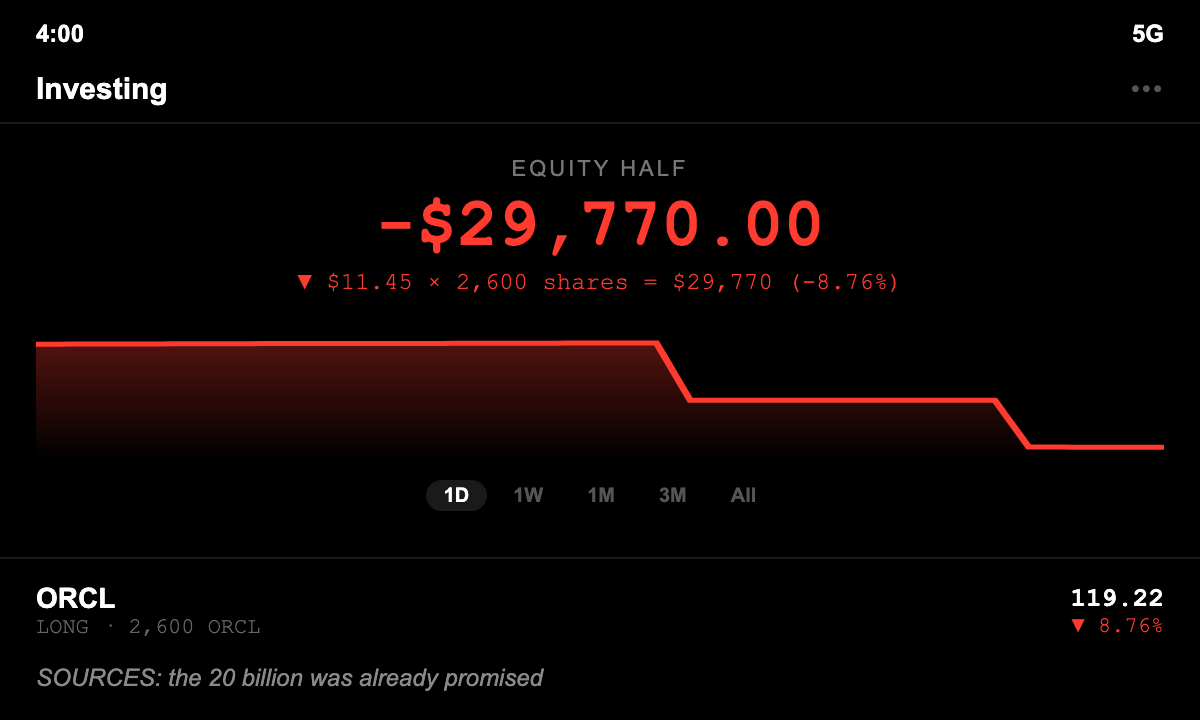
Casualty two was told exactly what was coming and still lost $29,770 when it arrived. u/twenty_billion_was_the_plan bought 2,600 Oracle shares at Friday's close of $130.67, about $339,742 of stock. The thesis: at last week's investor day, Oracle capped additional capital-market raises through fiscal 2030 at $20 billion, split $10 billion of equity and $10 billion of gross debt. A cap is a known number, and known numbers are in the price. Five days later, Oracle went to market for all of it. • The filing: $10 billion of common stock and $10 billion of senior notes, filed on Monday. The offering had not priced. • The shares: the preliminary prospectus assumes about 76.5 million shares at Friday's $130.67, taking the count from about 3.02 billion to about 3.10 billion, roughly 2.5% more. • The debt already there: about $236.1 billion of consolidated debt outstanding as of August 31, plus access to $19.7 billion under a revolver. • The bonds: the existing 6.85% notes due 2066 lost more than 1.2 cents on the dollar, according to Tradeweb. Monday's tape: a close of $119.22, down $11.45 or 8.76%, after a low of $118.43, on 58,484,300 shares. That leaves Oracle about 15% below Wednesday's close, roughly $65 billion of market value gone in under a week, and down about 33% in 2026. $11.45 a share on 2,600 shares is $29,770. The plan was pre-announced. The equity half still came out of the equity holders.
Here's what stood out: the surprise was the speed, not the size. A cap that runs through fiscal 2030 read like a four-year budget, and all of it was filed for inside one week. When the cheapest way to fund a data center is your own share count, the dilution is the price of the plan. Total damage: $29,770, for treating "already announced" as "already paid for."
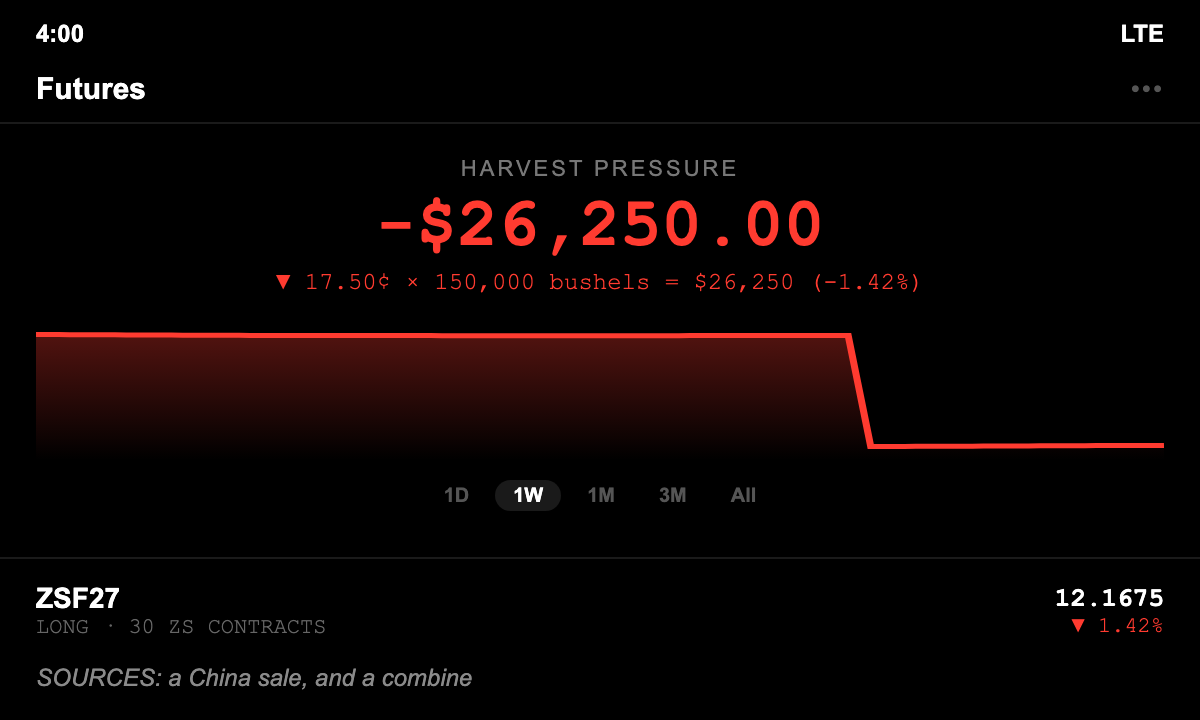
Casualty three bought the bullish headline in soybeans and lost $26,250 to a harvest that was already ahead of schedule. u/china_books_another_cargo bought 30 January soybean contracts on the Chicago Board of Trade, 150,000 bushels, at Friday's settlement of 12.34 1/4 dollars a bushel. The thesis: China was buying US beans again, and a flash sale to China is the kind of headline the market has to respect. On Monday the USDA delivered one. • The sale: 136,000 metric tons of soybeans to China for the 2026/27 marketing year, plus 1,729,740 metric tons of corn to Mexico, both reported as flash sales on Monday. • Inspections: 2,444,828 metric tons of soybeans and 884,766 metric tons of corn inspected for export. • The harvest: 88% of the soybean crop in, 4 percentage points ahead of the five-year average, in the USDA's Crop Progress report at 3 p.m. Central on Monday. Corn was 74% harvested, 3 points behind. One problem: the sale was a single headline, and the harvest pace behind it covered the whole country. January soybeans settled at 12.16 3/4 dollars a bushel, down 17 1/2 cents or 1.42%. November settled at 12.04 3/4 dollars a bushel. The rest of the grain room held up: December corn finished up 1/2 cent at 4.48 1/4 dollars a bushel, and December CBOT wheat up 3 cents at 6.06 1/2 dollars a bushel. 17 1/2 cents a bushel on 150,000 bushels is $26,250. The export sale was real. The supply arriving behind it was bigger.
For context: the Crop Progress number landed after the settlement, but the pace it measured was not news to anyone with a field. It put a figure on what the tape had already priced. A harvest running 4 points ahead of average puts more beans into the pipeline sooner, and nearby contracts like January carry that weight first. Total damage: $26,250, for owning the demand headline while the supply side was already in the truck.
THIS WEEK BY THE NUMBERS 🔟 Every figure below is sourced. Nobody in this section is invented.
Two of Monday's four losses came from new paper: one company paying in its shares, another selling them for cash. The S&P 500 fell 0.51% to 7,541.40 on Monday and the Nasdaq Composite fell 1.07% to 25,164.32, its third straight decline. The Dow rose 0.41%. The S&P 500 technology index fell 2.7% and the energy index fell 4%. January Brent settled at $104.77 a barrel, down $8.66 or 7.63%, its biggest one-day fall since July 27, on hopes for US-Iran talks through Qatari mediation. December WTI settled at $96.46 a barrel, down $7.66 or 7.36%, carrying Friday's $104.12 from above $100 to below it. After the close, Apple reported revenue of $114.48 billion against $113.39 billion expected and EPS of $2.10 against $1.99. The shares fell as much as 2.5% in extended trading, according to CNBC, on a gross margin guide that reflected higher memory costs. Tuesday in Seoul, the KOSPI closed down 3.59% at 5,648.79, with foreigners net selling 1.5 trillion won and Samsung Electronics down 4.15% at 219,500 won. Tokyo was closed for Culture Day. US midterm elections are today, Tuesday. This issue has no results, because there are none yet. Alstom cut production to about 4,000 rail cars. Our four traders cut nothing, which is how this issue got written.
BITE-SIZED COPIUM FOR THE ROAD 😵 Four replies from the comments, each one confident. • "Penalties are a one-off." The CFO said the Coradia project's gross margin is now negative. One-offs do not usually come with a margin. (u/penalties_are_a_one_off) • "The deal spread is free money." It pays you to wait until the first half of 2028 while the buyer moves 12.7% in a day. (u/merger_arb_is_a_coupon) • "The dilution was priced in." It was priced in at $130.67. The filing priced it again at $119.22. (u/dilution_was_priced_in) • "China always shows up." It did, with 136,000 metric tons. The harvest showed up with 88%. (u/beijing_never_misses_a_dip)
DUMB MEMES 💀 The meme desk checked what every promise was paid in. Two entries.
POV: the train passed every test except the extra ones
POV: you got a 23.9% raise, paid in your new boss's stock If this made you laugh, you did not own anything on Monday that runs on rails, light or soybeans. If it did not, the harvest is still 12% out there, and Crop Progress puts the number on it on Monday afternoons. See you next issue. The tape is real. The traders are fiction. Traders and P&L screenshots are satirical composites. Market data, price moves and quotations are real and dated October 28 to November 3, 2026. Not financial advice. Obviously. Look at us.
Stay liquid,
|
Alstom promised positive cash flow and delivered minus 1.5 billion euros. The stock fell 26.06%.
An Alstom long lost 37,080 euros when the free cash flow guide went from positive to a 1.5 billion euro outflow. The takeover premium at Lumentum, Oracle's own share sale and January soybeans cost another 95,095 dollars, for 136,602 dollars in all.