Skip to content
The Financial Darwin Awards logo The Financial Darwin Awards

Bloom Energy beat on everything. Except the cash.

Bloom Energy beat and raised, and a long lost $34,258 on the cash line. CoreWeave bonds cost $30,360, a cattle short $22,200 and an Aussie dollar short $26,700.
GM. This is The Financial Darwin Awards, your portfolio's support group, 4x a week.

Bloom Energy beat every estimate on Thursday and raised its full-year guidance for the third time this year. By Friday's close the stock was down 11.24%.

One number missed. It was the one made of actual cash.

$113,518 lost across four trades, and every one of them had a number that seemed to back it up.

Plus a bond bought for its coupon, a cattle short that met the calves, and a dollar trade that ran into Australia's central bank.

Composite traders, real tape. Here's what we've got today:

⚡Bought Bloom for the beat. The cash line had other plans.
🏦Bought CoreWeave bonds for 15%. The 15% was the warning.
🐄Shorted cattle near the top of the market. The calves never showed up.
🦘Shorted the Aussie in a risk-off week. Its central bank was the trade.
🤡Dumb memes from the trenches.
 
💣
 

THIS WEEK'S DAMAGE REPORT 💣

$114K

Lost This Week

5.00%

10-year Treasury yield, Oct 23

∞

Lessons Ignored

The first number is the sum of the four stories below. The second is the Treasury's daily par yield for the 10-year note on Friday, October 23 (CNBC printed 4.999%).

The bond market had its best day since March 2023 on Thursday. Our four traders did not.

 
🥉
 

DARWIN AWARD OF THE WEEK 🥉

Every issue we crown the single worst financial decision on the internet. This week it goes to someone who held a beat-and-raise overnight and lost $34,258 by Friday's close.

Here's the setup.

Bloom Energy makes fuel cells that power data centers on site. It reported third-quarter results after the bell on Thursday, October 22.

It beat on everything a headline can hold.

•Revenue: $1.24 billion, up 138% from a year earlier, against about $1.06 billion expected (Visible Alpha had $1.08 billion).
•Adjusted earnings: 94 cents a share, against about 69 cents expected.
•Net income: $250.3 million, against a loss a year earlier.
•Adjusted operating margin: 23.1%.
•Full-year guidance: raised for the third time this year, to $4.4 billion to $4.6 billion of revenue from $3.9 billion to $4.2 billion, with adjusted earnings of $3.10 to $3.40 a share.

u/raised_it_three_times owned 1,400 shares from Thursday's close of $217.77, about $304,878 of stock, and held them through the release.

The thesis: a company that keeps raising its guidance is a company that keeps being right.

One problem: one line in the release went the other way.

•Free cash flow: negative $181 million, against Visible Alpha expectations of a positive $43 million.
•Operating cash flow: an outflow of about $27 million.
•Capex: $153.5 million, up from $51.6 million in the second quarter.

The stock printed about 6% lower after hours. Friday's session finished the job.

Bloom closed Friday at $193.30, down $24.47 or 11.24%, on 36.0 million shares. Analysts cut their price targets the same day.

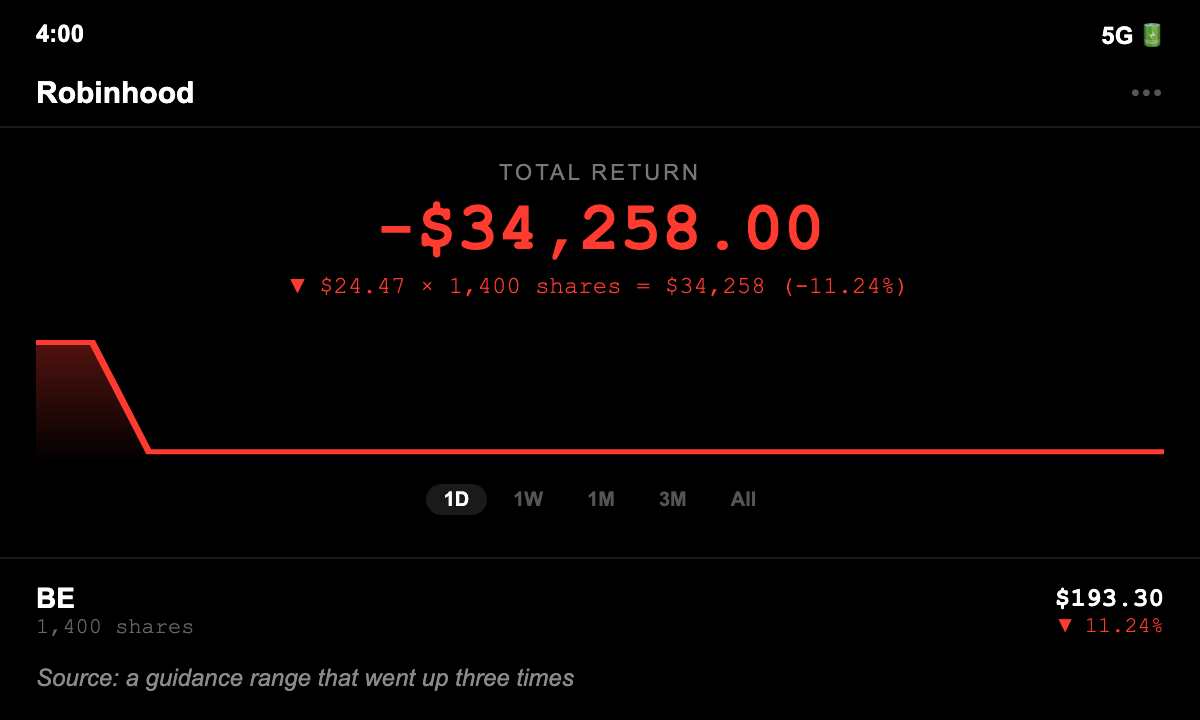
$24.47 a share on 1,400 shares is $34,258.

The company could raise every forecast it owns. It could not raise the cash it had already spent.

Brokerage screenshot: 1,400 Bloom Energy (BE) shares bought at Thursday's close of $217.77, down $34,258.00 after the stock fell 11.24 percent to $193.30 on Friday, when the company beat estimates and raised guidance but reported free cash flow of negative $181 million.
R
u/raised_it_three_times
r/stocks • 3h ago

Bought BE for a third guidance raise. Down 11% by Friday.

Revenue up 138% and EPS beat by 25 cents. I did not scroll down to the cash flow statement.

"Apparently the guidance is not where they keep the money."

 
⬆ 14.2k   💬 4.6k   🔖 1.9k

Here's the thing. Guidance is a forecast, and a company can change a forecast with a press release.

Cash flow is the record of what already happened. Nobody gets to raise it a third time.

For context: Bloom joined the S&P 500 last month, and the shares are still up about 122% this year.

They are also about 44% below the $346 record close of June 22, with October losses of about 30%.

Total damage: $34,258, for reading the forecast and skipping the receipt.

Free cash flow, stated plainly: Free cash flow is the cash a business brings in from its operations minus what it spends on equipment and buildings, the money actually left over to pay down debt or return to shareholders, and it can go negative in a quarter when profits look great, because revenue is booked when it is earned while customers may pay later and new plants are paid for up front. Bloom reported $250.3 million of net income but an operating cash outflow of about $27 million and $153.5 million of capital spending, which comes to free cash flow of negative $181 million against an expected positive $43 million. Guidance is the company's forecast for the rest of the year, and raising it costs nothing but a press release. 1,400 shares down $24.47 is $34,258.

 
🕰
 

THIS WEEK'S CASUALTIES 🕰

Not everybody can be Darwin Award of the week. These three gave it a real shot.

One bought a coupon, one shorted a steak and one forgot that Australia has a central bank.

Casualty #1: The Bondholder Who Bought The Coupon

CoreWeave rents out AI computing power, and it has borrowed heavily to build it.

CNBC counts more than $51 billion of debt and obligations, with about $20.7 billion due through 2030 and another $14.9 billion after that.

u/fifteen_percent_to_wait bought 11,500 of its 9.75% senior notes due 2031, a $1.15 million face position, at 83.00 on October 15.

The thesis: a yield above 15% pays you handsomely to wait for the AI build-out to work.

So here's the question: who sets that yield?

•The bond: BondTerminal marked the notes at 80.360 cents on the dollar on October 22, a 15.58% yield to worst and a 1,080 basis point spread over Treasuries. They had traded at 78 on October 14.
•The yield: CNBC put it at 15.637% on Friday.
•The swaps: CNBC put CoreWeave's five-year credit default swaps at 1,129 basis points on Friday, above the 1,000 level S&P Global Market Intelligence's Gavan Nolan calls a sign of distress.
•The stock: closed Friday at $54.24, down 2.46%, a fresh 52-week low. Morgan Stanley cut its target to $70 from $99, and UBS kept a Buy but trimmed to $105 from $120.

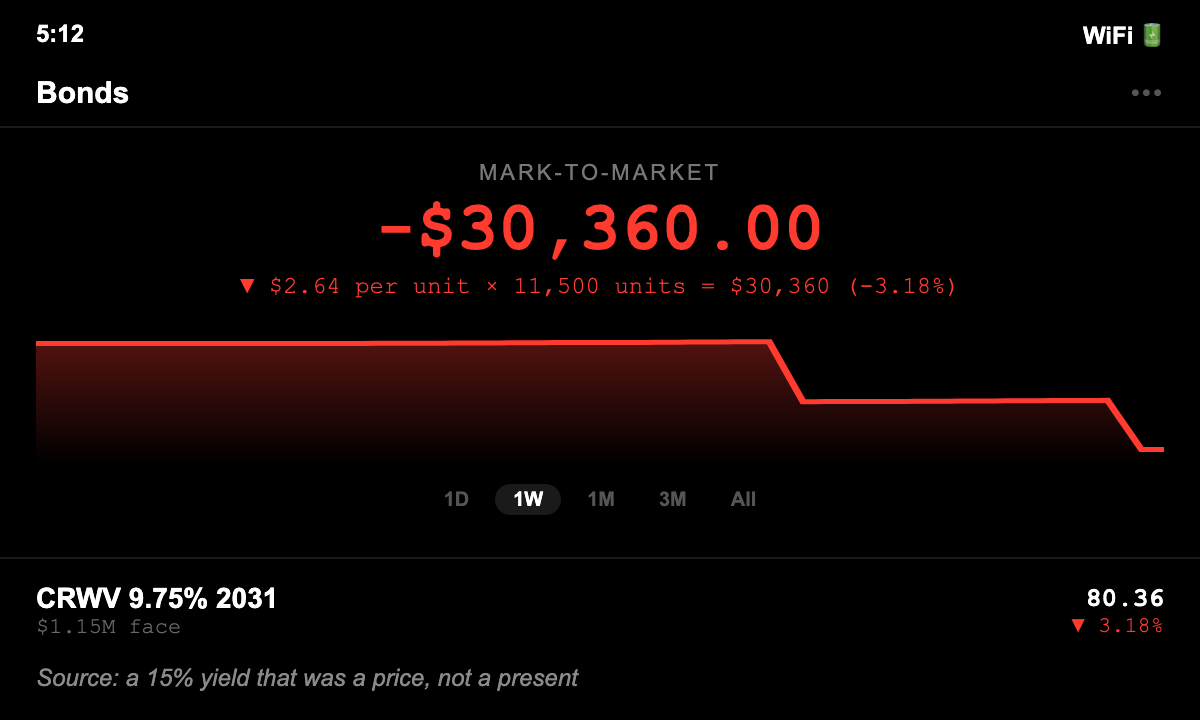
83.00 down to 80.36 is 2.64 points on every $100 of face. On 11,500 bonds that is $30,360, or 3.18%.

They read the 15% as their reward. The market had priced it as their risk.

Bond account screenshot: $1.15 million face of CoreWeave 9.75% senior notes due 2031 bought at 83.00 on October 15, down $30,360.00 after the notes were marked at 80.36 on October 22, a 3.18 percent fall, as CoreWeave's five-year credit default swaps widened above 1,000 basis points.
F
u/fifteen_percent_to_wait
r/bonds • 5h ago

Bought CoreWeave 2031s at 83 for the yield. They are at 80.

15% for doing nothing seemed generous. It turns out it was a quote, not a gift.

"The coupon is still 9.75%. That is the good news."

 
⬆ 8.7k   💬 2.9k   🔖 1.3k

Translation: a bond's yield rises when its price falls, so a bigger yield is usually the market charging more for the risk, not a better deal.

The coupon on $1.15 million of face is about $112,125 a year. This mark has already eaten more than three months of it.

Bill so far: $30,360, for collecting a yield that was quoting the risk back to them.

Credit default swaps, stated plainly: A credit default swap is insurance against a borrower failing to pay, and its price is quoted in basis points a year, so CoreWeave's 1,129 basis points means paying about $1.129 million a year to protect $10 million of its debt for five years, which is the market saying out loud how likely it thinks trouble is. A bond's yield moves the opposite way to its price, so when buyers demand more protection the bond falls and its yield climbs, which is why a 15% yield on a 9.75% coupon is a warning label rather than a bonus. The yield is the market's price for the risk, not a payment for patience. 11,500 bonds down 2.64 points is $30,360.

Casualty #2: The Cattle Short Who Counted Shoppers, Not Calves

December live cattle was coming off a weekly gain, after a week when the whole complex ground higher.

u/beef_cannot_go_higher shorted 20 December live cattle contracts at the close on Friday, October 16, at 228.35 cents a pound. That is 800,000 pounds of cattle.

The thesis: beef this expensive would ration demand, and the front month would sag back toward the cash market.

Here's what stood out: the week did not sag. Then the USDA published its monthly Cattle on Feed report on Friday afternoon, after the session closed.

•On feed: 11.372 million head on October 1, just under a year earlier and 100% of last year, against a Reuters poll at 100.3%.
•Placements: 1.777 million head in September, 12% below a year earlier and 88% of last year, against a trade estimate of 92.6%. The lowest September since the series began in 1996.
•Marketings: 1.524 million head, 7% below a year earlier.
•The futures: December live cattle settled unchanged on Friday at 231.125 cents a pound, about $2.77 higher on the week.
•Feeders: November feeder cattle rose 1.200 cents to 348.125 cents a pound on Friday and were up $6.22 on the week, their third straight weekly gain and the highest weekly close since June.
•The funds: managed money was net long 51,143 live cattle contracts as of Tuesday, up 2,395 on the week.

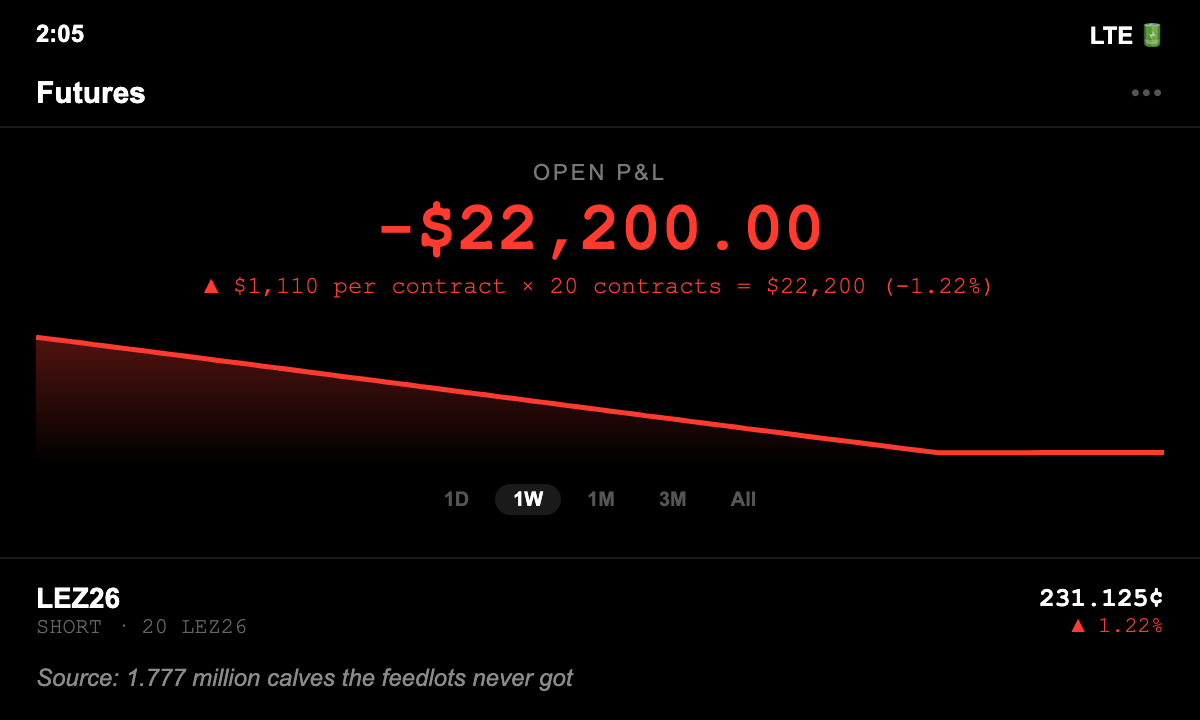
From 228.35 cents to 231.125 cents is 2.775 cents a pound. Times 40,000 pounds is $1,110 a contract, so 20 contracts is $22,200, or 1.22%.

They shorted the steak. The report counted the calves.

Futures screenshot: a short position of 20 December live cattle contracts sold at 228.35 cents a pound on October 16, down $22,200.00 after December cattle settled at 231.125 cents a pound on Friday, up 1.22 percent, before USDA's Cattle on Feed report showed the lowest September placements since 1996.
B
u/beef_cannot_go_higher
r/commodities • 6h ago

Short December cattle because beef can't go higher. Beef went higher.

My whole thesis was the grocery store. The USDA counted feedlots.

"Nobody told me the cows had a supply chain."

 
⬆ 7.4k   💬 2.1k   🔖 940

That's the part worth understanding. Demand rationing is a story about shoppers, and it takes months to show up in a futures price.

A placement shortfall is a story about cattle that will not be ready to sell next spring. The report printed the second kind.

Cash trade was thin, with live steers at $226 per hundredweight and dressed at $355, while boxed beef was lower.

Final bill: $22,200, marked before the futures have even traded the report.

Cattle on Feed, stated plainly: Cattle on Feed is the USDA's monthly count of cattle in large US feedlots, released after the futures close, and it splits into three numbers: how many head are on feed, how many were placed into feedlots during the month (placements) and how many were sold for slaughter (marketings). Placements matter most for prices further out, because a calf placed this month is a finished steer several months later, so a record-low September means fewer cattle to sell next year. A CME live cattle contract covers 40,000 pounds and is quoted in cents a pound, so each 1 cent move is worth $400 a contract, and 20 contracts short with the price 2.775 cents higher is $22,200.

Casualty #3: The Aussie Short In A Risk-Off Week

Last week was a risk-off week almost everywhere you looked. The Nasdaq had its biggest one-day drop since June on Thursday, and the Dow lost 652.82 points on Friday.

u/risk_off_means_dollar_up sold 3 million Australian dollars against the US dollar at the close on Friday, October 16, at 0.6949.

The thesis: when stocks fall, money runs to the dollar, and the Aussie is the classic currency it runs away from.

The answer? The Aussie rose 1.28% on the week to 0.7038, with a high of 0.7041, while the dollar index slipped 0.09% to 101.75.

•The deputy governor: Andrew Hauser said the inflation outlook is "materially worse" than the Reserve Bank of Australia had forecast.
•The assistant governor: Sarah Hunter said the bank had not yet done enough to bring inflation under control.
•The pricing: odds of a quarter-point hike at the November 3 board meeting roughly doubled during the week. XTB had them rising from about 20% to nearly 50%.
•The rate: the cash rate is 4.60% after the September 29 hike, the fourth increase of 2026.
•The calendar: September quarter CPI is due on Wednesday, October 28, the last input before the board meets.

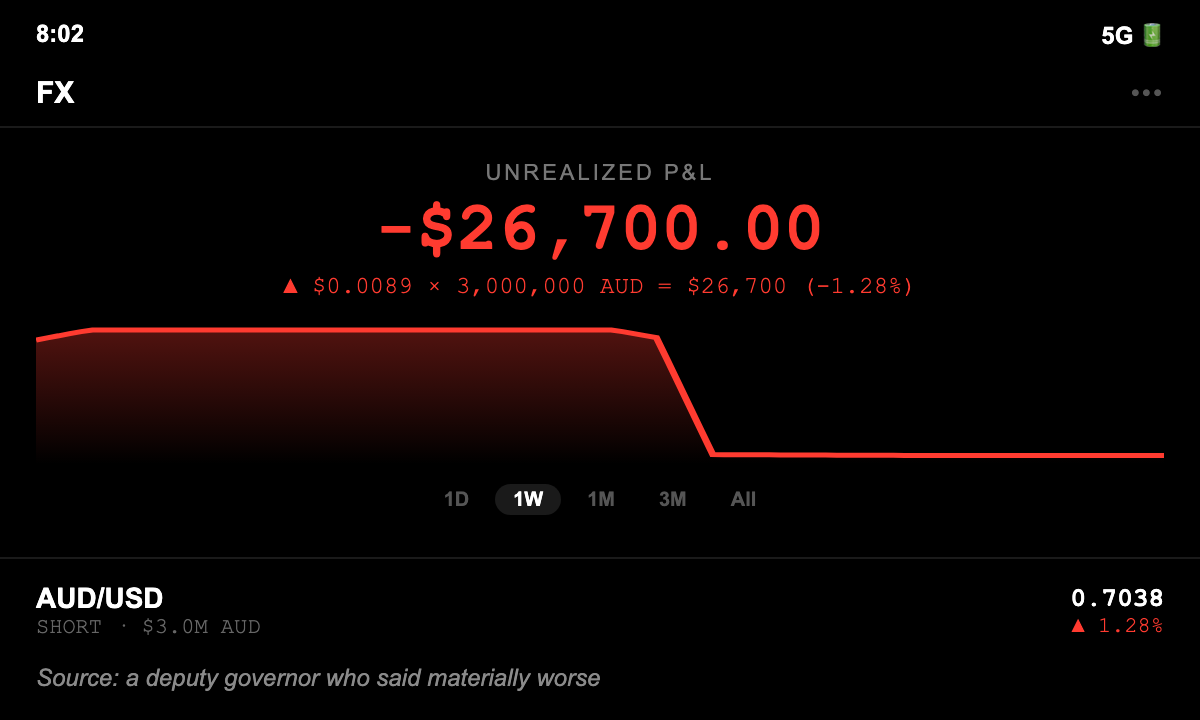
0.6949 to 0.7038 is a move of 0.0089. On 3 million Australian dollars that is $26,700, or 1.28%.

Every other market traded the risk. The Aussie traded its own central bank.

Currency trading screenshot: a short AUD/USD position of 3 million Australian dollars sold at 0.6949, down $26,700.00 after the Australian dollar rose 1.28 percent on the week to 0.7038 as Reserve Bank of Australia officials raised the odds of a November rate hike.
R
u/risk_off_means_dollar_up
r/Forex • 4h ago

Shorted AUD into a risk-off week. AUD rose 1.28%.

Nasdaq down, Dow down, everyone nervous. Textbook Aussie dump, I thought.

"Turns out Australia reads its own inflation numbers, not my playbook."

 
⬆ 6.3k   💬 1.8k   🔖 720

What this means: a currency is mostly a bet on its own interest rates. Risk appetite matters until the central bank starts talking.

Total so far: $26,700, and the CPI print that decides the next chapter lands on Wednesday.

Shorting AUD/USD, stated plainly: Currency pairs are quoted as the price of the first currency in the second, so AUD/USD at 0.7038 means one Australian dollar buys 70.38 US cents, and shorting the pair is a bet that the Australian dollar falls against the US dollar. The Aussie usually trades as a risk currency that weakens when stocks sell off, but higher expected interest rates pull money into a currency, and a central bank lining up a hike can outweigh a bad week everywhere else, which is what the Reserve Bank of Australia did with its cash rate at 4.60% and a board meeting on November 3. A short of 3 million Australian dollars that moves 0.0089 against you costs $26,700.

 
🔢
 

THIS WEEK BY THE NUMBERS 🔢

Real numbers only in this section. No composites allowed.

The 10-year Treasury yield fell 19.3 basis points on Thursday to 4.953%, its biggest one-day drop since March 2023.

The 2-year fell 18.5 basis points and the 30-year fell 15, its largest drop since August 2024. On Friday the 10-year climbed back about 5 basis points to 5.00%.

Friday's stocks were red. The Dow fell 652.82 points, or 1.23%, to 52,215.16, the S&P 500 fell 0.52% to 7,623.68 and the Nasdaq Composite slipped 0.21% to 25,955.34.

For the week the S&P 500 lost 0.5% and the Nasdaq 0.7%, while the Dow gained 0.4%.

Asia this morning was mixed. The Nikkei 225 slipped 0.1% to 62,602.86, the Hang Seng added 0.2% to 23,137.93 and the Shanghai Composite fell 0.4% to 3,673.83, with Taiwan closed for a holiday.

Bloom's third-quarter capex works out to about $1.67 million a day. Our four traders lost $113,518 between them, about 98 minutes of it.

 
😖
 

BITE-SIZED COPIUM FOR THE ROAD 😖

The best part of any loss thread is the comments section. Here are this week's greatest hits.

•"Cash flow is lumpy." This lump was $224 million against the estimate. (u/cash_flow_is_lumpy)
•"The coupon pays the bills." The coupon is 9.75% a year. The mark took 3.18% in a week. (u/coupons_pay_the_bills)
•"Placements will recover." September's were the lowest since 1996. (u/placements_will_recover)
•"CPI will be soft." It prints Wednesday, and the deputy governor already called the outlook materially worse. (u/cpi_will_be_soft)

Four traders, four numbers, and each of them picked the one that agreed with them.

 
🤪
 

DUMB MEMES 🤪

Every newsletter needs a meme section. Ours writes itself when a company raises guidance and gets sold anyway.

⚡📈  💸📉

Guidance: raised. Cash flow: -$181M

POV: you read the press release, not the cash flow statement

🐄🥩  📊📈

Steak: expensive. Calves: missing

POV: you shorted the grocery store, not the feedlot

If you laughed, you are probably not short cattle.

If you didn't, go check what the cash flow statement says.

See you next issue.

The forecasts were real, the coupons were real and the calves were real. Only the traders are made up.


Traders and P&L screenshots are satirical composites. Market data, price moves and quotations are real and dated June 1 to October 26, 2026. Not financial advice. Obviously. Look at us.

Stay liquid,
The Financial Darwin Awards

Free, 4x a week

Learn from other people's worst trades.

Five minutes of reading. A lifetime of bad decisions to study. Your portfolio will thank you, eventually.

No spam. Just other people's mistakes.

Almost there. Check your inbox to confirm.