Skip to content
The Financial Darwin Awards logo The Financial Darwin Awards

Boeing sold the recovery on a delivery schedule. The schedule moved to 2027.

A Boeing long lost $32,208 when the 737 ramp moved to 2027. Valero cost $27,594, Welltower $24,678 and December cotton $26,000, for $110,480 in all.
GM. This is The Financial Darwin Awards, your portfolio's support group, 4x a week.

Boeing reported before Tuesday's open and then told everyone when the cash arrives. The answer was later than expected, and the stock fell 10.69%.

The trade that lost the most was built on a delivery schedule, not on demand.

$110,480 lost across four longs. Each one was right about a number, and the market traded a different one.

Plus a refiner bought a week after its best quarter ever, a senior-housing REIT that beat on the number its sector trades, and a cotton long that checked the crop and skipped the calendar.

Invented traders, real tape. Here's what we've got today:

🛫Bought Boeing for the recovery. The recovery got a new delivery date.
⛽Bought Valero after the best quarter in its history. That was the problem.
🏥Bought Welltower on an FFO beat. The market read the line above it.
🌱Long December cotton on a poor crop. The harvest ran seven points early.
😹Two memes, both about calendars.
 
💸
 

THIS WEEK'S DAMAGE REPORT 💸

$110K

Lost This Week

47.3M

Boeing shares traded Tuesday

∞

Lessons Ignored

The first number is the sum of the four stories below, $110,480. The second is Tuesday's Boeing volume, 47,270,890 shares, about seven times its average.

Seven ordinary days of Boeing changed hands in one session. Our trader's 1,600 shares were not among them.

 
🥇
 

DARWIN AWARD OF THE WEEK 🥇

This week's award goes to someone who bought Boeing for its recovery and lost $32,208 on the morning the recovery got a new date.

Here's the setup.

u/the_rate_is_the_recovery bought 1,600 Boeing shares at Monday's close of $188.31, about $301,296 of stock, ahead of third-quarter results before Tuesday's open.

The thesis: Boeing's problem was never demand, with a record $745 billion backlog. It was output, and output was about to go up.

Half of that was right.

•The loss: an adjusted core loss of 34 cents a share, against about 21 cents expected.
•Revenue: rose 4% to $24.19 billion.
•Commercial Airplanes: an operating loss of $697 million, a segment margin of -6.5%. Defense ran a 6.2% margin.
•Cash: free cash flow was a positive $464 million in the quarter.

One problem: the release came with a calendar.

•The rate: 737 MAX production goes to 52 a month from 47, but in the second half of 2027.
•This year: the roughly 500 737 deliveries planned for 2026 will be missed.
•2027: free cash flow of about $3 billion, against roughly $5.7 billion expected.
•2028: about $6 billion, against roughly $9.6 billion.
•The target: the $10 billion free cash flow goal now lands in 2029.

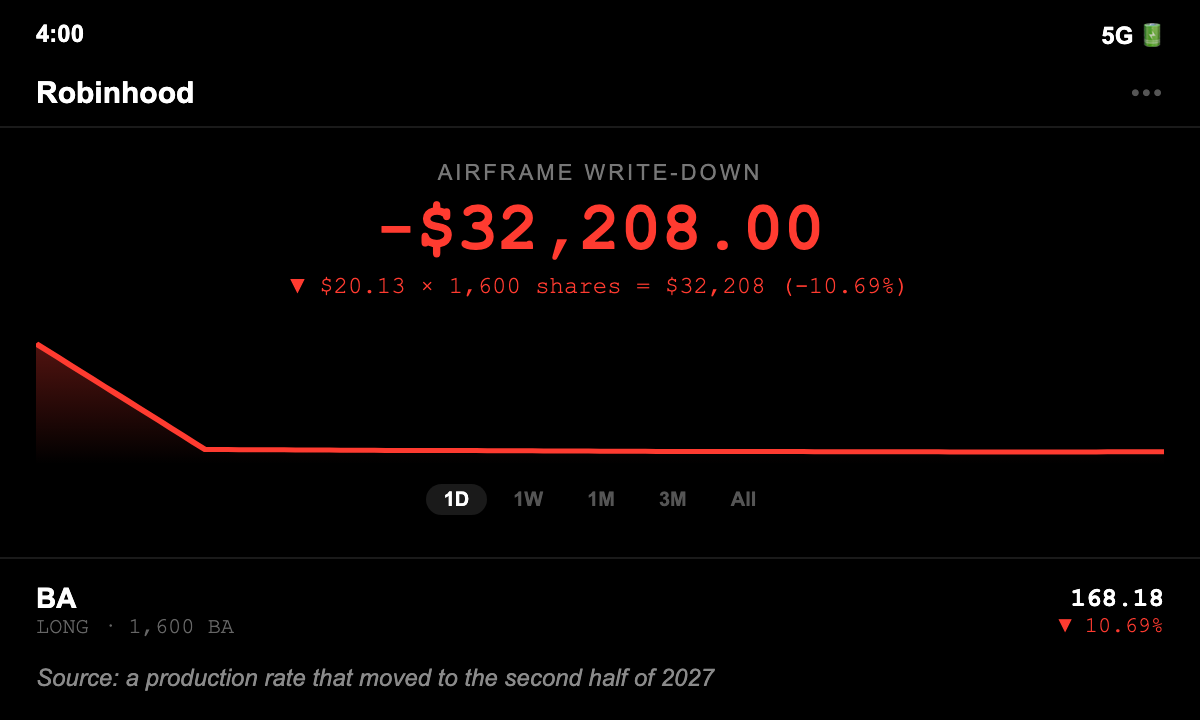
Boeing opened at $183.50, slid to a low of $167.41 and closed at $168.18, down $20.13 or 10.69%, a fresh 52-week low.

It was the worst performer in the Dow, on 47,270,890 shares, about seven times its average.

$20.13 a share on 1,600 shares is $32,208.

They bought the recovery as a product. Boeing sold it as a schedule, and the schedule moved.

Brokerage screenshot: a long position of 1,600 Boeing (BA) shares bought at Monday's close of $188.31, down $32,208.00 after the stock fell 10.69 percent to $168.18 on Tuesday, when Boeing pushed the 737 MAX rate increase to the second half of 2027 and guided free cash flow well below expectations.
T
u/the_rate_is_the_recovery
r/investing • 3h ago

Bought BA for the 737 ramp. Down 10.69% on earnings morning.

Record backlog, positive cash flow, revenue up 4%. I was buying the ramp.

"The ramp is still coming. It just has a 2027 return address."

 
⬆ 14.2k   💬 4.7k   🔖 2.1k

Here's the thing. A backlog says how many planes customers want, and a production rate says when Boeing gets paid for them.

Move the rate and the same $745 billion arrives later. Later cash is worth less when the 10-year Treasury yield closes Tuesday at 4.99%.

For context: Jefferies kept its Buy rating and a $265 target. The stock is down about 22% this year.

Total damage: $32,208, for owning a recovery that was always measured in planes a month.

Free cash flow guidance: Free cash flow is the cash a company keeps after running the business and paying for its plants and equipment, and for a manufacturer sitting on a record backlog it is mostly a question of timing, because the planes are already sold and the cash arrives as they are built and delivered. That makes the production rate the real forecast: lifting the 737 MAX to 52 a month from 47 in the second half of 2027 rather than sooner moves deliveries, and the cash attached to them, further out. Boeing's 2027 guide of about $3 billion against roughly $5.7 billion expected, and its 2028 guide of about $6 billion against roughly $9.6 billion, together take about $6.3 billion out of two years of expected cash, and the $10 billion target now lands in 2029. Investors value a stock on the cash it will produce, discounted back to today, so the same backlog delivered later is worth less. 1,600 shares down $20.13 is $32,208.

 
🪦
 

THIS WEEK'S CASUALTIES 🪦

Three more losses from the same session, none of them small enough to ignore.

One bought a record quarter, one bought the right metric on the wrong morning, and one bought a poor crop.

Casualty #1: The Refiner Bought After Its Best Quarter

Last week Valero posted the best quarter in its history. On Tuesday the day's list of worst closes read Boeing, then three big refiners: Valero, Marathon Petroleum and Phillips 66.

u/record_quarter_record_top bought 700 Valero shares at Monday's close of $426.76, about $298,732 of stock.

The thesis: a company that just earned $23.89 a share does not trade like a company that is about to stop.

Here's what stood out: everything in the release was true.

•Earnings: net income attributable to stockholders of $6.8 billion, or $23.89 a share. Adjusted earnings were $23.90, against roughly $21.17 expected.
•Revenue: $46.1 billion, up 43%.
•Refining: segment operating income of $8.8 billion against $1.6 billion a year earlier, on a refining margin of $39.24 a barrel and throughput of 3 million barrels a day.
•Costs: refining cash operating expenses of $5.03 a barrel.
•The balance sheet: $9.8 billion of cash and a 52% payout ratio.

So here's the question: what does a stock up about 165% this year do once the best quarter is behind it?

The answer? Management guided fourth-quarter throughput slightly lower and planned to run its refineries at 96% to 99% utilization.

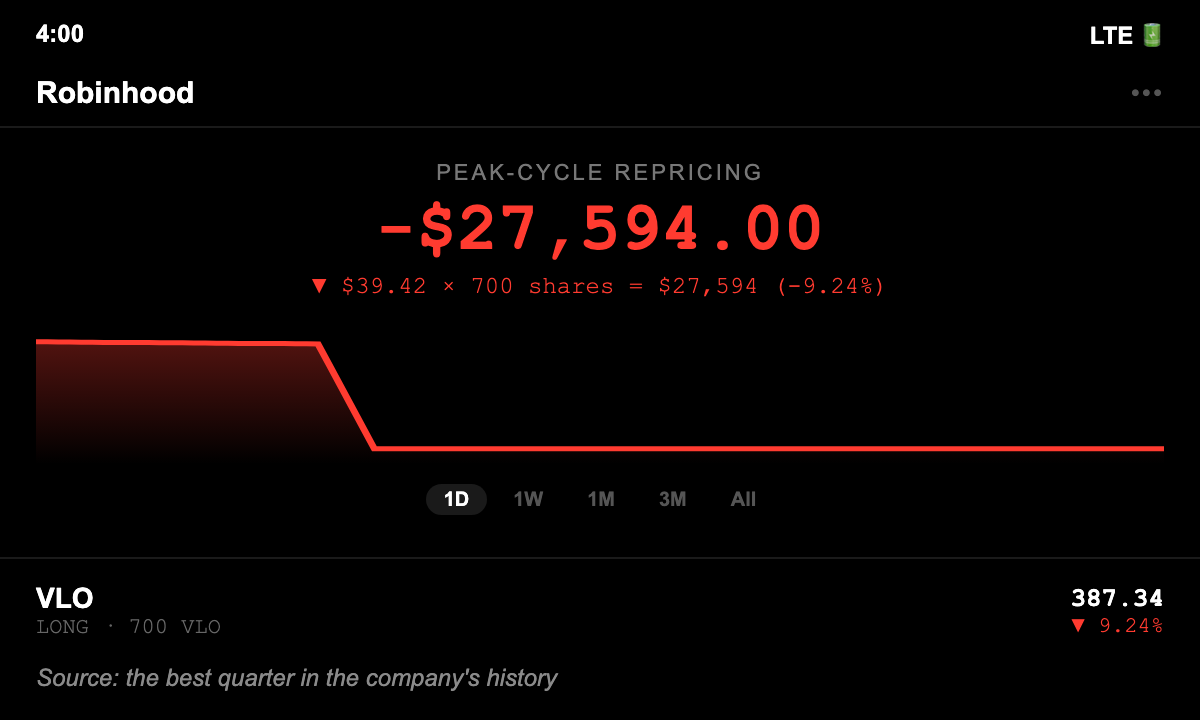
Valero closed at $387.34, down $39.42 or 9.24%. Marathon Petroleum fell 7.5% and Phillips 66 fell 7.3% in the same session.

$39.42 a share on 700 shares is $27,594.

A record quarter is a statement about the past. The price was a bet that the margin would last.

Brokerage screenshot: a long position of 700 Valero Energy (VLO) shares bought at Monday's close of $426.76, down $27,594.00 after the stock fell 9.24 percent to $387.34 on Tuesday, as refiners sold off together a week after Valero reported the best quarter in its history.
R
u/record_quarter_record_top
r/stocks • 5h ago

Bought VLO days after a record quarter. Down 9.24%.

$23.89 a share and refining income more than five times last year. I thought I was buying the cheapest record on the board.

"The record is still a record. It just closed 16% under the October high."

 
⬆ 8.9k   💬 2.6k   🔖 1.1k

Translation: a refiner earns the spread between what it pays for crude and what it gets for fuel, and that spread moves with the cycle.

When a price assumes the peak margin is permanent, a hint that volumes are flattening is enough. Tuesday's close sits 16% below the October 14 high of $461.52.

Bill so far: $27,594, for paying a peak price for a peak quarter.

Peak-cycle pricing: Refiners are cyclical businesses, because their profit is the gap between the cost of crude and the price of the gasoline, diesel and jet fuel they sell, and that gap widens and narrows with supply, demand and plant outages that no single company controls. A cyclical stock often looks cheapest on its trailing earnings exactly when those earnings are at their highest, since the market is already pricing the next part of the cycle rather than the last one. Valero earned $8.8 billion in refining in the third quarter against $1.6 billion a year earlier, on a margin of $39.24 a barrel, and the stock had run about 165% this year, so a slightly lower throughput guide and a 96% to 99% utilization plan read as the quarter that does not repeat. The whole group moved together, which is the sign of a sector repricing rather than a company problem. 700 shares down $39.42 is $27,594.

Casualty #2: The FFO Beat That Lost On The Call

Welltower is a real estate investment trust that owns senior housing. It reported third-quarter results after Monday's close and held its call at 9:00 on Tuesday morning, New York time.

u/ffo_is_the_number bought 1,800 shares at Monday's close of $240.61, about $433,098, after the stock had risen into the print.

The thesis: REITs trade on funds from operations, and this one was going to beat.

On that number, they were right.

•Normalized FFO: $1.67 a share, up 24.6%, ahead of the roughly $1.64 expected.
•Same-store NOI: up 15.8% in total and 21.0% in the seniors housing operating portfolio.
•Occupancy: 90.2%, up 320 basis points from a year earlier, with revenue per occupied room up 5.3%.
•Guidance: raised for the third time this year, with full-year normalized FFO at $6.47 to $6.53 a share, from $6.36 to $6.44.

One problem: a REIT reports two earnings lines, and the other one missed.

•Net income: 54 cents a diluted share attributable to common stockholders, against about 65 cents expected.
•Revenue: $3.72 billion.
•The other guide: full-year net income raised to $3.31 to $3.37 a share, from $3.11 to $3.19.

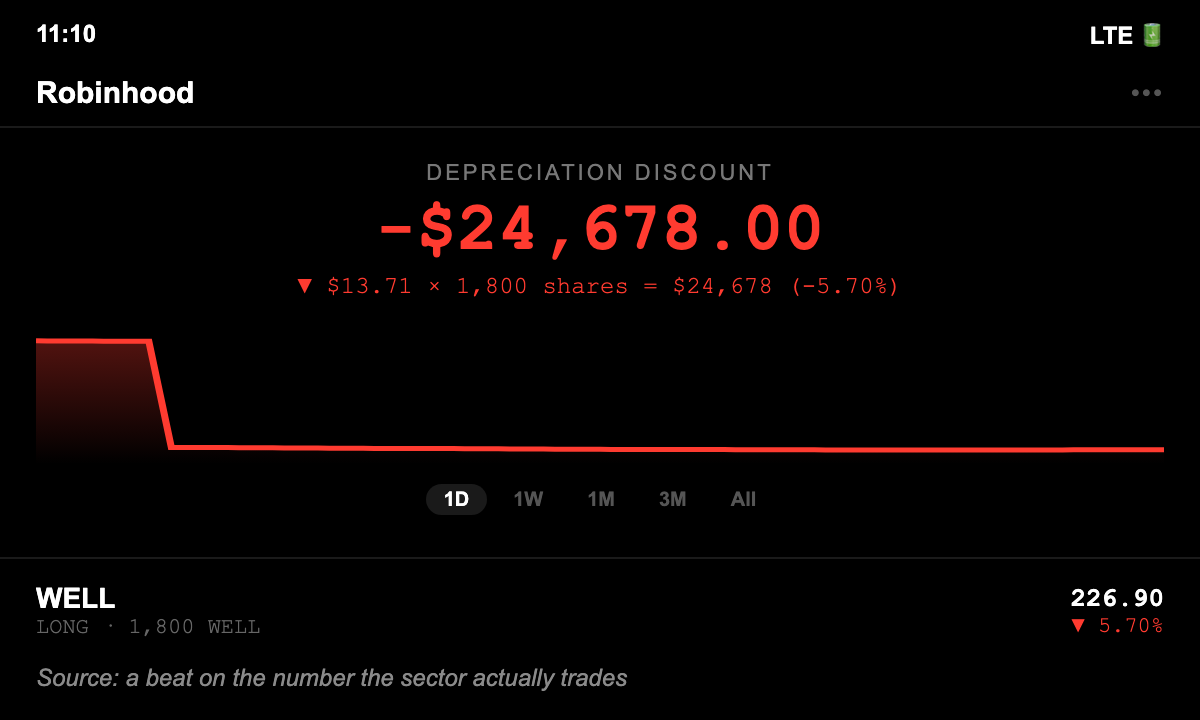
The stock fell 5.70% to $226.90, down $13.71, on about 6.0 million shares against a 2.7 million average. It was the steepest one-day fall since April 2025.

$13.71 a share on 1,800 shares is $24,678.

They bought the number the sector trades on. The tape traded the one with depreciation in it.

Brokerage screenshot: a long position of 1,800 Welltower (WELL) shares bought at Monday's close of $240.61, down $24,678.00 after the stock fell 5.70 percent to $226.90 on Tuesday, when Welltower beat on normalized funds from operations but missed on GAAP net income per share.
F
u/ffo_is_the_number
r/dividends • 6h ago

Bought WELL on an FFO beat. Down 5.70% by the close.

Guidance raised three times this year. Occupancy up 320 basis points.

"I skipped the GAAP line because REIT investors are supposed to skip it. Tuesday did not get the memo."

 
⬆ 6.3k   💬 1.9k   🔖 740

What this means: GAAP net income at a REIT subtracts depreciation on buildings that often hold their value, which is why the sector reports FFO in the first place.

The loss arrived on the call, not on the release. A stock about 10% below its July record had little room for a miss on any line.

Final bill: $24,678, for a beat on the right number and a miss on the visible one.

Funds from operations: Funds from operations, or FFO, starts from net income and adds back real estate depreciation, because buildings are written down on paper over decades while their market value often holds or rises, so REIT investors treat FFO, and the normalized version that also strips out one-off items, as the closer measure of recurring cash earnings. GAAP net income still carries the depreciation charge, which means a REIT can beat on FFO and miss on net income in the same quarter. Welltower did exactly that, with $1.67 of normalized FFO against about $1.64 expected and 54 cents of net income against about 65 cents. Most of the time the market reads the FFO line, but when a stock has risen into a release the weaker line can set the price for a day. 1,800 shares down $13.71 is $24,678.

Casualty #3: The Cotton Long That Read One Column

The USDA's crop progress report for the week to October 25 carried the final cotton condition rating of the year.

Just 33% of the US crop was rated good to excellent, down two points, and 37% was rated poor to very poor.

u/a_third_is_good_enough bought 52 December cotton contracts at Monday's settle of 79.06 cents a pound. That is 2.6 million pounds of cotton, about $2,055,560 worth.

The thesis: a poor crop is a small crop, and a small crop means a higher price.

So here's the question: how much of that crop was still in the field?

•The harvest: 52% complete, against a 45% five-year average and 41% a week earlier.
•The bolls: 89% open, against a 92% average.
•Brazil: the exporters' association ANEA raised its 2026/27 crop estimate 5.9% to 4.267 million metric tons, a third straight crop above 4.2 million.
•The warehouse: ICE certified stocks fell 1,074 bales to 26,791 on October 26, the first decrease after several days of additions.
•Spot: the Cotlook A index slipped 50 points to 91.95 cents a pound, and The Seam sold 61 bales on October 27 at an average of 65.15 cents a pound.

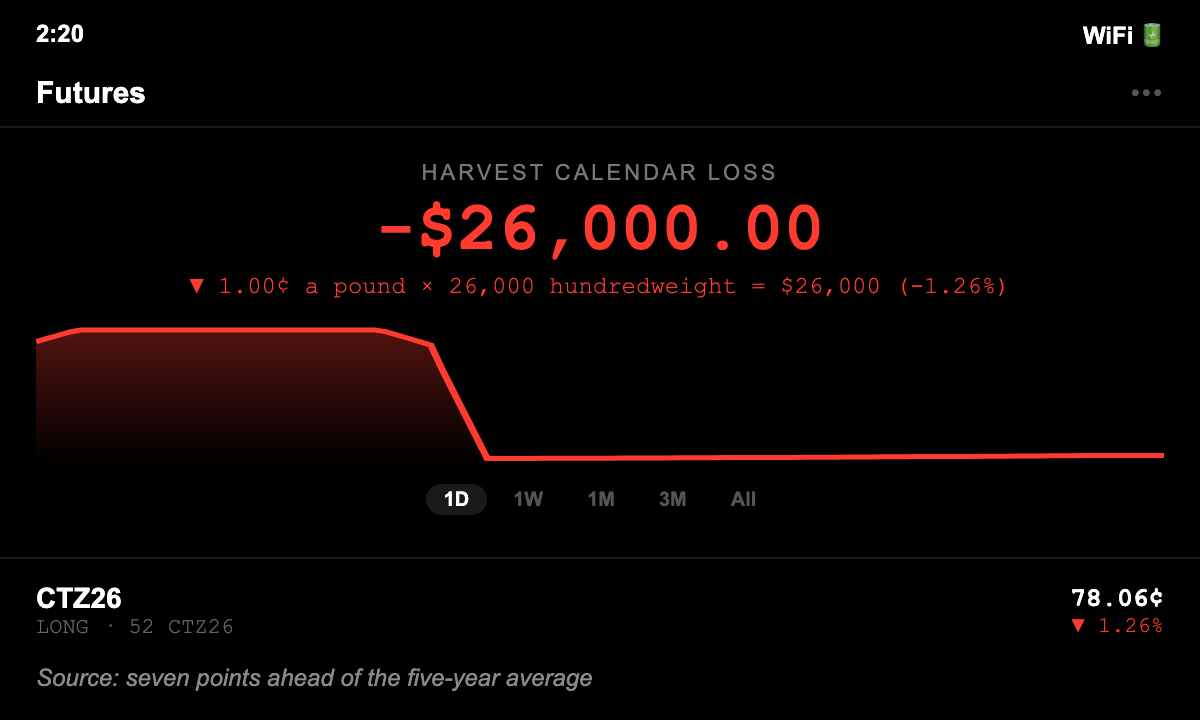
December settled Tuesday at 78.06 cents a pound, down 1.00 cent, or 1.26%. Every contract closed 79 to 112 points lower.

Barchart put it down to lower crude oil and a firmer dollar, with the dollar index up 0.4% at 102.37.

One cent a pound on 2.6 million pounds is $26,000, or 1.26%.

They bought the grade of the crop and skipped the calendar. The harvest was seven points ahead of normal.

Futures screenshot: a long position of 52 ICE December 2026 cotton contracts (CTZ26) bought at Monday's settle of 79.06 cents a pound, down $26,000.00 after December cotton settled Tuesday at 78.06 cents a pound, a 1.26 percent fall, as the US harvest ran ahead of the five-year average.
A
u/a_third_is_good_enough
r/commodities • 4h ago

Long Dec cotton on a 33% good-to-excellent crop. Down a full cent.

37% poor to very poor, the final rating of the year. I bought 52 contracts.

"I checked how good the crop was. I never checked how much of it was already picked."

 
⬆ 5.8k   💬 1.7k   🔖 690

That's the part worth understanding. A condition rating describes the crop in the field, and harvest progress describes when it reaches the market.

With 52% picked against a 45% average, the supply showed up early. Brazil's exporters raised their own crop estimate on top of it.

Final tally: $26,000, and the crop is still a poor one.

Crop progress and cotton futures: The USDA's weekly crop progress report tracks two different things: condition, the share of the crop rated from very poor to excellent, and progress, the share planted, opened or harvested against the five-year average. Condition speaks to how much cotton the fields will eventually yield and at what grade, while progress speaks to timing, and a harvest running ahead of normal puts bales in front of buyers sooner, which is when the seasonal selling pressure known as harvest pressure tends to arrive. A buyer who reads only the condition column is long a future shortage while the present supply is arriving early. ICE cotton trades in cents a pound on 50,000 pounds a contract, so 52 contracts are 2.6 million pounds, or 26,000 hundredweight, and a 1.00 cent fall is $500 a contract and $26,000 in all.

 
🧾
 

THIS WEEK BY THE NUMBERS 🧾

Every figure below is sourced. Nobody in this section is invented.

AI names carried the Nasdaq on Tuesday while energy finished at the bottom.

The S&P 500 rose 0.60% to 7,722.60, and the Nasdaq Composite gained 1.2% to 26,477 with its AI names leading again. The Dow was little changed, with Boeing its worst performer.

Energy was the weakest sector, with XLE down more than 2% as the refiners sold off together.

The 10-year Treasury yield finished at 4.99%, the 30-year at 5.30% and the 2-year at 4.68%. The dollar index rose 0.4% to 102.37.

In Asia on Wednesday, the Nikkei 225 rose 1.25% to 64,065.33 and the Shanghai Composite gained 0.5% to 3,666.50. The Hang Seng fell 0.7% to 23,041.32.

The Fed announces its decision after the European close on Wednesday, and the Bank of Japan follows on Friday. Nobody in this issue was waiting for either.

Boeing expects $10 billion of free cash flow in 2029. Our four traders would settle for $110,480 back by Friday.

 
😵
 

BITE-SIZED COPIUM FOR THE ROAD 😵

Every loss thread grows a comments section. These four held their ground.

•"Schedule slips are normal." This one took about $3.6 billion out of Boeing's 2028 cash guide. (u/schedule_slips_are_normal)
•"Margins mean-revert slowly." The stock did not wait for the margin: 9.24% in one session. (u/margins_mean_revert_slowly)
•"Depreciation is paper." So is the 54 cents of net income the market sold on. (u/depreciation_is_paper)
•"The calendar is a detail." This detail was seven points ahead of the five-year average. (u/the_calendar_is_a_detail)

Every one of them quoted a true rule. None of them checked the date on it.

 
😹
 

DUMB MEMES 😹

The meme desk worked a short shift. Two entries, both about timing.

🛫📈  📅📉

Backlog: $745 billion. Rate increase: second half of 2027

POV: you bought the planes and forgot to ask when they ship

🌱📉  📅✅

Crop rated good: 33%. Crop harvested: 52%

POV: you read the condition column and skipped the progress column

If this made you laugh, you did not own a refiner on Tuesday.

If it didn't, the cotton harvest is 52% done and still going.

See you next issue.

The guidance, the record quarter, the FFO beat and the harvest all happened. None of the four traders did.


Traders and P&L screenshots are satirical composites. Market data, price moves and quotations are real and dated April 2025 to October 28, 2026. Not financial advice. Obviously. Look at us.

Stay liquid,
The Financial Darwin Awards

Free, 4x a week

Learn from other people's worst trades.

Five minutes of reading. A lifetime of bad decisions to study. Your portfolio will thank you, eventually.

No spam. Just other people's mistakes.

Almost there. Check your inbox to confirm.