GM. This is The Financial Darwin Awards, where your worst trade is someone else's content. Brazil held its presidential runoff on Sunday. By Monday's close the Ibovespa had its worst session since March 2020, and EWZ was down 19.82%. The trade that lost was built on the first round, not the second. $105,134 lost across four trades, and only one of them was about who won an election. Plus an airline long that skipped its own loan terms, a sugar long paid in the wrong currency, and a short that stopped reading after the first line of the release. Composite traders, real tape. Here's what we've got today:
THIS WEEK'S DAMAGE REPORT 💥
The first number is the sum of the four stories below, $105,134. The second is Anthropic's net loss for the six months to June 30, 2026, from the S-1 it filed on Monday, and about $72.4 billion of it was a non-cash charge on convertible notes. Anthropic reported an $80.7 billion loss and filed to go public the same morning. Our four traders lost $105,134 and filed nothing.
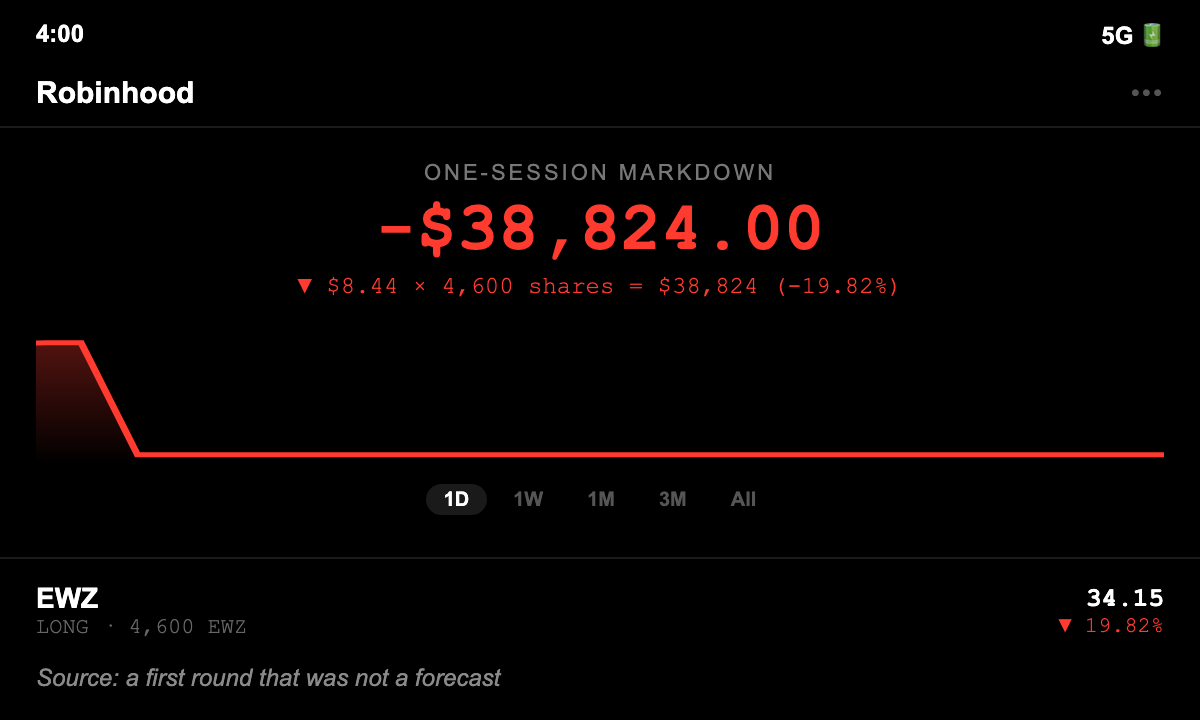
DARWIN AWARD OF THE WEEK 🎯 Every issue we crown the single worst financial decision on the internet. This week it goes to someone who held Brazil through a weekend vote and lost $38,824 by Monday's close. Here's the setup. Brazil elects its president in two rounds. On October 4, Flavio Bolsonaro led the first round with about 47% to President Luiz Inacio Lula da Silva's 45%. The market took that as the answer. The next day the Ibovespa jumped 7.85% and EWZ gained more than 10%, on bets that a Bolsonaro government would curb spending and open the door to rate cuts. Prediction markets put Lula's chance of winning at roughly one in five. u/round_one_is_a_forecast bought 4,600 shares of EWZ, the iShares MSCI Brazil ETF, at Friday's close of $42.59. That is about $195,914, held through Sunday's runoff. The thesis: the first round already told you who wins, so the runoff is a formality. One problem: Sunday did not follow the script.
EWZ closed at $34.15, down $8.44 or 19.82%, after trading as low as $31.40 on volume about 9 times its average. $8.44 a share on 4,600 shares is $38,824. They bought the first round as if it were the result. Brazil scheduled a second one for a reason.
Here's the thing. A first-round lead is a probability, and the 7.85% rally on October 5 turned that probability into a price. Once everyone owns the same outcome, the runoff is not a confirmation. It is a second repricing, with only one direction left to go. For context: the selling was heaviest in the domestic names. Magazine Luiza fell 58.23%, Vamos 56.79% and Hapvida 54.93%. Banco do Brasil fell 27.3%, Bradesco 21.2%, Itau 13.2% and Petrobras 8.5%. The exporters went the other way, with Vale up 4.5% and WEG up 5.1%. Total damage: $38,824, for holding a forecast through the day it was replaced by a count.
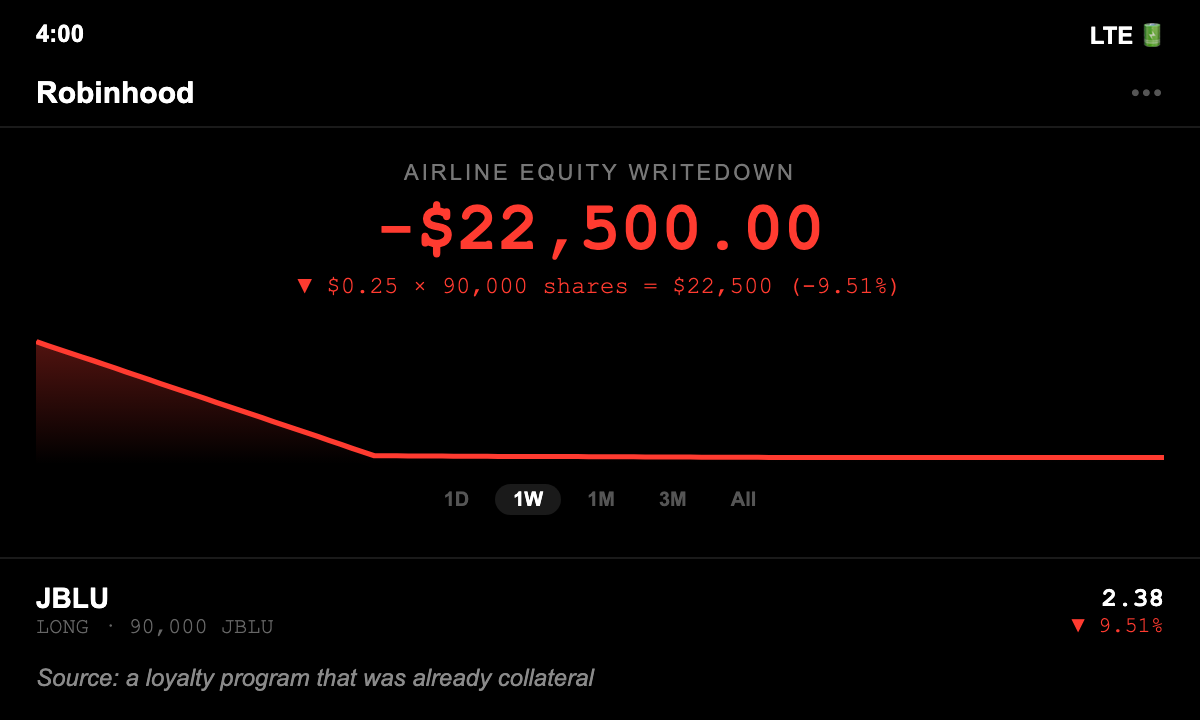
THIS WEEK'S CASUALTIES ⚰ Not everybody can be Darwin Award of the week. These three gave it a real shot. One bought an airline whose loyalty program belongs to its lenders, one bought sugar priced in someone else's currency and one shorted a penny. Casualty #1: The Airline Long In A Rising Sector Monday was a good day to own airlines. Cheaper fuel sent United up 3.2% and Delta up 2.3%, with Royal Caribbean up 2.1% alongside them. u/every_other_airline_rose owned 90,000 JetBlue shares from Friday's close of $2.63, about $236,700 of stock. The thesis: fuel is the whole airline story, and fuel was finally going the right way. Here's what stood out: on Friday, JetBlue's lenders had hired help.
On Monday the stock hit an all-time intraday low of $2.16 and closed at $2.38, down 9.52% on the day. $0.25 a share on 90,000 shares is $22,500, or 9.51% of what they put in. The sector had a fuel story. JetBlue had a loan story, and the lenders were the ones reading it.
Translation: when lenders hire restructuring advisers, they are organizing for a negotiation. Negotiations with lenders tend to end with shareholders owning less of the company. After the close JetBlue reported a third-quarter net loss of $257 million, against $143 million a year earlier. The adjusted loss was 60 cents a share against 55 cents expected (LSEG, via CNBC). Revenue rose 21.1% to $2.812 billion, just under the roughly $2.82 billion expected, while the fuel bill rose 61% to $868 million. It cut its 2026 outlook and said it still expects sustained profitability in 2027. The shares rose about 11% after hours to about $2.64 on that line. Bill so far: $22,500 at Monday's close, for buying the fuel story and skipping the part about the collateral.
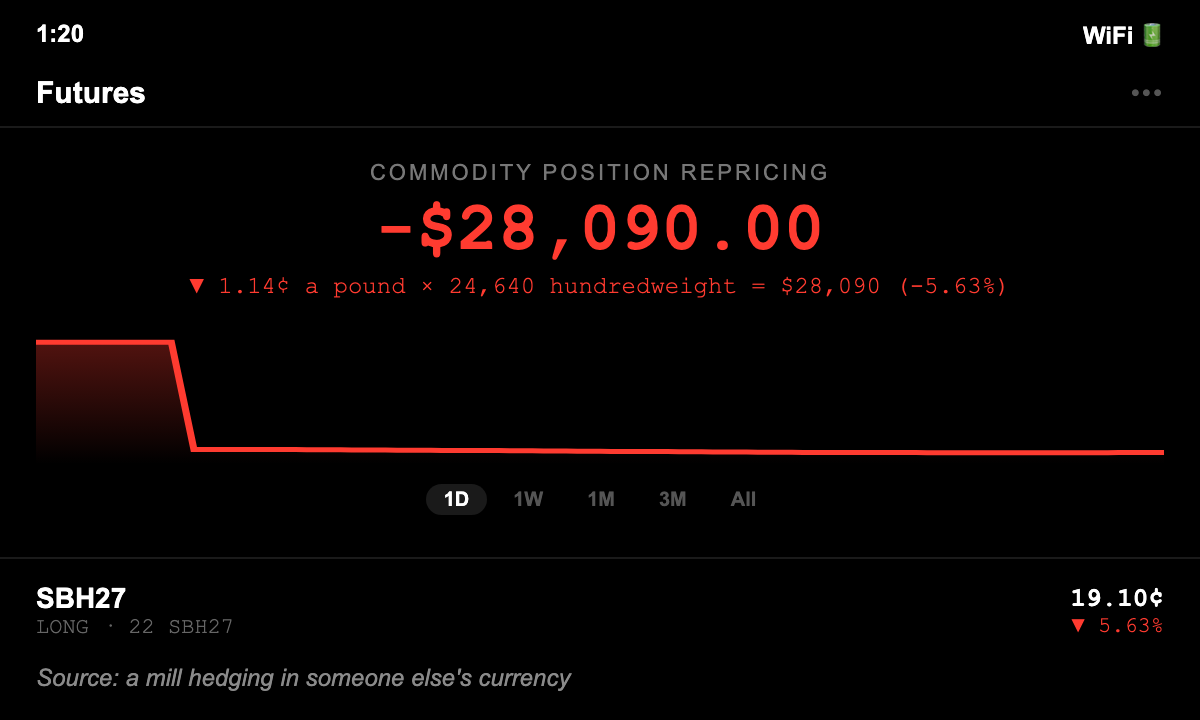
Casualty #2: The Sugar Long Paid In Someone Else's Currency Sugar was the crowded trade of last week. The speculative net long in raw sugar reached a five-year high (Saxo, via Dow Jones' weekly agricultural roundup). u/the_deficit_is_structural bought 22 March raw sugar contracts at Friday's settle of 20.24 cents a pound. That is 2,464,000 pounds of sugar, about $498,714 worth. The thesis: a structural deficit, a dry cane belt and the funds still buying. So here's the question: who was going to sell them the sugar? The answer? The mills of the biggest exporter, which sell in dollars and pay their costs in reais.
From 20.24 cents to 19.10 cents is 1.14 cents a pound. On 112,000 pounds a contract that is $1,276.80, and on 22 contracts it is $28,090, or 5.63%. They were long a weather story and, without noticing, short the exporter's currency. The currency settled it in one session.
That's the part worth understanding. A mill that sells in dollars and pays wages in reais just got a raise on every unsold ton, and the sensible thing to do with a raise is lock it in. Locking it in means selling futures. When enough mills do it on the same morning, the crowded long is on the other side of every trade. Final bill: $28,090, and nothing about the weather changed.
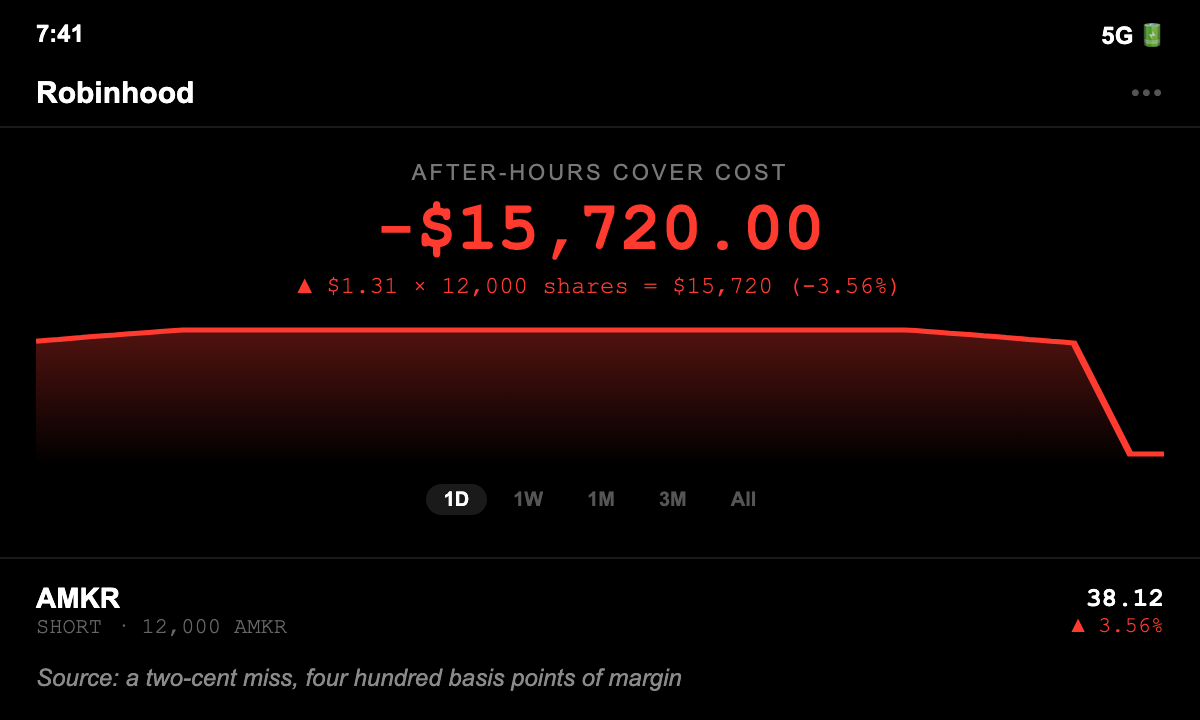
Casualty #3: The Short Who Read The First Line Amkor packages and tests chips, the last step before a processor goes into a server or a phone. It reported third-quarter results after Monday's close. The stock had already fallen 6.34% in the regular session, to $36.81 from Friday's close of $39.30. Its 52-week high is $96.68. u/a_penny_is_a_penny sold 12,000 shares short at that $36.81 close, about $441,720, ahead of the release. The thesis: a miss is a miss, and this one would miss on everything. They were right about that part.
One problem: the release kept going.
The shares rose 3.56% after hours to $38.12. Benzinga printed them as much as 5.98% higher, at $39.05, earlier in the session. $1.31 a share on 12,000 shares is $15,720, or 3.56%. They shorted the miss. The market bought the 400 basis points.
What this means: the top line describes a quarter that is already over. Gross margin and the computing mix describe what the next few quarters might earn. After-hours trading is also thin, so this mark can still move before the opening bell. Total so far: $15,720, marked after hours, with the regular session still to come.
THIS WEEK BY THE NUMBERS 🧮 Real numbers only in this section. No composites allowed.
Chipmakers led Wall Street higher on Monday after Anthropic filed its IPO paperwork that morning. The S&P 500 rose 53.09 points, or 0.7%, to 7,676.77. The Dow added 146.42 points, or 0.28%, to 52,361.58, and the Nasdaq Composite gained 214.04 points, or 0.82%, to 26,169.38. Communication services was the laggard, down about 1.4%, with the XLC ETF at its lowest since June 2025. The 10-year Treasury yield finished at 4.987%. The S-1 shows revenue of $16.29 billion for the six months to June 30 and a net loss of $80.7 billion, about $72.4 billion of it a non-cash charge on convertible notes. The operating loss was $693 million and adjusted operating income was a positive $1.62 billion. The shares will list on Nasdaq as ANT. Asia this morning was split. The KOSPI rose 3.09% to 5,638.34, after a surge of more than 4% during the session prompted the Korea Exchange to trigger a sidecar, and the Nikkei 225 rose 1.73% to 63,268.37. The Hang Seng fell 0.6% to 23,077.56 and the Shanghai Composite slipped 0.3% to 3,648.30. Anthropic's first-half loss works out to about $446 million a day. Our four traders lost $105,134 between them, roughly 20 seconds of it.
BITE-SIZED COPIUM FOR THE ROAD 🙃 The best part of any loss thread is the comments section. Here are this week's greatest hits.
Each of them had the right data. Each of them read it in the wrong order.
DUMB MEMES 🤡 Every newsletter needs a meme section. Ours writes itself when an election turns out to have a sequel.
POV: you bought the first round and held it into the second
POV: you shorted the headline and skipped the margin line If this made you laugh, you were probably in cash on Monday. If it didn't, count how many reais your sugar is worth this morning. See you next issue. The votes, the covenant and the margins all happened. The four people holding the positions did not. Traders and P&L screenshots are satirical composites. Market data, price moves and quotations are real and dated October 4 to 27, 2026. Not financial advice. Obviously. Look at us. Stay liquid, |
Brazil voted twice. The EWZ long only priced round one.
An EWZ long held through Brazil's runoff lost $38,824. JetBlue cost $22,500, March sugar $28,090 and an Amkor short $15,720, for $105,134 in all.