|
GM. This is The Financial Darwin Awards, where your worst trade is someone else's content. FutureFuel grew third-quarter revenue about 361 percent and still lost $8.4 million. On Tuesday, the stock fell 38.46%. Revenue up 361 percent, net loss $8.4 million. Both lines come from the same release. Plus an insurance broker restating three years of audited accounts, a fund manager with 32.9 billion dollars of net outflows in ten months, and an insurer that wrote off $181.8 million of goodwill in one quarter. This issue covers the US session of Tuesday 10 November and the Tokyo, Seoul and Sydney closes of Wednesday 11 November. Composite traders, real filings. Here's what we've got today:
THIS WEEK'S DAMAGE REPORT 🗂
The first number is the sum of the four stories below: $23,400 + $13,688 + 22,800 Australian dollars (about $15,740.42) + $12,210 = $65,038.42. The second is GQG's own figure, in US dollars, from the funds-under-management update it published on 11 November. Over the same ten months, GQG's investment performance added 0.6 billion dollars. Net flows took out 32.9 billion.
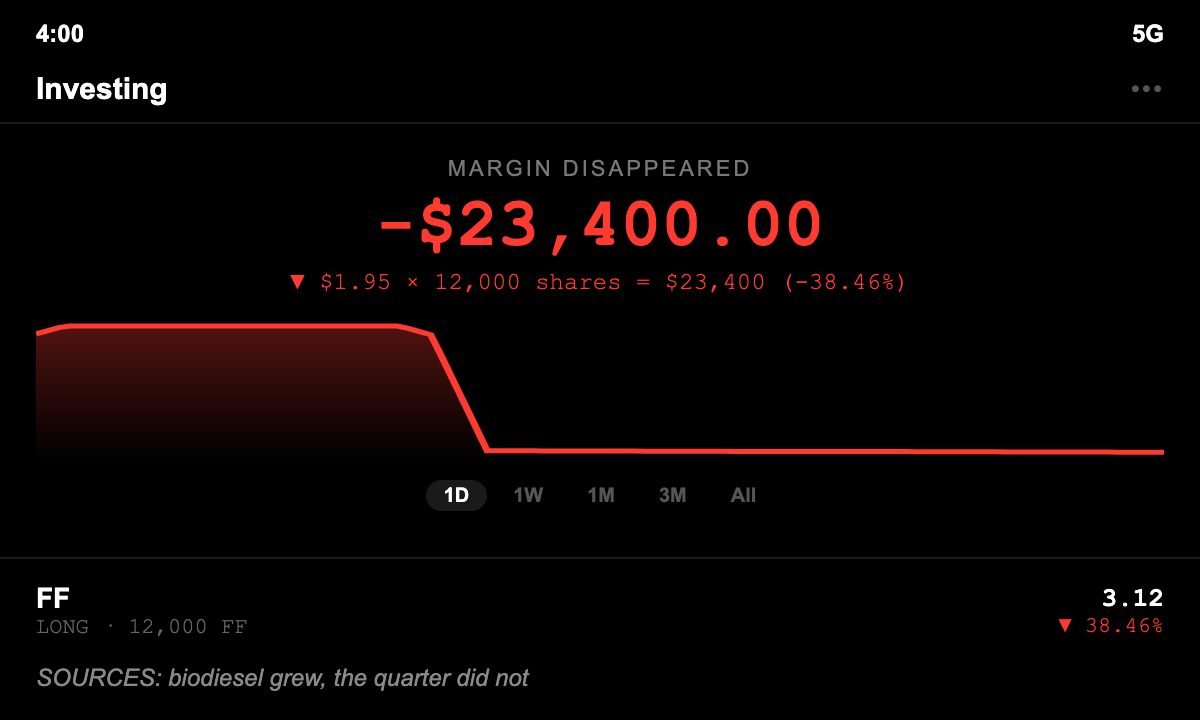
DARWIN AWARD OF THE WEEK 🥇 This week's award goes to a FutureFuel long that read the revenue line first and the profit line second. Here's the setup. FutureFuel (NYSE: FF) makes chemicals and biofuels. It reported its third quarter on Monday 9 November, after the close. u/biodiesel_carries_it bought 12,000 shares at Monday's close of $5.07, ahead of the release. That is about $60,840 of stock. The thesis: the biofuels plant was busy, and busy means revenue. The thesis was right. Here's the quarter: • Total revenues: $104.7 million, an increase of $82.0 million on the prior-year quarter, or about 361 percent. • Biofuels: sales volume up 11.3 million gallons on strong demand, offset by elevated feedstock costs. • GAAP net loss: $8.4 million, or a loss of $0.19 per diluted share. • Adjusted EBITDA: negative $4.9 million. One problem: revenue counts what comes in. Feedstock gets paid for first. For context: the chemicals side had a quarter of its own. • Chemicals volume: down 27 percent year over year, because of turnaround activity at two customer process units. • Chemicals revenue: still up $1.3 million, to $16.9 million. • The turnaround bill: about $4.3 million off third-quarter adjusted EBITDA. Translation: chemicals contributed $1.3 million of the $82.0 million increase. The growth was biofuels gallons, and the gallons came with expensive feedstock. Chief executive Roeland Polet said chemicals production has since returned to normalized rates. The company anticipates positive adjusted EBITDA in the fourth quarter and for the full year. Anticipates is a forecast word. The third quarter is the one with numbers in it. Let's run through Tuesday's tape. • Open: $3.574, already $1.496 under Monday's close of $5.07. • High and low: $3.6199 and $2.77. • Close: $3.12, down $1.95 or 38.46%. • Volume: 7,430,095 shares, against 916,539 on Monday. $1.95 a share on 12,000 shares is $23,400. Revenue grew 361 percent. The position shrank 38.46 percent. Both numbers are correct.
Here's the thing. Revenue measures how much moved through the plant. Profit measures what was left after paying for it. In this quarter, more moved through and less was left. The company's next stop is a forecast of positive adjusted EBITDA in the fourth quarter. The trader's next stop was Tuesday's close. Cost of reading one line of a two-line story: $23,400.
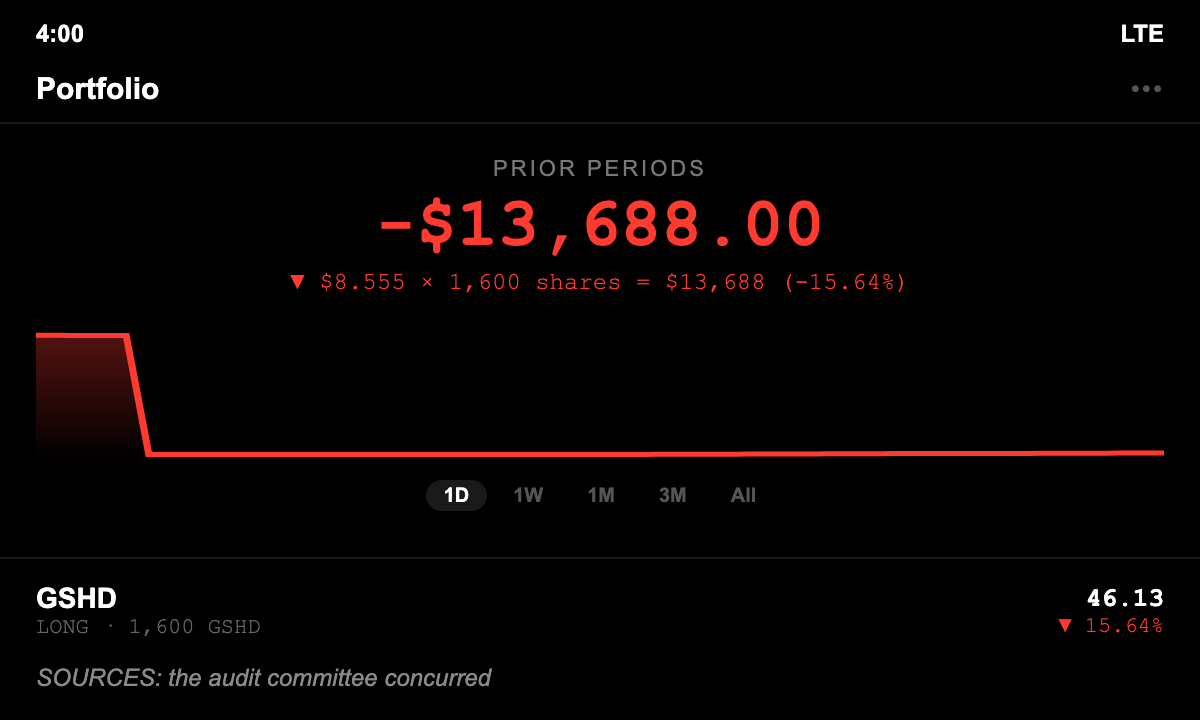
THIS WEEK'S CASUALTIES 🧨 The first casualty owned Goosehead Insurance and lost $13,688 when its audited accounts picked up a warning label. u/restatements_are_paperwork bought 1,600 shares of Goosehead (NASDAQ: GSHD) at Monday's close of $54.685, about $87,496 of stock. The thesis: an insurance broker earns a commission on policies that renew, and renewals do not need much explaining. The problem was a Form 8-K under item 4.02, the item for financial statements that can no longer be relied upon: • Who decided: the audit committee of the board, after discussion with management, concurred. • What it decided: previously issued financial statements should no longer be relied upon and should be restated. • Which statements: the audited consolidated financial statements for the fiscal years ended 31 December 2025, 2024 and 2023, plus the interim periods listed in the filing. • The filing's own name for them: the non-reliance periods. Here's what stood out: the direction of the fix. The company preliminarily expects employee compensation and benefits to decrease, and income from operations to increase, by approximately 0.5 to 5.5 percent of employee compensation and benefits. That covers full-year 2025 and the quarters ended 31 March and 30 June 2026, with related effects on tax expense and other assets. The same 8-K furnished a preliminary, unaudited third-quarter release. The company says those figures were prepared before the close process and before the restatement was completed. Translation: the old numbers are being redone, and the new ones arrived with a note saying they were drafted before the redo. Tuesday: opened at $45.66, reached $48.63, fell to $44.42 and closed at $46.13, down $8.555 or 15.64%. Volume was 1,057,458 shares, against 347,060 on Monday. $8.555 a share on 1,600 shares is $13,688. The preliminary fix points up. The stock priced the words "no longer be relied upon" instead.
That's the part worth understanding. A restatement reopens three fiscal years at once, and every ratio built on them waits for the new versions. The direction may be friendly. The holder still owns the wait.
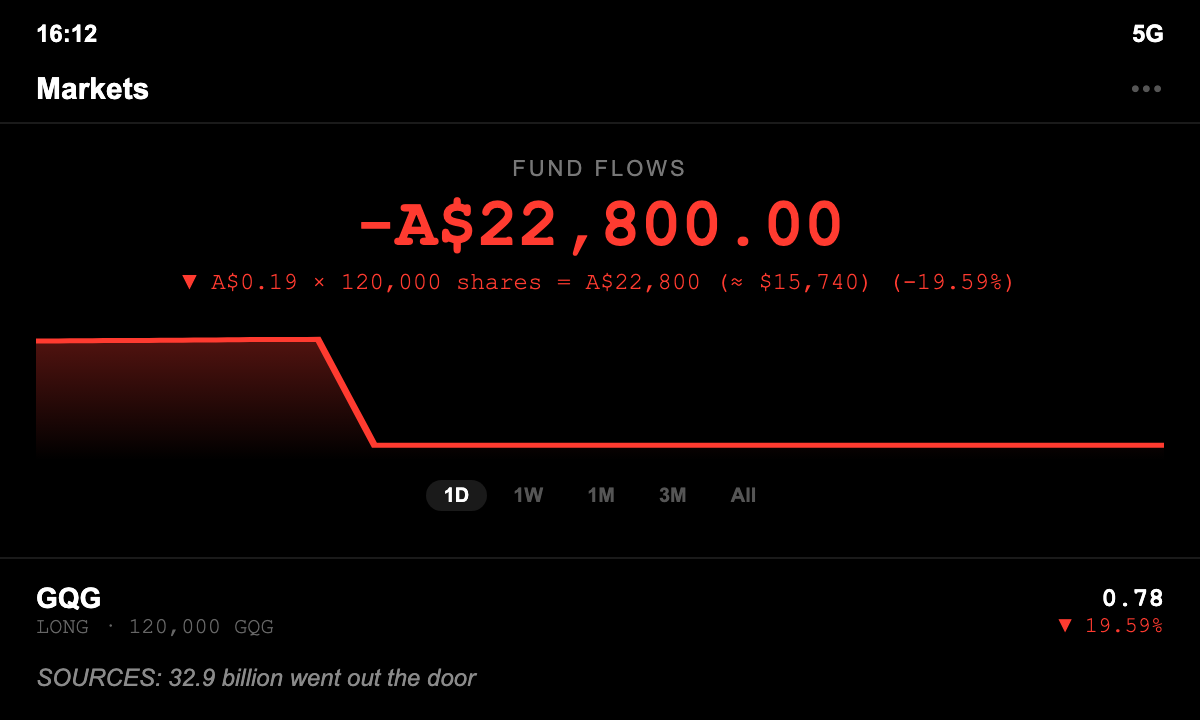
The next casualty bought a fund manager in Sydney and lost 22,800 Australian dollars, about $15,740, on the manager's own monthly update. u/performance_brings_flows bought 120,000 GQG Partners (ASX: GQG) shares at Tuesday's close of A$0.97, about A$116,400 of stock. The thesis: a fund manager's fees follow its assets, and the assets come back when performance does. On Wednesday 11 November, GQG published its funds-under-management update. The figures are in US dollars and unaudited: • 31 December 2025: 163.9 billion dollars. • 30 September 2026: 149.2 billion dollars. • 31 October 2026: 131.6 billion dollars. • October alone: net flows of negative 6.7 billion dollars and investment performance of negative 11.0 billion dollars. • Year to date: net flows of negative 32.9 billion dollars against investment performance of positive 0.6 billion dollars. So here's the question: did performance bring the flows? The answer? Over ten months, performance added 0.6 billion dollars. Net flows took out 32.9 billion. Wednesday in Sydney, in Australian dollars: opened at A$0.97, reached A$0.98, fell as low as A$0.77 and closed at A$0.78, down A$0.19 or 19.59%. Volume was 40,734,985 shares, against 3,874,857 on Tuesday. A$0.19 a share on 120,000 shares is A$22,800. That is about $15,740 at the European Central Bank reference rate of 1.4485 Australian dollars to the dollar. Performance was the thesis. Flows were the business.
Here's the thing. October had both problems in the same month: negative 6.7 billion dollars of net flows and negative 11.0 billion of investment performance. In those 31 days, funds under management went from 149.2 billion dollars to 131.6 billion. The shares trade in Australian dollars. The book is counted in US dollars. The trader lost in the first currency on news in the second.
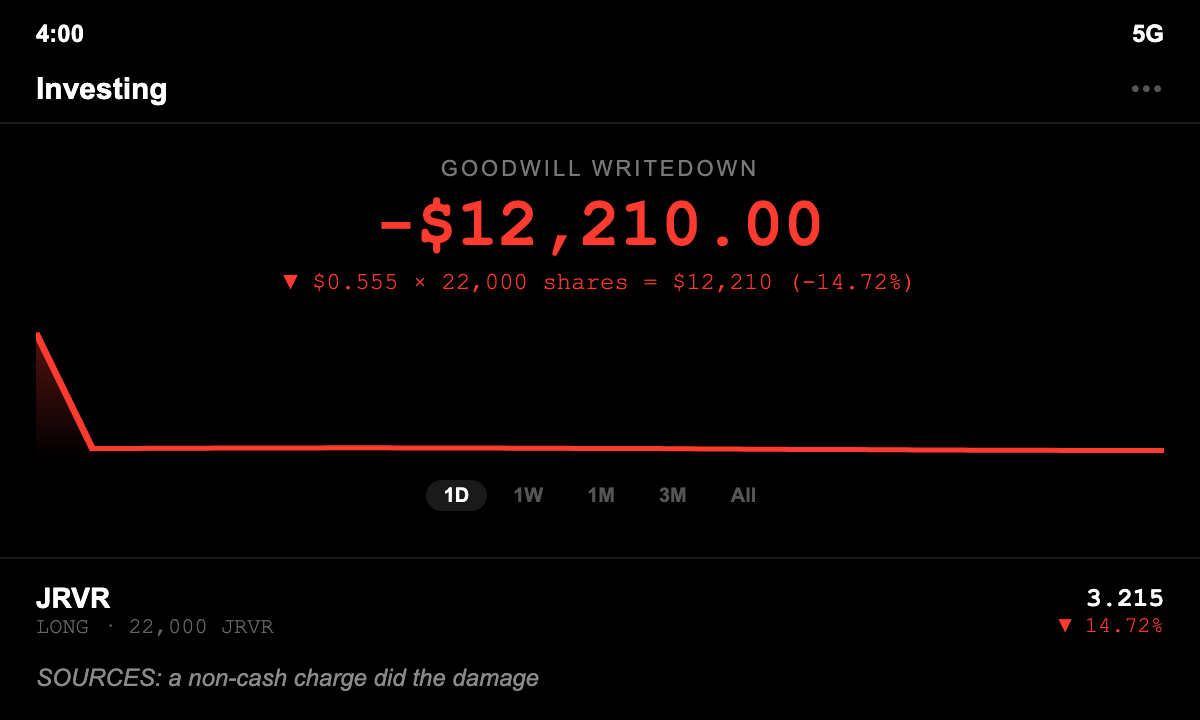
The last casualty bought James River Group and lost $12,210 on a charge that, by definition, moved no cash. u/the_writedown_clears_the_deck bought 22,000 James River (NASDAQ: JRVR) shares at Monday's close of $3.77, about $82,940 of stock. The thesis: the insurer was cheap, and whatever was wrong was already in the price. Monday 9 November, after the close, the third quarter arrived: • Goodwill impairment: $181.8 million, non-cash. • Net loss available to common shareholders: $189.4 million. • Per diluted share: a loss of $4.08. For context: the stock closed Monday at $3.77. The quarter's loss per diluted share was $4.08. Translation: one quarter's loss per share was bigger than the price of a share. The company also reports adjusted net operating income, a non-GAAP measure that leaves the $181.8 million impairment out. A brokerage statement has no adjusted line. Tuesday: opened at $3.10, reached $3.24, fell to $3.015 and closed at $3.215, down $0.555 or 14.72%. Volume was 1,368,144 shares, against 291,524 on Monday. $0.555 a share on 22,000 shares is $12,210. The impairment never touched the bank account. The $12,210 came straight out of one.
Here's what stood out: Tuesday's close of $3.215 was above Tuesday's open of $3.10. It was still $0.555 below Monday's close, which is the only comparison the card makes.
THIS WEEK BY THE NUMBERS 🔢 Four figures from four company documents. Nobody in this section is invented.
Four longs, four documents: a revenue line, a filing item, a monthly update and a goodwill charge. The backdrop: US October consumer prices rose 0.4 percent on the month against 0.3 percent expected. Core rose 0.3 percent against 0.2 percent. The S&P 500 closed Tuesday at 7,520.93, down 29.01 points or 0.38%, and technology was the worst of the eleven sectors. Wednesday in Asia, Tokyo's Nikkei 225 rose 1.31% to 61,248.59 and Seoul's KOSPI rose 2.60% to 5,375.36. Our four fell on their own paperwork, not on the index.
BITE-SIZED COPIUM FOR THE ROAD 🫠 Four replies from the comments, all posted before the closes in the cards. • "Turnarounds end." So did the quarter, at a net loss of $8.4 million. (u/turnarounds_end) • "The restatement goes up." Preliminarily. The stock did not wait for the final version: down 15.64%. (u/the_fix_points_up) • "Flows follow performance." Year to date, performance added 0.6 billion dollars and net flows took out 32.9 billion. (u/flows_follow_performance) • "Goodwill isn't real money." The $12,210 on the card was. (u/goodwill_isnt_money)
DUMB MEMES 🍿 The meme desk read three releases and one 8-K. Two entries.
POV: you bought the top line and the bottom line came with it
POV: the returns showed up and the money had already left If none of this cost you anything, you were not long a revenue line, a filing item, a flow report or a goodwill balance at the close. If it did, the statement in your app is the one set of accounts this week that nobody has to restate. See you next issue. Real filings, invented traders. Traders and P&L screenshots are satirical composites. Market data, price moves and quotations are real and dated November 9 to November 11, 2026. Not financial advice. Obviously. Look at us.
Stay liquid,
|
FutureFuel grew revenue 361 percent and still lost $8.4 million. The stock fell 38.46%.
A FutureFuel long lost $23,400 when the shares fell 38.46% on Tuesday. Goosehead, GQG and James River took the four composite losses to about $65,038.