|
GM. This is The Financial Darwin Awards, where your worst trade is someone else's content. Suncrete grew third-quarter revenue 163 percent. In the same release it lowered its 2026 outlook, and on the call that morning it corrected the loss figures in that outlook. On Friday the stock fell 37.44%. The concrete set faster than the guidance. Plus a rare disease drug the European committee looked at twice, a luxury group that beat on sales and profit and still fell, and a corn short that met the best export week of the marketing year. This issue covers the US session of Friday 13 November and the Tokyo close of Monday 16 November. Composite traders, real releases. Here's what we've got today:
THIS WEEK'S DAMAGE REPORT 🧾
The first number is the sum of the four stories below: $36,480 + $31,200 + 17,420 francs (about $20,763) + $33,000 = $121,443. The second is the Tokyo close on Monday 16 November: the Nikkei 225 fell 1,480.33 points to 59,662.02, and the TOPIX fell 1.02% to 3,901.37. Three longs and one short, and all four lost money. In each case the bad news shared a document with the good news.
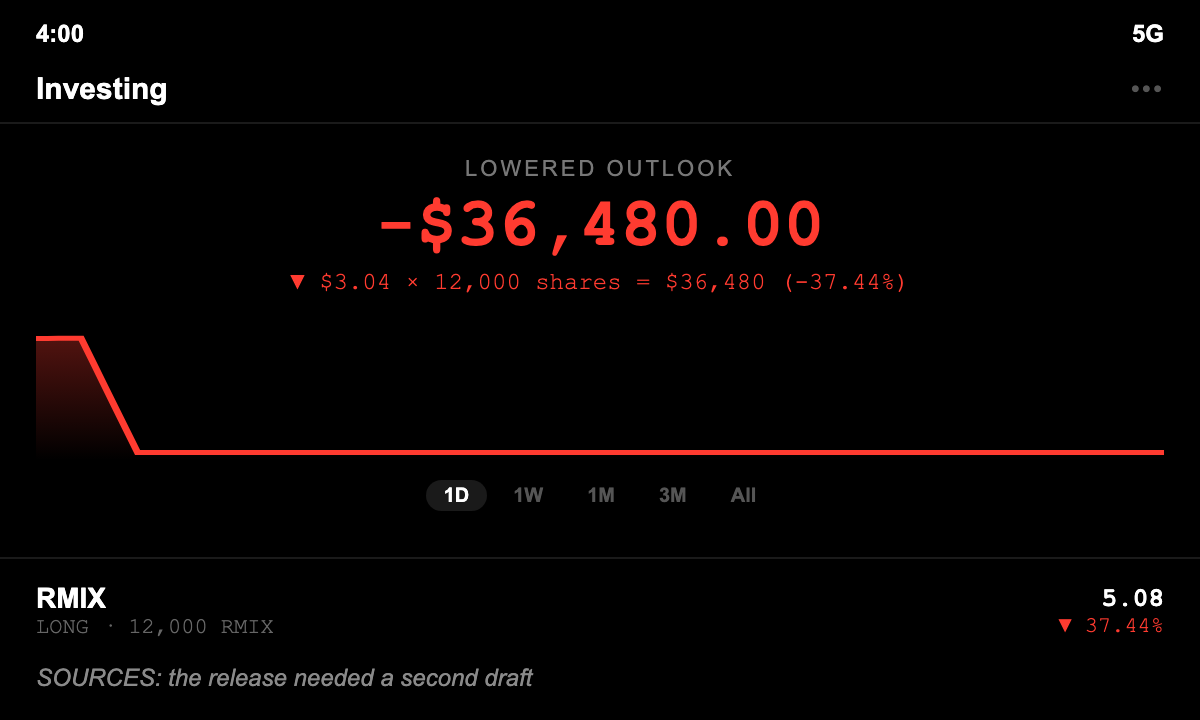
DARWIN AWARD OF THE WEEK 🥇 This week's award goes to a Suncrete long who bought a growth rate and was handed two versions of the forecast before lunch. Here's the setup. Suncrete (NASDAQ: RMIX) is a ready-mix concrete company built by buying other ready-mix concrete companies. It reported its third quarter, ended 30 September, before the open on Friday 13 November. u/acquisitions_count_as_growth bought 12,000 shares at Thursday's close of $8.12. That is about $97,440 of stock. The thesis: a roll-up that keeps buying keeps growing. Here's the quarter, and it was a good one: • Revenue: $140.957 million, up 163 percent from $53.542 million a year earlier. • Against the second quarter: up 45 percent from $97.231 million. • Organic growth: about 10 percent, per the chief executive. Acquisitions carried the rest. • Net income: $78 thousand, against a net loss of $37.1 million in the second quarter and net income of $4.6 million a year earlier. • Adjusted EBITDA: $22.4 million, a 15.9 percent margin, against $13.7 million and 25.6 percent a year earlier. • Supplemental Adjusted EBITDA: $23.3 million, up 60 percent on the second quarter, a 16.5 percent margin. Revenue grew 163 percent and the margin expanded on the second quarter. One problem: the same release lowered the 2026 outlook. • Revenue: $408 million to $434 million. • Adjusted EBITDA: $60 million to $64 million. • Supplemental adjusted EBITDA: $63.6 million to $67.6 million. The reason given: some large projects are moving their start dates into 2027, and elevated interest rates keep pressing on residential construction. Then the call started. The chief financial officer said the net loss range printed in the release had been overstated. The corrected net loss range is $43.685 million to $39.685 million. The corrected adjusted net loss range is $16.81 million to $12.81 million. The chief executive said the company had spent the morning working around what he called a massive email outage. A correcting 8-K, filed the same day, replaced the erroneous ranges. Translation: holders had to price a lowered outlook and a second version of it before lunch. Let's run through Friday's tape. • Previous close: $8.12. • Close: $5.08, down $3.04 or 37.44%. $3.04 a share on 12,000 shares is $36,480. Revenue up 163 percent, organic growth about 10 percent, and an outlook that needed a second draft. The stock kept the first reaction.
Here's the thing. Growth was growth, at 163 percent. About 10 points of it was organic, and the outlook covers the whole year, including the projects that moved to 2027. Cost of buying the headline growth rate and skipping the outlook paragraph: $36,480.
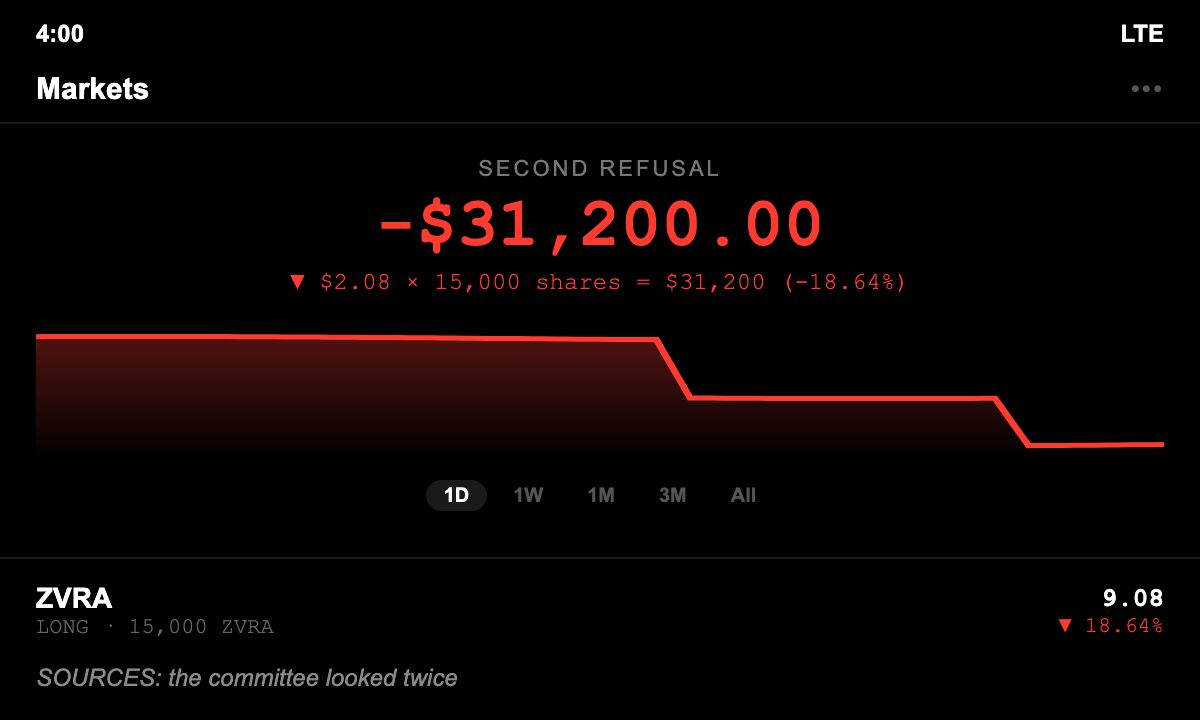
THIS WEEK'S CASUALTIES ⚰️ The first casualty owned Zevra Therapeutics into a second look and lost $31,200 when the second look matched the first. u/re_examination_flips_it bought 15,000 Zevra (NASDAQ: ZVRA) shares at Thursday's close of $11.16, about $167,400 of stock. The thesis: Zevra's drug arimoclomol treats Niemann-Pick disease type C, and the company had asked Europe's drug committee to look again. For context: the European Medicines Agency's Committee for Medicinal Products for Human Use adopted its initial opinion on 23 July 2026. Zevra asked for re-examination. On Friday 13 November Zevra announced the result: • Opinion: negative, on the marketing authorization application for arimoclomol. • Re-examination: the agency's own page records the refusal as confirmed on 12 November 2026. • Next step: a European Commission decision, expected within 67 days. • Patients: about 1,000 people in Europe have the condition, per the company's release. The chief executive said the company is deeply disappointed. Zevra said it will keep supplying eligible patients through its expanded access program. Friday's tape: previous close $11.16, close $9.08, down $2.08 or 18.64%. The stock had already fallen 5.82% on Thursday, from $11.85 to $11.16. $2.08 a share on 15,000 shares is $31,200. The committee was asked to look again. It looked again.
That's the part worth understanding. The stock had already fallen 5.82% the day before the announcement. The second no was priced, then priced again for another 18.64%.
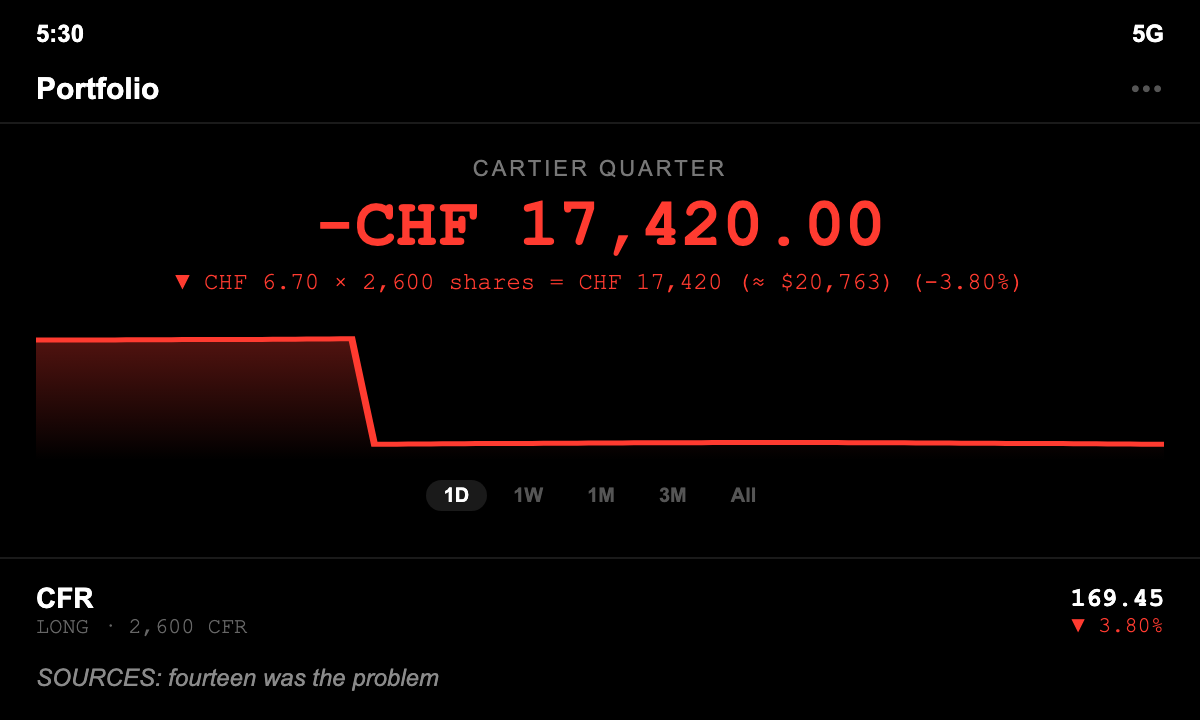
The next casualty owned Richemont in Zurich and lost 17,420 francs, about $20,763, on a half year that beat. u/cartier_never_misses bought 2,600 Richemont (SIX: CFR) shares at Thursday's close of 176.15 francs, about 457,990 francs of stock. The thesis: Richemont owns Cartier, and the jewelry business carries the group. The half year to 30 September, released Friday 13 November, beat: • Sales: 12.282 billion euros, up 16 percent at actual rates and 17 percent at constant exchange rates. • Net profit: 2.528 billion euros, up 39 percent. • Operating profit: 3.13 billion euros, up 33 percent, including a 229 million euro one off related to tariffs. • Second-quarter group sales: up 13 percent at constant rates to 5.95 billion euros, above the 5.89 billion euro consensus. One problem: the second quarter grew slower than the first, which grew 20 percent. • Jewelry, second quarter: up 14 percent at constant rates to 4.41 billion euros, against the 16 percent analysts expected. • Watches: up 12 percent to 833 million euros. The chief executive said mainland China remains soft and that confidence there is not at its high. Hong Kong and Macao compensated. Friday in Zurich: opened at 165.00 francs, fell as far as 160.30 francs, reached 169.75 francs, and closed at 169.45 francs, down 6.70 francs or 3.80%. Volume was 2,558,404 shares. The shares were down as much as 9 percent during the session. 6.70 francs a share on 2,600 shares is 17,420 francs. That is about $20,763 at 0.8390 francs to the dollar. Sales and profit both beat. Jewelry grew 14 percent, and the valuation was priced for 16.
Here's what stood out: jewelry delivered 4.41 billion euros in a quarter, up 14 percent. Two points under the poll was enough to take 3.80% off the close and as much as 9 percent at the low.
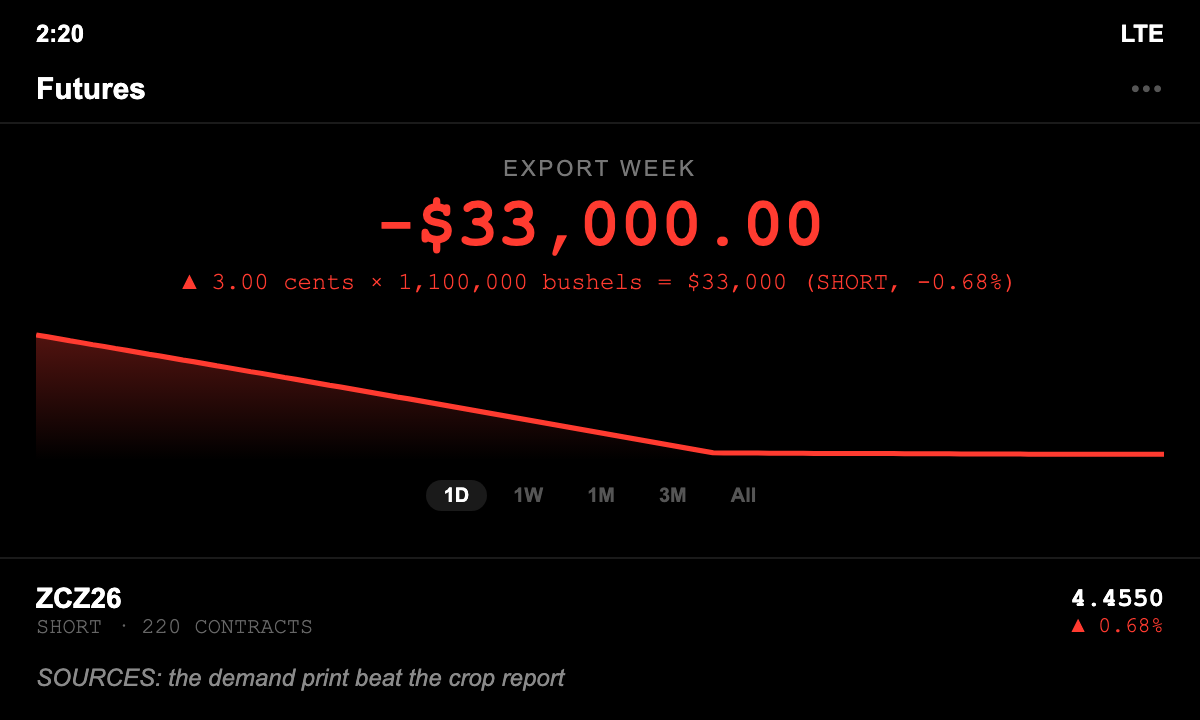
The last casualty was short December corn and lost $33,000 the session after the government made the crop bigger. u/the_bigger_crop_was_the_trade sold 220 December corn contracts (CBOT: ZCZ26) at Thursday's settlement of 442.50 cents a bushel. At 5,000 bushels a contract, that is 1,100,000 bushels. The thesis: the November crop report raised supply, and more corn means a lower price. On Thursday 12 November, that thesis worked: • Yield: the government raised its national corn yield estimate to 179.6 bushels an acre. • Production: about 15.9 billion bushels. • Thursday's session: December corn fell 5.5 cents to settle at 442.50 cents a bushel. One problem: Friday brought the weekly export sales report. • Export sales: 136.8 million bushels of old and new crop corn in the week through 5 November. • Rank: the highest weekly total of the marketing year, and above the range of analyst estimates. • Largest buyer: Mexico. December corn settled Friday at 445.50 cents a bushel, up 3.00 cents or 0.68%. For the week, the contract gained 4 cents. The dollar index rose 1.1% over the week, which the trade press treated as a cap on grain. 3.00 cents a bushel on 1,100,000 bushels. That is $33,000 against a short. The government raised the supply on Thursday. Mexico raised the demand on Friday.
Here's the thing. A bigger crop is bearish only until someone buys it. The best export week of the marketing year arrived the next morning.
THIS WEEK BY THE NUMBERS 🔟 Four figures from four primary releases. Nobody in this section is invented.
Four positions, four releases: an outlook, an opinion, a division and a weekly report. Three of the four were longs in companies that published good numbers somewhere in the release. The fourth was short a commodity the government had just made more plentiful. Every one of them read the right document. Each skipped the paragraph after the headline.
BITE-SIZED COPIUM FOR THE ROAD 😵 Four replies from the comments, all posted before the closes in the cards. • "The quarter was a beat." It was. The outlook was lowered in the same release and corrected on the call. (u/the_quarter_was_the_story) • "The Commission can still overrule it." It decides within 67 days. The committee has now said no twice. (u/sixty_seven_days_is_a_lifetime) • "Fourteen percent is still double digits." It is. The poll said 16. (u/double_digits_is_double_digits) • "The USDA made the crop bigger." Mexico was the largest buyer. The settlement went up 3.00 cents a bushel. (u/supply_always_wins)
DUMB MEMES 😬 The meme desk read three releases and one export table. Two entries.
POV: the outlook needed a second draft and the inbox was down
POV: you shorted the supply and the demand showed up a day later If none of this cost you anything, you were not long an outlook, a re-examination or a jewelry quarter, or short a crop report, at the close. If it did, your statement is the one figure this week nobody had to correct. See you next issue. Real releases, invented traders. Traders and P&L screenshots are satirical composites. Market data, price moves and quotations are real and dated November 12 to November 16, 2026. Not financial advice. Obviously. Look at us.
Stay liquid,
|
Suncrete grew revenue 163 percent and lowered its outlook. The stock fell 37.44%.
A Suncrete long lost $36,480 when the concrete company lowered its outlook, then corrected its own loss forecast on the call. Zevra, Richemont and a corn short took the four losses to about $121,443.