|
GM. This is The Financial Darwin Awards, your portfolio's support group, 4x a week. WTI crude settled 8.3% lower on Wednesday, the day after Democrats won both the House and the Senate. The biggest loss of the issue belongs to a trader who paid for a war premium and never asked who was keeping it alive. Four positions, three markets, and every entry price on this page lasted less than a day. Plus a Tokyo chip-test supplier bought on Wednesday's bounce, a biotech whose partner walked out, and a short seller who met a quarter about $100 million above its own forecast. Invented traders, real tape. Here's what we've got today:
THIS WEEK'S DAMAGE REPORT 📊
The first number is the sum of the four stories below: $48,060 + $32,203.93 (¥5,085,000) + $16,779 + $26,247 = $123,289.93. The second is foreign investors' net selling of 3.39 trillion won (about $2.3 billion) on the KOSPI on Thursday, Korea Exchange data reported by the Seoul Economic Daily. Foreign funds needed trillions of won to make Thursday's news in Seoul. Our four traders needed one position each.
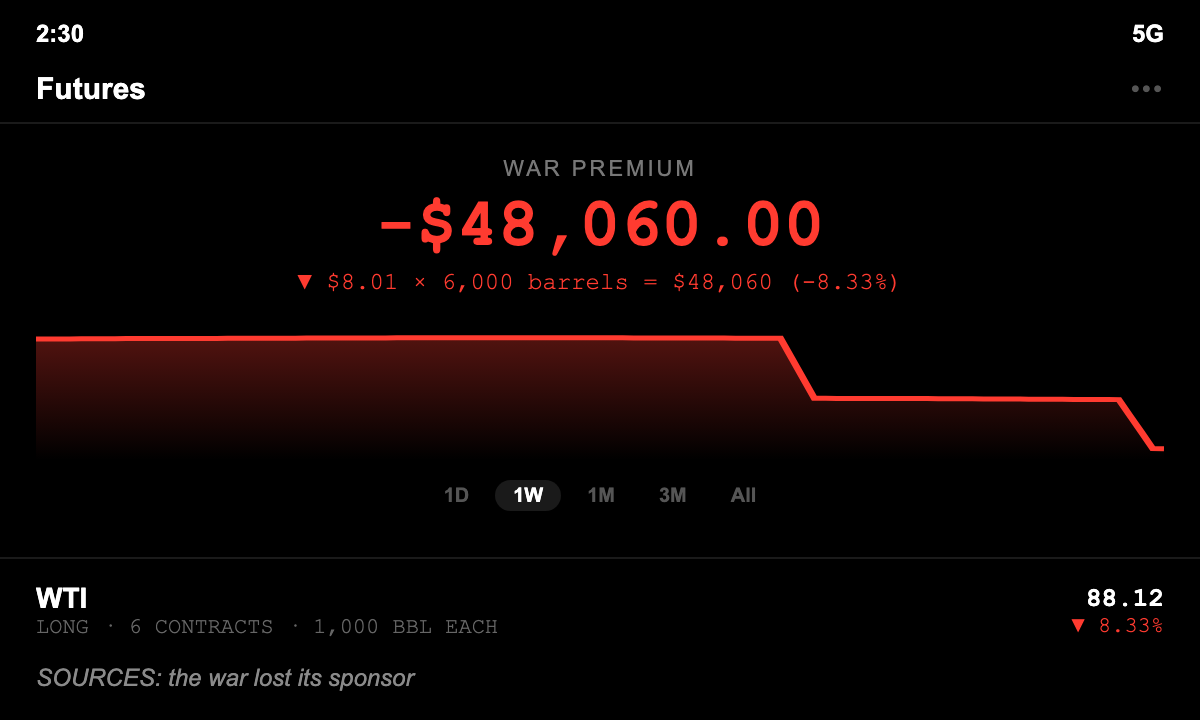
DARWIN AWARD OF THE WEEK 🏆 This week's award goes to a crude oil long that lost $48,060 in one settlement, because the war premium it was paying for met an election result. Here's the setup. u/the_premium_is_structural was long six WTI crude futures, 6,000 barrels, marked at Tuesday's settlement of $96.13 a barrel. That is about $576,780 of oil. The thesis: oil gained more than 10% in October, and Brent peaked near $118 a barrel on Friday. A premium that size does not leave in a week. On Tuesday the US voted. Democrats won both the House and the Senate, CNBC reported. Then the politics around the war changed in public, in two quotes: • The losing side: "The reason we lost is the war," CNBC quoted Vance as saying. • The president: Trump told the Financial Times on Tuesday he has no immediate plans to strike Iran. One problem: the premium was the position. Wednesday's tape: • WTI: down $8.01, or 8.3%, to settle at $88.12 a barrel. • Brent: down 8.7% to settle at $94.62 a barrel. • Brent's week: almost 17% lower week to date, its worst weekly decline since April 24, 2020, per Dow Jones Market Data. • WTI's week: about 15% lower week to date. • Three sessions: Brent down 19.6%, its steepest three-session fall since April 22, 2020, per MarketWatch. $8.01 a barrel on 6,000 barrels is $48,060. The oil was still there on Wednesday. The premium was not.
Here's the thing. A war premium is the part of the price that pays for a risk, not for a barrel. When Tuesday's result changed the politics around that risk, the market did not wait for a policy. It repriced the premium on Wednesday. For context: Brent went from near $118 on Friday to $94.62 at Wednesday's settlement. Translation: the trade was never really on oil. It was on a headline, and the headline changed on election night. Total damage: $48,060, for paying a war premium in the week the war's politics were on the ballot.
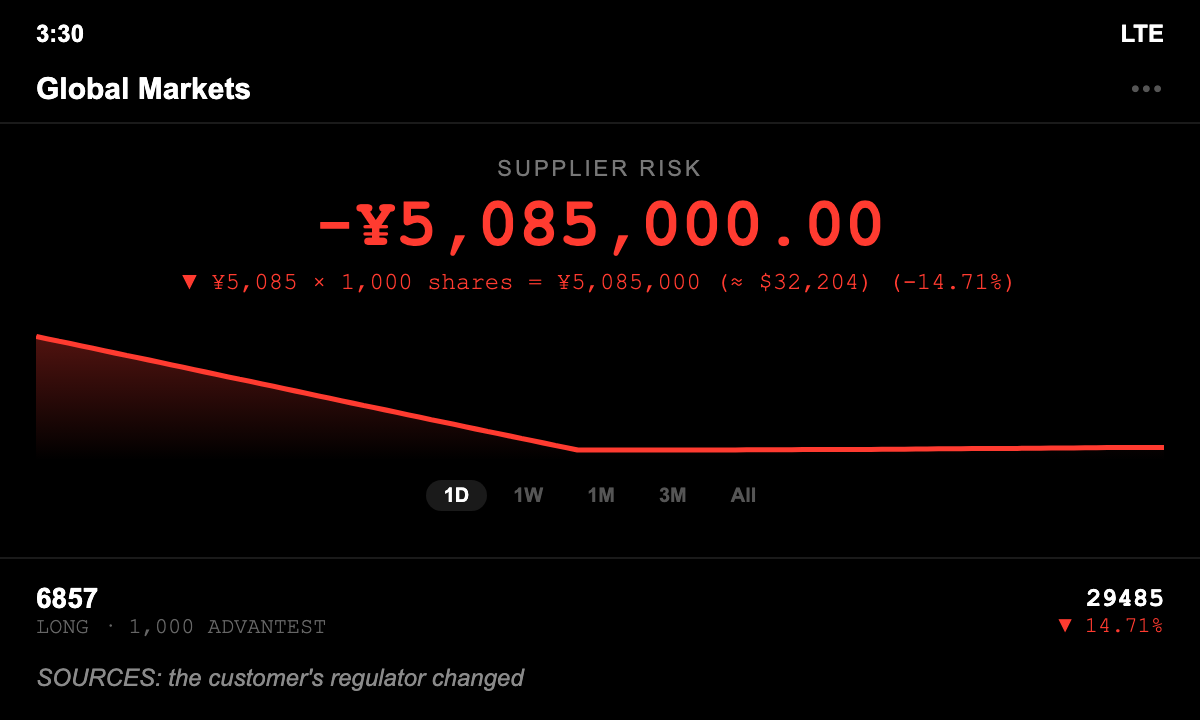
THIS WEEK'S CASUALTIES ⚰️ The first casualty bought Tokyo's Wednesday bounce and lost ¥5,085,000, about $32,204, when Thursday did not repeat it. u/i_only_own_the_shovels bought 1,000 Advantest shares at Wednesday's Tokyo close of ¥34,570, about ¥34.57 million of stock. The thesis: Advantest makes the machines that test chips, not the chips. Whatever Washington does about AI data centers lands on the customer first. Wednesday had already cost Advantest 3.35%. Then New York traded, and Seoul opened. • Nvidia: down 3.17% in Wednesday's US session. • Micron: down 7.00% the same session. • The reason Korean coverage gave: the Democratic sweep revived fears of tighter regulation of AI data centers, power rules and a corporate tax rise. Thursday's Tokyo tape for Advantest: • Open: ¥32,550, already ¥2,020 under the entry. • Range: a high of ¥32,740 and a low of ¥29,070. • Close: ¥29,485, down ¥5,085 or 14.71%, on 23,743,700 shares. ¥5,085 a share on 1,000 shares is ¥5,085,000, about $32,204. The fear was about the customer. The selling did not check the address.
That's the part worth understanding. A supplier's sales are its customers' spending, so a fear about the customers is a fear about the supplier. The open was ¥2,020 under the entry. The rest of the session found another ¥3,065. Total damage: ¥5,085,000, about $32,204, for buying the first day of a scare as if it were the last.
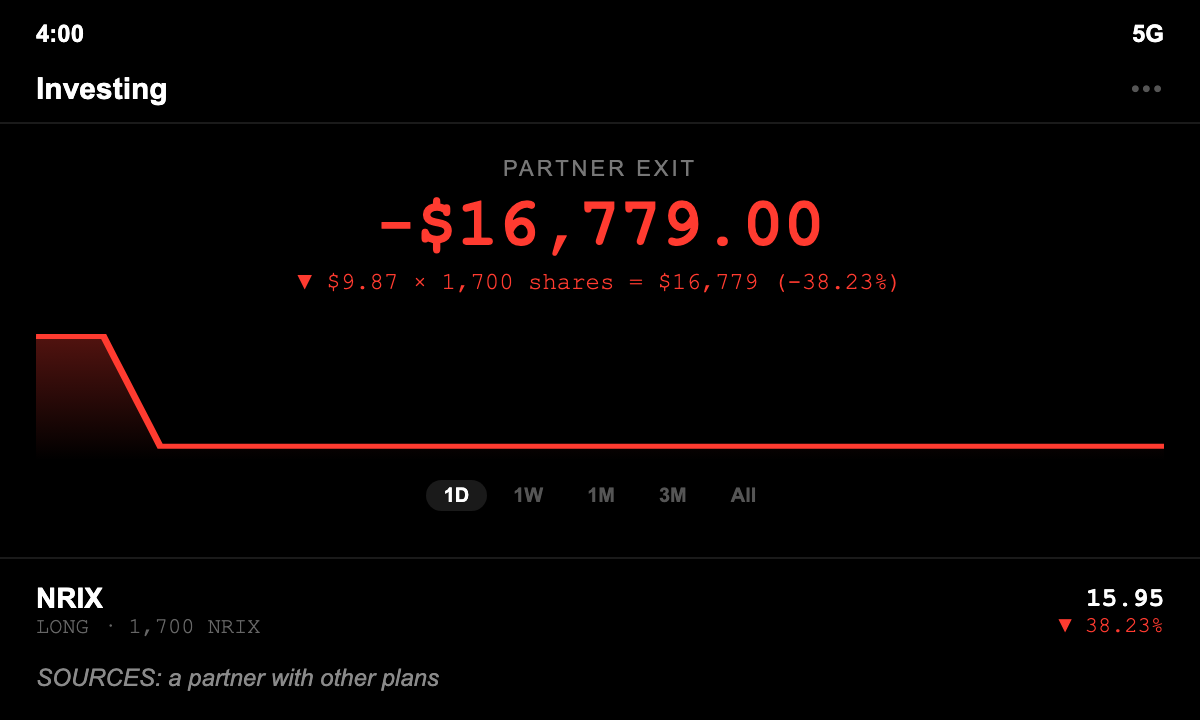
The next casualty owned a biotech for its partner and lost $16,779 overnight when the partner changed its plans. u/the_partner_validates_it bought 1,700 Nurix Therapeutics shares at Tuesday's close of $25.82, about $43,894 of stock. The thesis: a big pharma partner is a second opinion you do not have to pay for. Sanofi was running SAR448272, an oral STAT6 degrader, in its first human trial. On Tuesday, Nurix put out the release. • The decision: "Sanofi notified Nurix of its decision to discontinue the Phase 1 first-in-human clinical trial of SAR448272, an oral STAT6 degrader, and to terminate the SAR448272 program." • The money: Nurix does not expect any future development, regulatory or commercial milestone payments or royalties from the program. • After hours: the stock fell 34% on Tuesday evening, per MarketScreener. • Wednesday's close: $15.95, down $9.87 or 38.23%. For context: the rest of the pipeline is still running, with bexobrutideg in Phase 3, NX-1607 in Phase 1b and the IRAK4 program with Gilead in Phase 1. $9.87 a share on 1,700 shares is $16,779. The thesis was the partner. The partner had other plans.
Here's what stood out: Wednesday's session took the stock further than the evening did, 38.23% against 34%. Translation: a partnered program is worth what the partner is willing to keep paying for it. Total damage: $16,779, for outsourcing conviction to a company with its own portfolio to manage.
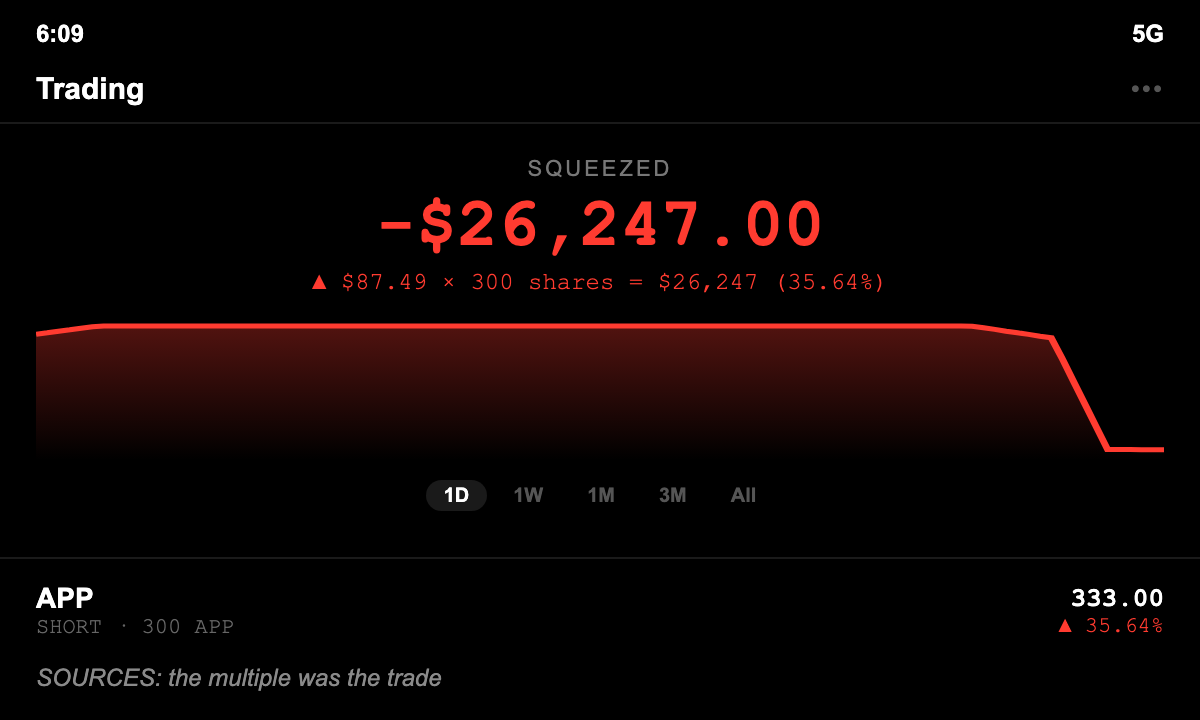
The last casualty bet against AppLovin into its quarter and lost $26,247 by 6:09 in the evening, New York time. u/the_multiple_cannot_hold shorted 300 AppLovin shares at Tuesday's close of $245.51, about $73,653 of stock. The thesis: the price already assumed everything, so anything less than everything would do. The regular session went the wrong way first. AppLovin closed Wednesday at $271.49, up $25.98 or 10.58%. Then the quarter landed. • Revenue: $2.185 billion, up 55%, a record, and about $100 million above the top of its own $2.055 billion to $2.085 billion guide. • Consensus: about $2.07 billion of revenue and $4.03 to $4.04 of EPS. • Profit: net income of $1.439 billion, up 72%, and diluted EPS of $4.30. • Adjusted EBITDA: $1.842 billion, an 84% margin. • Cash: $1.4 billion of free cash flow, and $1.4 billion returned to shareholders. • Fourth-quarter guide: revenue of $2.365 billion to $2.395 billion and adjusted EBITDA of $1.995 billion to $2.025 billion. After hours, the stock printed $333.00 at 6:09 in the evening, up $61.51 or 22.66% from the regular close. That is a print, not a close. $87.49 a share on 300 shares is $26,247. The short was on the multiple. The quarter was on the revenue line.
Here's the thing. A valuation short needs a reason for the valuation to shrink, and the company set its own bar and then cleared it. At the regular close the loss was $7,794. The after-hours print more than tripled it. Total damage: $26,247, marked to an after-hours print, so the official number is still waiting for Thursday's session.
THIS WEEK BY THE NUMBERS 🧮 Every figure below is sourced and dated. Nobody in this section is invented.
Four ways out: a premium that lost its reason, a supplier sold with its customers, a partner that left and a beat that broke a short. Wednesday in New York, WTI settled at $88.12 a barrel, about 15% lower on the week so far. Brent settled at $94.62 a barrel, almost 17% lower week to date. In stocks, Nvidia fell 3.17% and Micron 7.00% on Wednesday, the Chosun Ilbo reported. Thursday in Tokyo, Advantest closed at ¥29,485, its second down day after the vote. The Thursday US session has not opened yet, so this issue has no result for it. Crude took three sessions to lose its premium. Our four traders each lost theirs in one.
BITE-SIZED COPIUM FOR THE ROAD 😵 Four replies from the comments, all posted before the numbers came in. • "The Strait is still the Strait." The geography did not move. The price for it settled 8.3% lower. (u/the_strait_is_still_there) • "Shovels don't vote." No, but their buyers' politics still reach the price, ¥5,085 a share of it. (u/shovels_dont_vote) • "Three programs is still a pipeline." It is, and Wednesday priced it at $15.95 a share. (u/three_programs_is_a_pipeline) • "After-hours isn't real." The $333.00 trade was real. It just was not the close. (u/after_hours_isnt_real)
DUMB MEMES 🎭 The meme desk read the settlement. Two entries.
POV: you bought the risk and the market sold the reason
POV: the close was a warning and the print was the bill If this made you laugh, you held nothing this week that depended on a premium, a partner or a print. If it did not, New York has not opened on Thursday yet. That is one more session to stay out of the next issue. See you next issue. Same rules as ever: the prices are real, the people are not. Traders and P&L screenshots are satirical composites. Market data, price moves and quotations are real and dated October 30 to November 5, 2026. Not financial advice. Obviously. Look at us.
Stay liquid,
|
The war premium lost its sponsor on Tuesday. Crude lost 8.3% on Wednesday.
A long in WTI crude lost $48,060 when Tuesday's election took the war premium out of the price. An Advantest long, a Nurix long and an AppLovin short cost another $75,230, for about $123,290 in all.