|
GM. This is The Financial Darwin Awards, the only financial newsletter with a 100% loss rate. Tuesday was one of the quietest sessions of the month. The S&P 500 fell 0.2%, the Nasdaq 0.1%, and consumer confidence hit its lowest reading since 2014. Underneath that, a company lost a quarter of itself because a government official posted something on a Monday night. Four traders lost $131,602 between them, and three of the four were beaten by something that arrived from outside their industry entirely. A social media post, a pipeline, and a market in a different regulatory category. The fourth was beaten by time, which is the only one of the four that was always going to happen. The traders are composites. The moves are not. Here's what we've got today:
THIS WEEK'S DAMAGE REPORT 📊
The first number is the sum of the four stories below. The second is real: TransUnion has committed to pricing VantageScore 4.0 at 99 cents a score through December 2028, against the $4.95 Fair Isaac charges for a mortgage score.
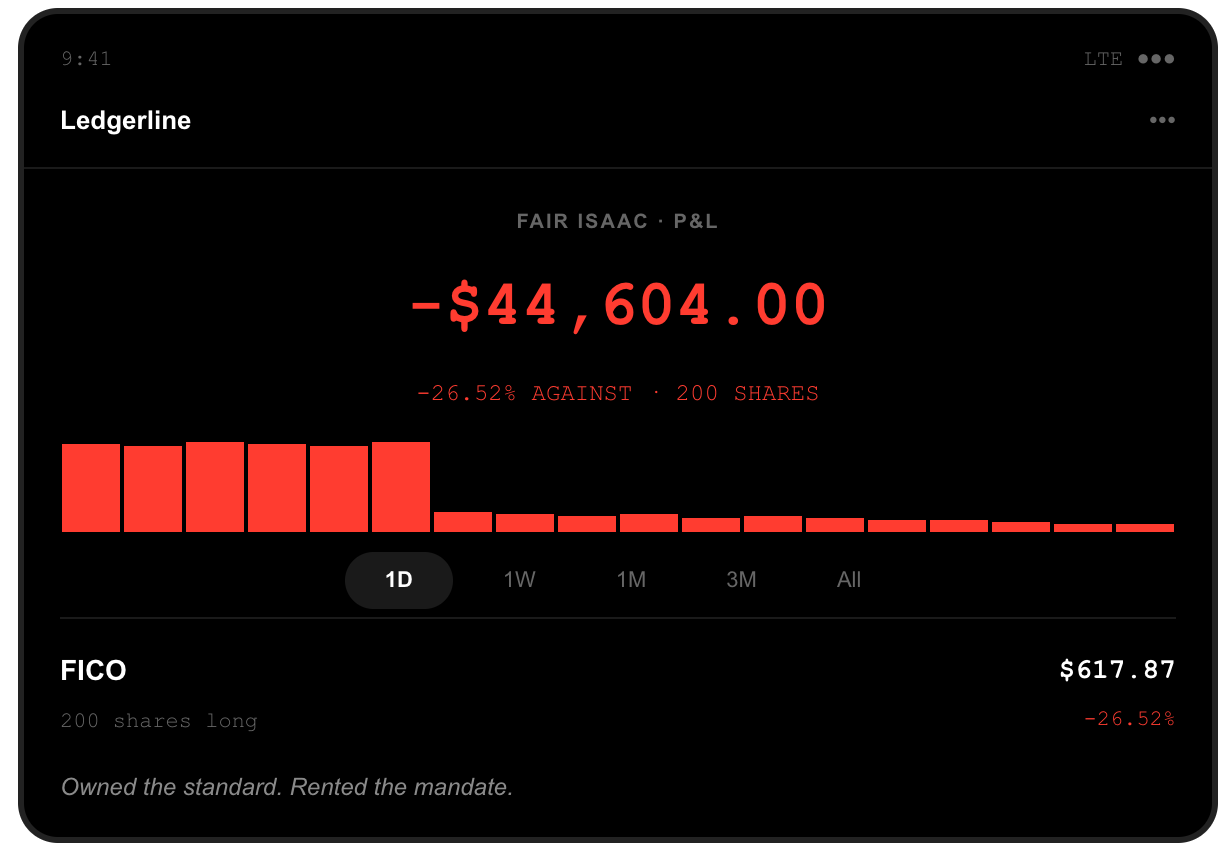
DARWIN AWARD OF THE WEEK 🏆 Every issue we crown the single worst financial decision on the internet. This week it goes to a man who owned a monopoly and had never checked who granted it. Here's the setup. u/the_moat_is_the_standard owned 200 shares of Fair Isaac, about $168,000 at Monday's close of $840.89. It is the quality-compounder trade in its purest form. Fair Isaac owns the FICO score, every American mortgage needs one, and the company has been raising the price for years. That last part is the tell, and he read it as pricing power. A mortgage score went from well under a dollar in 2018 to $3.50, and then to $4.95 in November 2024. On Monday night the director of the Federal Housing Finance Agency, Bill Pulte, posted on X that Fannie Mae and Freddie Mac would move to a single pricing grid. VantageScore 4.0, which is owned by the three credit bureaus, would sit on that grid alongside FICO Classic, without the pricing penalty that had previously been applied to loans using it. TransUnion has committed to selling VantageScore at 99 cents through December 2028, and Rocket Mortgage said it would make it its preferred model. Fair Isaac closed Tuesday at $617.87, down $223.02, or 26.52%, on a day the S&P 500 fell 0.2%. 200 shares, down $223.02 each, is $44,604. The moat was never the score. It was a line in a government pricing grid, and the man who controls that line has an X account.
Here's the thing. There are two kinds of monopoly and they look identical on a margin chart. One is earned, where customers keep choosing you because the alternatives are worse, and the defense is that switching costs something real. The other is conferred, where a rule says that your product is the one that must be used, and the defense is that somebody has not yet changed the rule. A conferred monopoly can show better margins than an earned one for decades, because it does not have to spend anything defending itself, which is exactly what makes the accounts so convincing. That is the part worth understanding, and it cost him $44,604 to learn that repeatedly raising the price of something people are required to buy is not a demonstration of pricing power. It is a demonstration to the regulator.
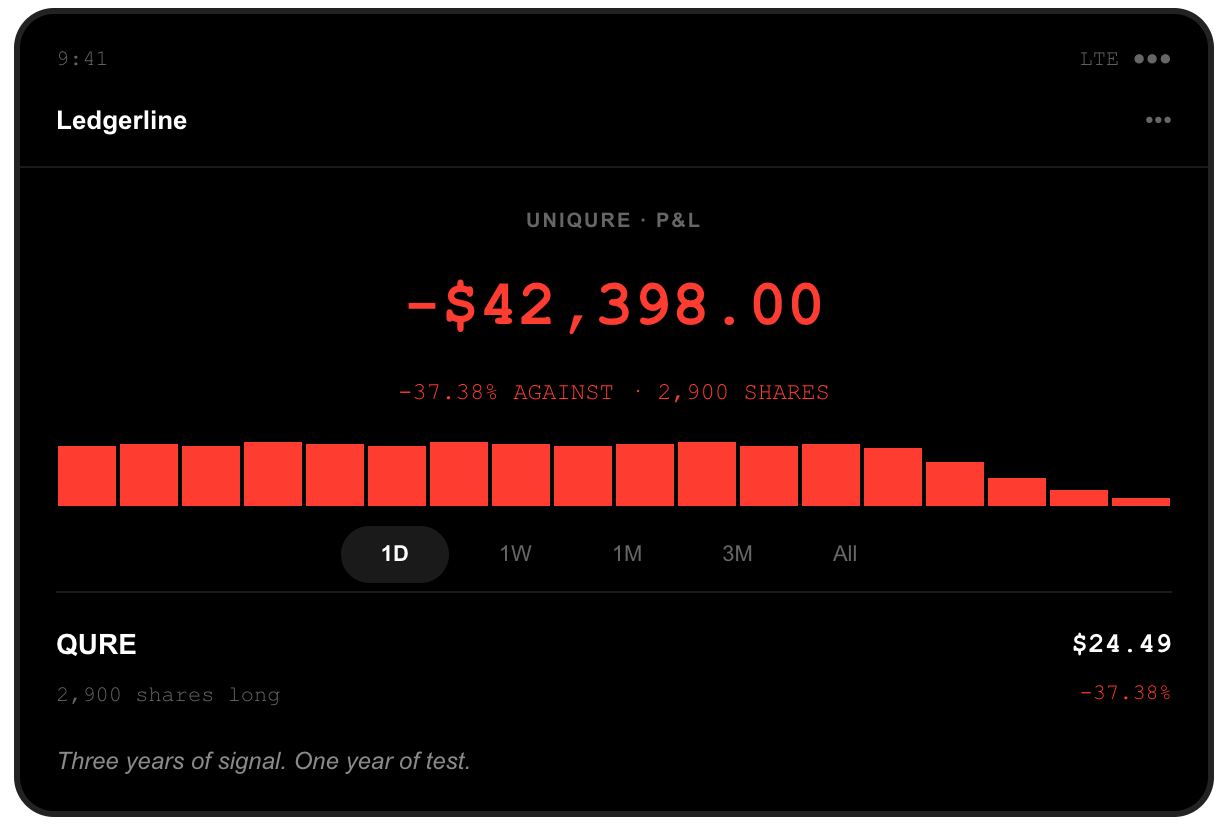
THIS WEEK'S CASUALTIES 💀 Not everybody can be Darwin Award of the week. These three gave it a real shot. Let's run through the tape. Casualty #1: The Man Who Owned Three Good Years u/forty_eight_month_data owned 2,900 shares of uniQure, about $113,000 at Monday's close of $39.11. The company is developing AMT-130, a one-time gene therapy for Huntington's disease, which is a genuinely terrible illness with no treatment that changes its course. The three-year data had been good enough to support a regulatory filing, and he had held through a great deal on the strength of it. On Tuesday the 48-month results arrived and missed statistical significance on the key composite measure. uniQure closed at $24.49, down $14.62, or 37.38%. 2,900 shares, down $14.62 each, is $42,398. The published numbers that afternoon were worse still. Several outlets ran 48%, 64% and 65%, all of which were pre-market and intraday prints on a stock that settled down 37.38%.
Here's the thing. Long-duration data is the only kind that matters for a one-time therapy, and it is also the kind that arrives last. A treatment given once has to keep working, so the durability readout is not a bonus on top of the efficacy case. It is the efficacy case. That creates an uncomfortable asymmetry for anybody holding the shares. Every good interim result raises the price and the position size, and the test that could invalidate all of them is still years away. None of this means the therapy does not work, and the three-year filing package has not gone anywhere. It means the market now has to price a wider range of outcomes than it did on Monday. That is the part worth understanding, and it cost him $42,398 to learn that in a durability story, the later the data, the more of the thesis it carries.
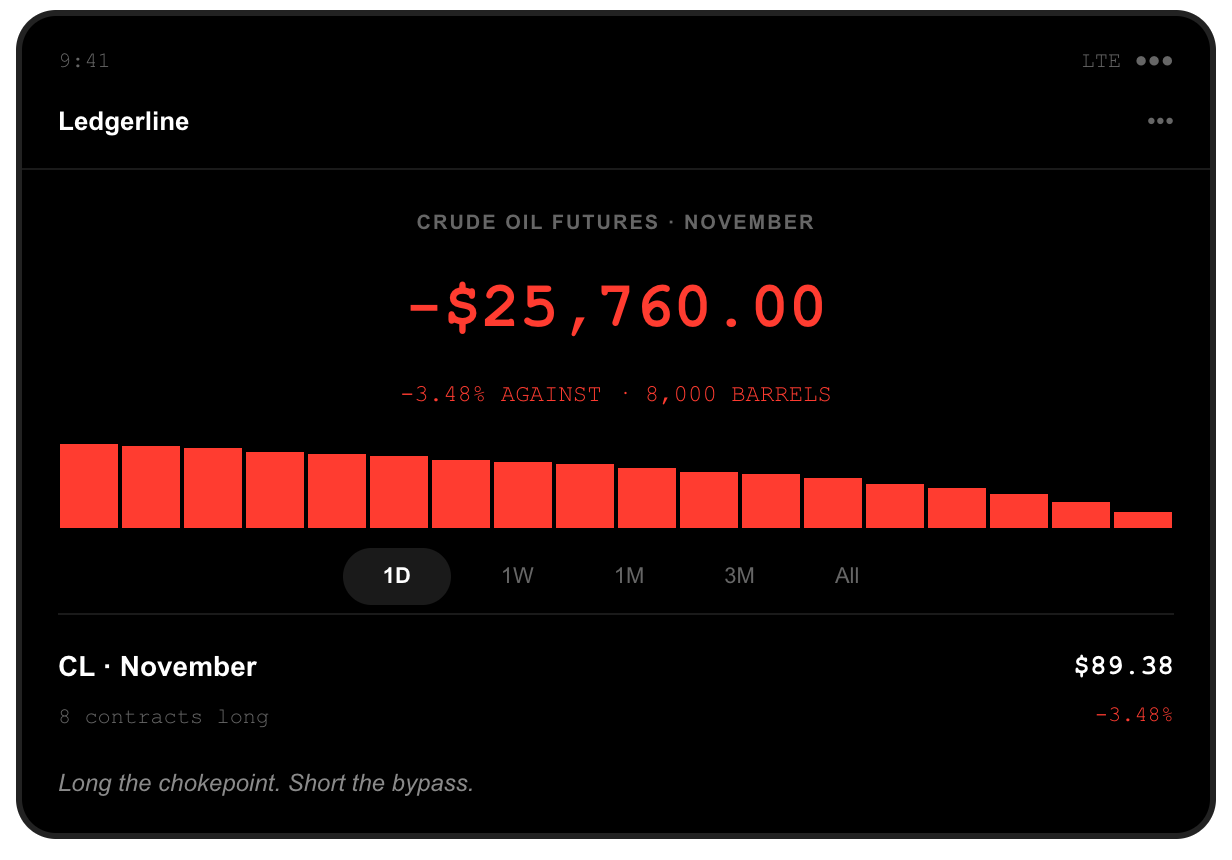
Casualty #2: The Man Who Was Long The Chokepoint u/the_strait_is_the_thesis was long eight November crude contracts, which is eight thousand barrels, from Monday's settlement of $92.60. His argument was the one everybody has been making for a month. Traffic through the Strait of Hormuz is escorted and constrained, and about a fifth of the world's oil consumption normally passes through it. It is a good argument and it has been right. What it missed is a pipeline that Saudi Arabia commissioned in 1981 for precisely this situation. The East-West line, or Petroline, runs from the eastern oilfields across the peninsula to Yanbu on the Red Sea, on the other side of the chokepoint. It was shut on September 11 after drone attacks. It restarted on September 22. Loadings at Yanbu were confirmed by satellite on the 27th, and on Monday evening Aramco issued its October loading program for the port. So nothing began on Tuesday. Tuesday was the day the market accepted that Red Sea exports were genuinely back, a week after they had restarted. November West Texas Intermediate settled at $89.38, down $3.22 a barrel, or 3.48%. Brent settled at $102.59, down 2.6%. Eight thousand barrels, down $3.22 each, is $25,760. Three weeks ago this newsletter gave its Darwin Award to a man who was long crude on a war premium that a possible meeting removed. This time the barrels genuinely moved, and they had been moving for a week.
Here's the thing. A chokepoint is only worth what it costs to go around it, and that number changes without anybody announcing it. Every major disruption risk in commodities has an alternative route attached, because the people who own the cargo have had decades and very strong incentives to build one. Those routes are usually slower, smaller and more expensive, which is why the market still prices a premium when the main route is threatened. The East-West line alone is rated at seven million barrels a day. So the question is never whether the chokepoint is closed. It is how much of the flow the bypass can take, how quickly, and whether the operator has any reason to hold back. That is the part worth understanding, and it cost him $25,760 to learn that geography sets the problem and infrastructure sets the price.
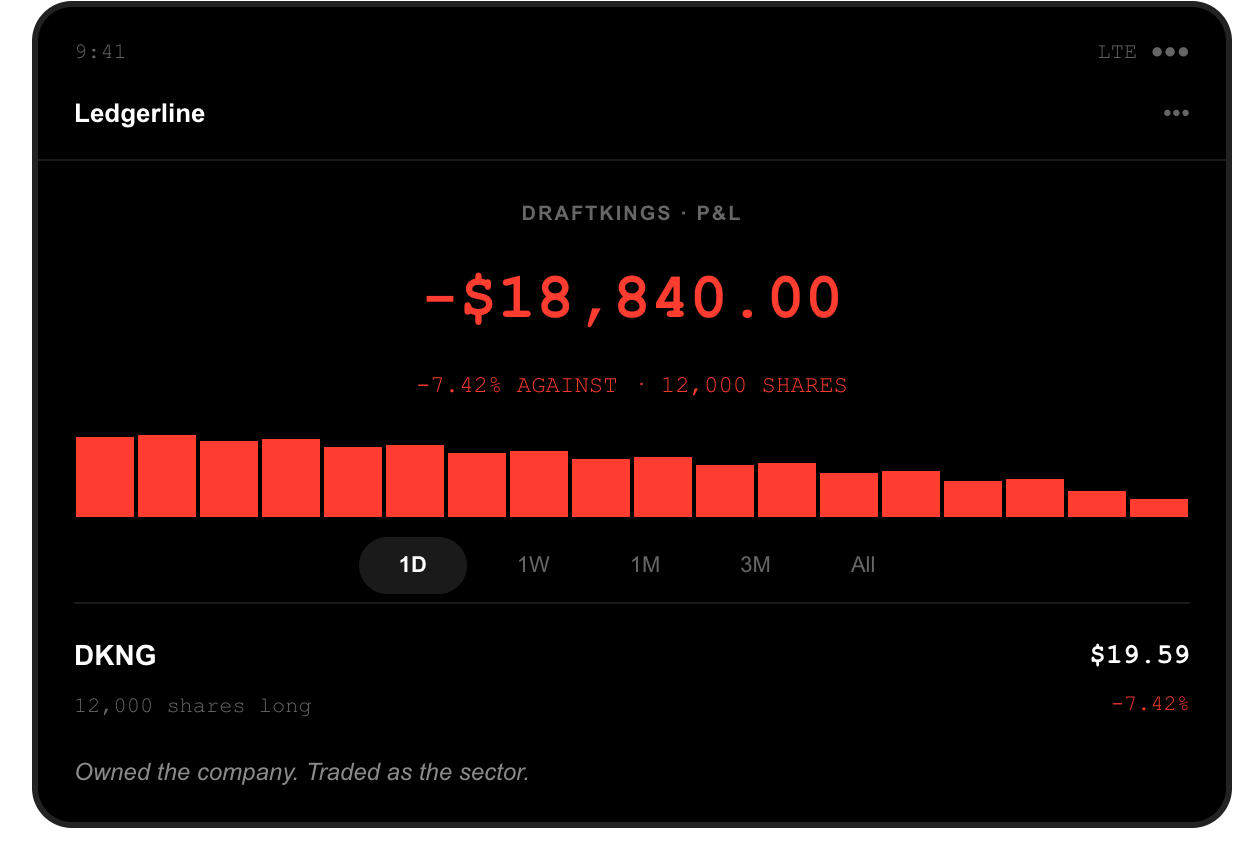
Casualty #3: The Man Who Was Hit By Somebody Else's News u/nobody_switches_sportsbooks owned 12,000 shares of DraftKings, about $254,000 at Monday's close of $21.16. The thesis was market structure. Online sports betting in America is effectively a duopoly, with DraftKings and FanDuel taking about 80% of gross gaming revenue between them. On Monday the company had announced an exclusive sportsbook and casino sponsorship of NHL coverage on Prime for the coming season, which is the kind of thing that is supposed to help. Then Tuesday happened, and the two pieces of news that moved the sector had nothing to do with DraftKings. Brazil banned online betting, which forced Flutter, the owner of FanDuel, to halt operations there. DraftKings has no Brazilian business at all. Separately the House Oversight Committee widened an inquiry into prediction-market platforms, writing to three of them. DraftKings was not one. DraftKings closed at $19.59, down $1.57, or 7.42%, its lowest close since the spring of 2023. 12,000 shares, down $1.57 each, is $18,840. Underneath both of those is the thing that has actually been repricing the stock for weeks, which is prediction markets selling event contracts under a federal regulator rather than a state gaming one.
Here's the thing. When you own a company in a small sector, you own the news flow of the whole sector whether or not it applies to you. Funds that want exposure to a theme rarely hold one name, so a headline about any member of the group is traded across all of them within minutes, long before anybody checks the geography. That is not irrational, because the second question after "does this affect DraftKings" is "does it tell us something about how governments are thinking about betting", and the answer there was not comforting. It does mean that in a two-name sector attached to a live regulatory argument, a large part of your daily volatility is generated by companies you have never analyzed. That is the part worth understanding, and it cost him $18,840 to learn that a concentrated sector is a shared reputation, and he owned a share of it.
THIS WEEK BY THE NUMBERS 🔢 We track the data because the data is funnier than anything we could make up.
The S&P 500 fell 0.2% on Tuesday, the Dow 0.3%, the Nasdaq 0.1% and the Russell 2000 0.4%. One more number, for the people who read headlines rather than tapes. Fair Isaac was widely reported at down 20% and uniQure at down 48%, 64% and 65%. Every one of those was an intraday or pre-market print. The closes were 26.52% and 37.38%, and the difference between the two sets of numbers is roughly a day of your own panic.
BITE-SIZED COPIUM FOR THE ROAD 🍡 The best part of any loss thread isn't the screenshot. It's the comments section. Here are this week's greatest hits.
Translation: four people who had done the work, inside four boundaries somebody else was drawing.
DUMB MEMES 😐 Every newsletter needs a meme section. Ours just hits different when the catalyst was a post published after the close.
POV: your moat has a social media account
u/the_strait_is_the_thesis, discovering a pipeline from 1981 If you laughed, you're coping. If you didn't laugh, take your largest position and write down who would have to make a decision for the business to stop working. See you next issue. A moat is only a moat until somebody with a pen decides it is a road. Traders and P&L screenshots are satirical composites. Market data, price moves and quotations are real and dated September 28 to September 29, 2026. Not financial advice. Obviously. Look at us. Stay liquid, |
A post on X took 26.52% off a monopoly. It was not even the biggest loss on this page.
The housing regulator let a rival credit score into Fannie and Freddie's pricing grid and Fair Isaac fell 26.52%. A gene therapy missed at 48 months and fell 37.38%. Crude settled down 3.48% because a pipeline restarted.