GM. This is The Financial Darwin Awards, where your worst trade is someone else's content. Wednesday belonged to the bond market. The ten-year Treasury yield touched about 5.36%, its highest since April 2002, and the Fed's minutes said most officials expect another rate hike by year end. Four traders lost $98,257 between them, and every one of them was undone by a document. A congressional report repriced a broker, and a set of release notes said where an upgrade had actually shipped. An auction result told one trader the buyers had not gone anywhere. A financing report told another who was paying for the AI buildout. The traders are composites. The moves are not. Here's what we've got today:
THIS WEEK'S DAMAGE REPORT 📑
The first number is the sum of the four stories below. The second is Wednesday's volume in Webull, about 5.6 times its three-month average of 13.8 million shares.
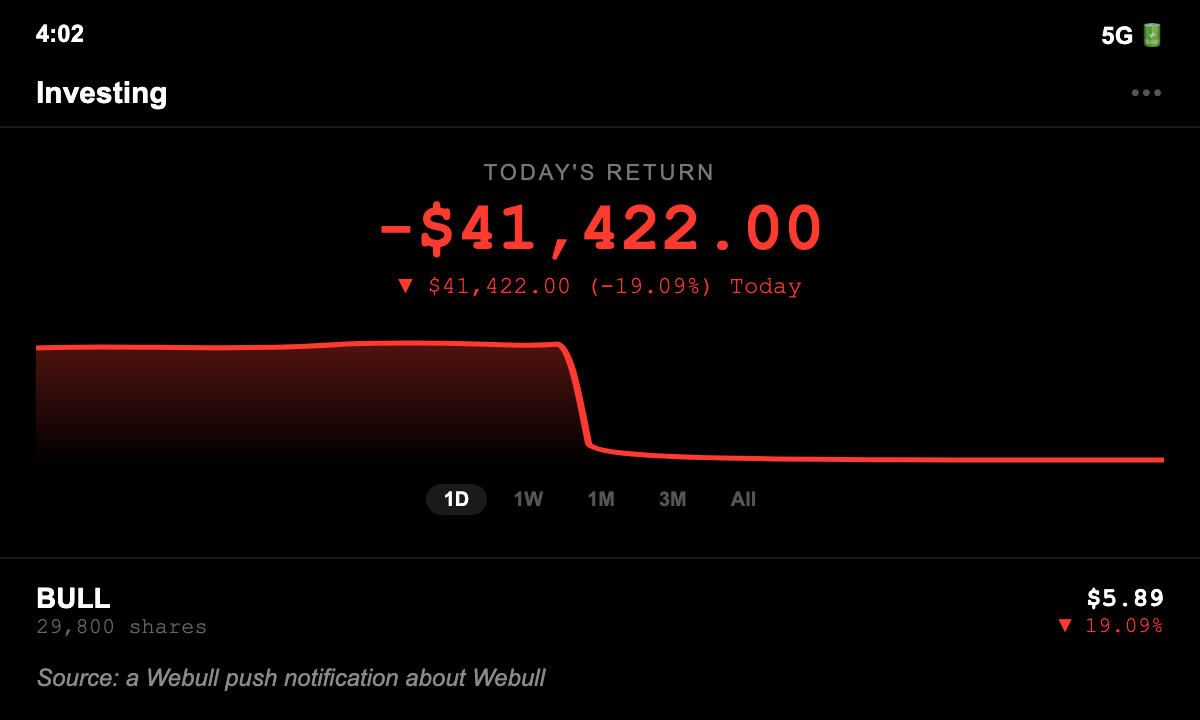
DARWIN AWARD OF THE WEEK 🏆 Every issue we crown the single worst financial decision on the internet. This week it goes to someone who owned shares in their own broker, and watched them fall inside that broker's app. Here's the setup. u/i_bought_my_own_broker held 29,800 shares of Webull from Tuesday's close of $7.28, about $216,944. The thesis was loyalty, mostly. They used the app every day, liked it, and decided that a company they trusted with their money was a company worth owning. On Wednesday the House Select Committee on China published a report on Webull. It found that the company's "ownership architecture, technical workforce, technology infrastructure, cross-border data routing, corporate financing, and compliance frameworks were tied in structural ways to China." The committee said its concerns had "escalated" since October 2025, when Webull began carrying customer cash directly, creating what it called a "structural exposure of billions of dollars" in American capital. They spent a year checking the stock in the app. Congress spent the year checking who built the app. Let's run through the tape.
29,800 shares, down $1.39 each, is $41,422. It was the stock's worst day in about a year. Webull is now down 56% since it went public in 2025.
Here's the thing. Webull disputes the report, calling it full of "significant inaccuracies and unsupported conclusions." It says the committee "had not sought clarification from the company before publishing it," and that its American business runs from offices in Florida and New York City. None of that changed the close. A stock does not wait for an argument to be settled before it prices the cost of having one. What this means: the risk was never that the app works badly. The app works fine. The risk is a decision in Washington about who gets to run it, and that decision has no earnings date. Robinhood fell 2.22% and Interactive Brokers 3.5% on the same day. The market charged the whole sector a little and one company a lot. Final bill: $41,422, for confusing a good user experience with a clean ownership structure.
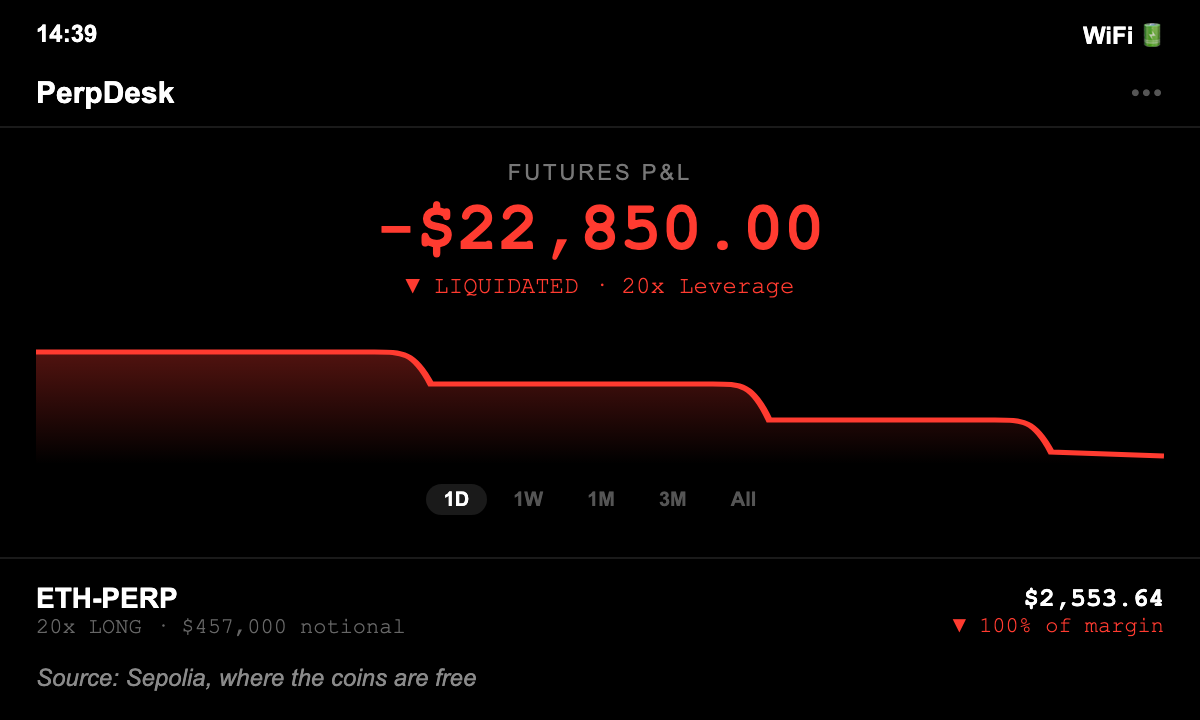
THIS WEEK'S CASUALTIES 💀 Not everybody can be Darwin Award of the week. These three gave it a real shot. Two of them never touched a stock. Casualty #1: The Trader Who Bought The Test Network On Tuesday, Ethereum's Glamsterdam upgrade went live on Sepolia. Sepolia is Ethereum's test network. The coins on it are free, because the entire point of it is that nothing on it is worth anything. Glamsterdam is a big upgrade: a stack of core improvement proposals, including one that moves the split between block proposers and block builders into the core protocol. u/it_was_on_the_testnet read the headline on Wednesday morning and opened a 20x leveraged long on ether at the day's open of $2,697.42. That is a $457,000 position on $22,850 of margin. One problem: mainnet, the version with real money on it, is "targeted for the fourth quarter of 2026, with no confirmed date."
At 20x, a 5% move against you is the whole margin. Their liquidation price was about $2,576, roughly 4.5% below the entry, because the exchange keeps a slice of margin in reserve. Ether opened at $2,697 and traded at $2,554 by the afternoon in London. The $22,850 is gone.
Here's what stood out. Even the coverage of the upgrade said "market data does not show that the testnet fork caused the move." Ether fell with everything else: bitcoin, a 24-year high in the ten-year yield, and Brent back above $101. Ether ETFs had $201.9 million of outflows on Tuesday, the sixth losing session in a row. Somebody was selling the whole time. A 20x position does not need to be wrong about Ethereum. It only needs one bad afternoon, and Wednesday had $546.89 million of them.
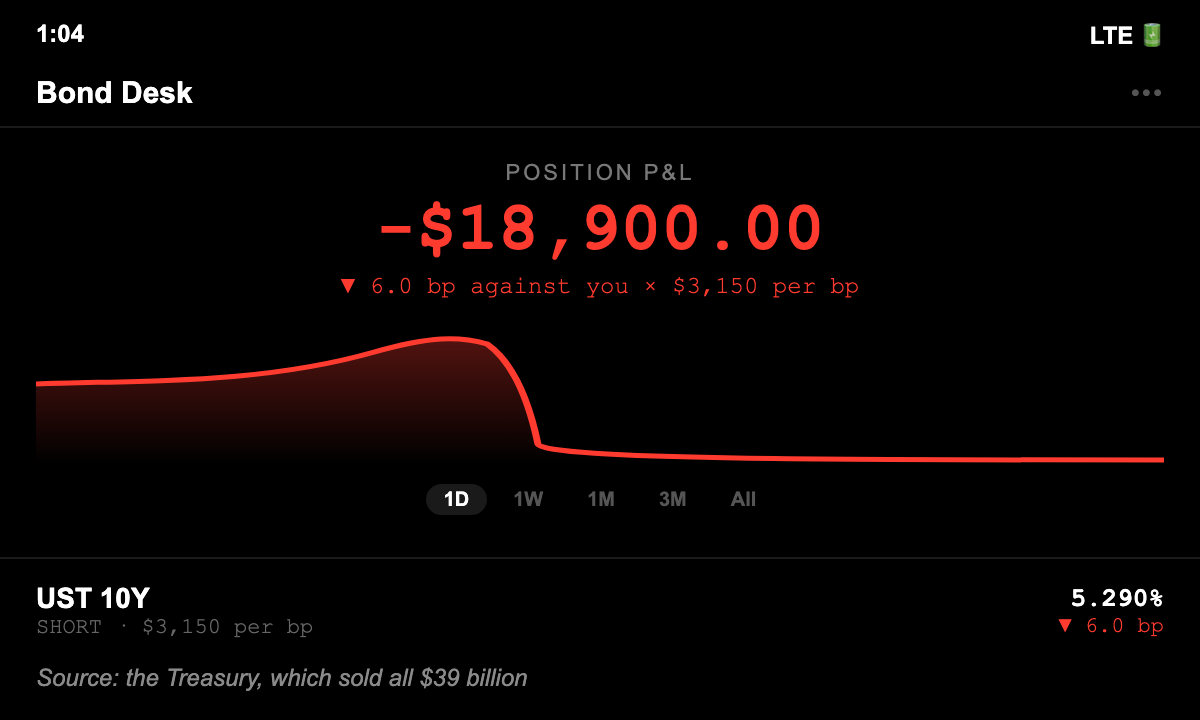
Casualty #2: The Trader Who Shorted The Auction For three weeks the bond market had one story. The ten-year yield climbed from 5.00% in mid-September to 5.31% on Monday, and the question was whether anyone would turn up to buy the government's debt. On Wednesday morning the ten-year yield touched about 5.36%, its highest since April 2002. That afternoon the Treasury was selling $39 billion of new ten-year notes. u/nobody_wants_ten_years shorted ten-year Treasuries near 5.35%, on the theory that the auction would struggle and yields would keep climbing. The position was sized so every basis point was worth $3,150 to them. The answer?
Translation: buyers accepted a yield 1.7 basis points lower than the market had been asking for, and the dealers were barely needed. The buyers they were betting against took 80.3% of the auction. The ten-year fell to a session low of 5.29%. Covering there is a 6 basis point loss, and 6 times $3,150 is $18,900.
The cruel part came later that afternoon. The Fed's minutes said "most participants assessed that another increase in the target range for the federal funds rate would likely be appropriate by year end." That is exactly the hawkish news a bond short wants. Yields finished little changed and still below the morning high. A yield at a 24-year high is not only a warning sign. To a buyer with $39 billion of appetite, it is a price. Cost of the lesson: $18,900, for treating a high yield as proof that nobody would buy it.
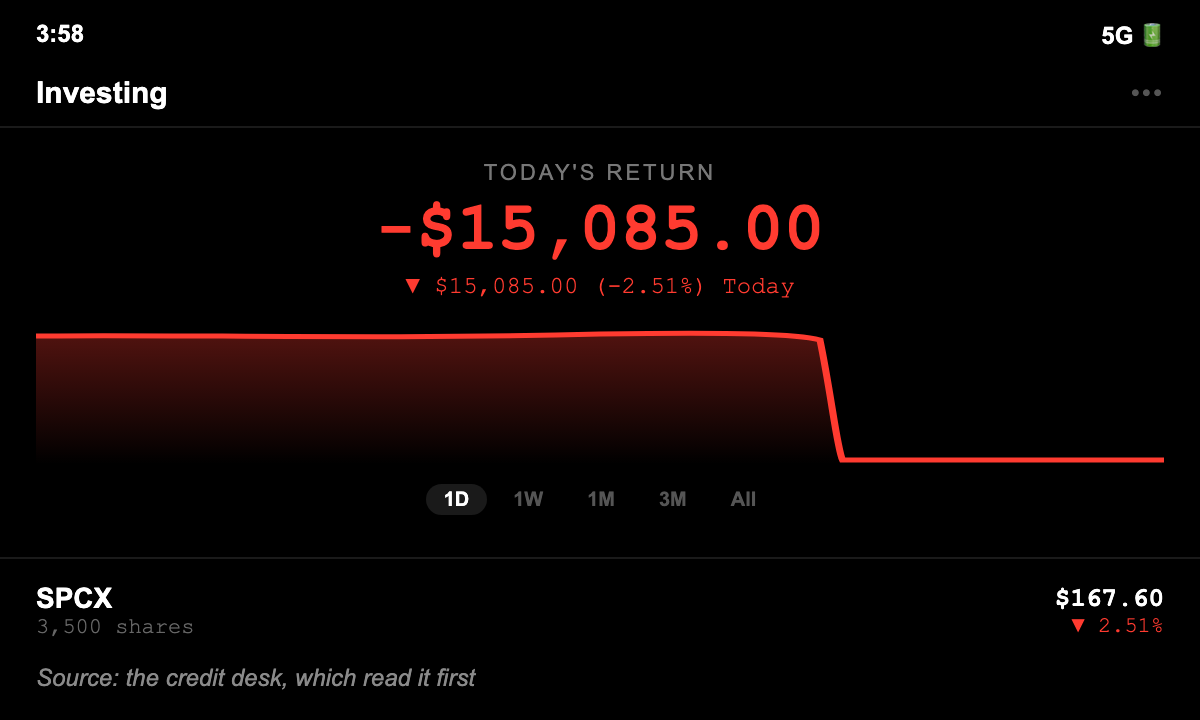
Casualty #3: The Trader Who Bought The Chips On Wednesday the Financial Times reported that SpaceX is buying a lot more Nvidia chips. For u/the_chips_are_the_moat, who owned 3,500 shares from Tuesday's close, about $601,700, that was the entire bull case arriving early. They had not asked who was paying. SpaceX is seeking $40 billion of debt to buy the chips: $30 billion of investment-grade bonds and $10 billion of bank loans, with Apollo expected to lead and Pimco in early talks.
3,500 shares, down about $4.31 each, is $15,085. The shareholders read "chips." The credit market read "$40 billion."
So here's the question: who is most exposed to a $40 billion borrowing? The answer is whoever lent money to the company before it. Existing bondholders now sit beside $40 billion of new debt, which is why the credit gauge hit a record while the stock lost only 2.51%. The equity still owns every chip. It also owns every repayment that comes after the lenders are paid. The receipt: $15,085, for reading the shopping list and skipping the invoice.
THIS WEEK BY THE NUMBERS 💯 We track the data because the data is funnier than anything we could make up.
The ten-year yield hit a 24-year high in the morning, and in the afternoon foreign buyers took 80.3% of the auction. The Fed raised rates by a quarter point in September, to a range of 3.75% to 4.00%, on a 12 to 0 vote. The minutes say most officials want one more by the end of the year. Stocks blinked. The Dow fell 341.41 points, or 0.66%, to 51,179.87. The S&P 500 fell 0.22% to 7,801.77 and the Nasdaq 0.22% to 27,538.69, one day after both closed at records. Three more things from Wednesday.
A 24-year high in yields, a broker under congressional review and $546.89 million of forced selling in crypto, and the S&P 500 lost 0.22%.
BITE-SIZED COPIUM FOR THE ROAD 😳 The best part of any loss thread isn't the screenshot, it's the comments section. Here are this week's greatest hits.
Translation: four people who read the headline and skipped the document.
DUMB MEMES 😆 Every newsletter needs a meme section. Ours just hits different when the most painful screenshot of the week was sent by the stock to its own shareholders.
POV: your broker is your biggest position
the coins on Sepolia are free, the margin was not If you laughed, you're coping. If you didn't laugh, read the second sentence of the next headline before you size the trade. See you next issue. Every loss on this page came with paperwork. Traders and P&L screenshots are satirical composites. Market data, price moves and quotations are real and dated October 6 to October 7, 2026. Not financial advice. Obviously. Look at us. Stay liquid, |
Webull fell 19.09% on Wednesday. Its shareholders found out in the Webull app.
A congressional report repriced a broker. An Ethereum upgrade shipped to the test network and a 20x long shipped to zero. The bond auction everybody was braced for went fine. And SpaceX told its shareholders the AI buildout will be paid for in bonds.