GM. This is The Financial Darwin Awards, the only financial newsletter with a 100% loss rate. Monday was about as good a day as a market gets. The Nasdaq closed at a record, Nvidia extended the record it had set on Friday, and four companies agreed to buy or spin off something. A pneumococcal vaccine met all thirty-two of its primary endpoints, and an election went the way the market wanted. A private investor put $37.5 billion on a business that does not exist yet. Four traders lost $130,883 between them, and every single one of those things is good news. Just not for them. That is the whole issue: four people standing on the far side of other people's very good day. The traders are composites. The moves are not. Here's what we've got today:
THIS WEEK'S DAMAGE REPORT 📰
The first number is the sum of the four stories below. The second is Brazil's stock index, which had its largest single-day gain since March 2020 and is the reason the first number has a Darwin Award attached to it.
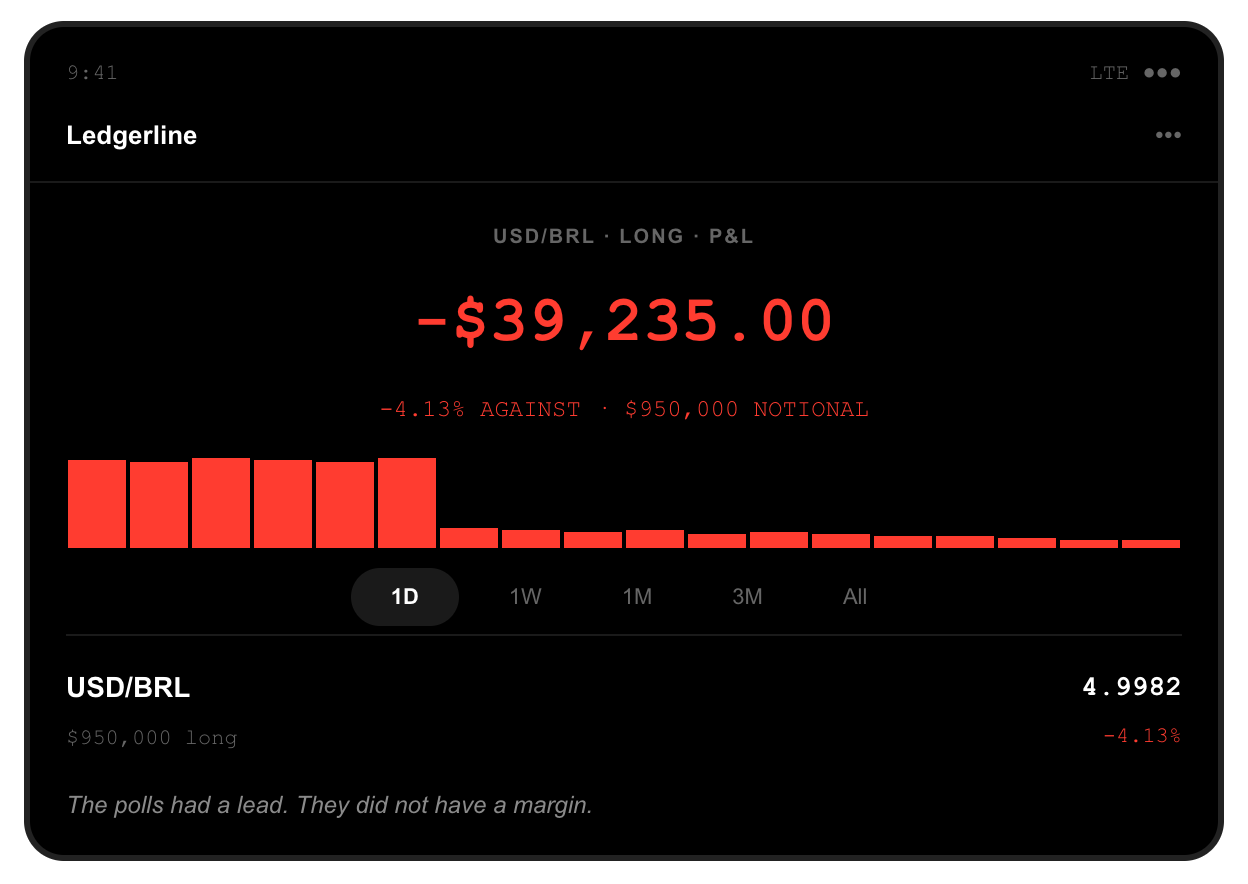
DARWIN AWARD OF THE WEEK 🏆 Every issue we crown the single worst financial decision on the internet. This week it goes to a man who traded an election on a three-point polling lead. Here's the setup. u/the_polls_had_lula_ahead was short the Brazilian real going into Sunday, through $950,000 of long dollars against it at 5.2133. The trade was a bet on continuity. Polls had President Lula leading the first round by about three percentage points, and a Lula win means more spending, which means a weaker currency. On Sunday, Flavio Bolsonaro took 47% of the vote and Lula took about 45%. The market reads Bolsonaro as the fiscally tighter of the two, so it bought everything in the country at once on Monday morning.
The dollar bought 5.2133 reais on Friday and 4.9982 on Monday, which is 4.13% of its value. $950,000 of notional, against by 4.13%, is $39,235. Here is the part that should sting more than the money. A Reuters poll of analysts, published on Friday, had already given him the answer. It said the real could strengthen by as much as 4.6%, to 5.00, in the immediate aftermath of the vote if Bolsonaro won the first round. The size of the move was public property. Only the direction was unknown, and he had treated a three-point polling lead as though it settled that.
Here's the thing. A poll is not a forecast, it is a measurement with an error bar, and a three-point lead sits comfortably inside the error bar of almost any national survey. What he owned was not a view about Brazilian fiscal policy. It was a coin flip with a two-percentage-point lean on it, sized as though it were a conclusion. The runoff is still to come later this month, which is the detail that makes the position worse rather than better. He has to decide whether to do it again with less money, having just been shown what the tail looks like. That is the part worth understanding, and it cost him $39,235 to learn that when the market has already published what happens if you are wrong, the trade is no longer about information.
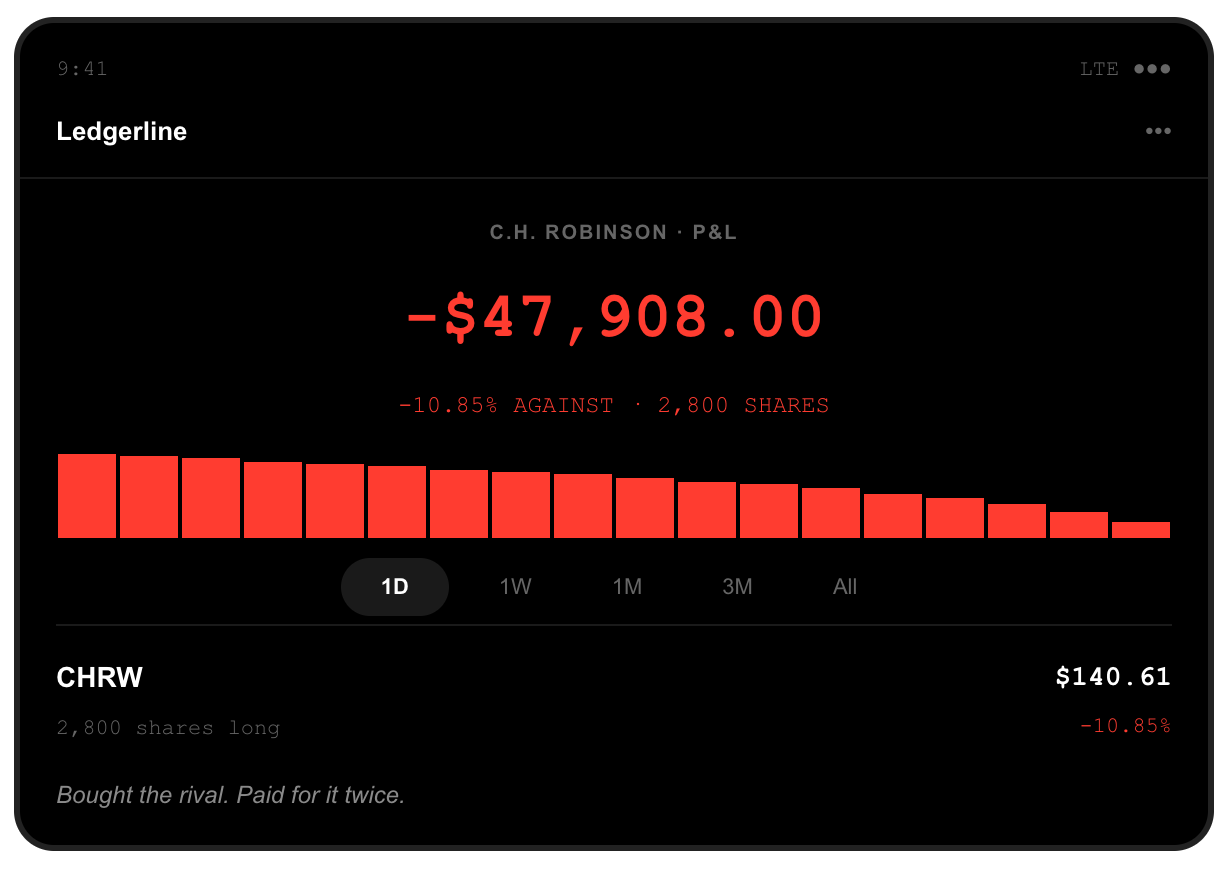
THIS WEEK'S CASUALTIES 💀 Not everybody can be Darwin Award of the week. These three gave it a real shot. Let's run through the tape. Casualty #1: The Man Who Owned The Buyer u/synergies_within_two_years owned 2,800 shares of C.H. Robinson, about $441,616 at Friday's close of $157.72. On Monday the company agreed to buy RXO, a rival truck broker, in a stock-and-cash deal that values it at roughly $5.8 billion. RXO holders get $30.25 a share. The strategic case is not silly. The combination has an enterprise value over $25 billion, and management put numbers on it.
C.H. Robinson closed at $140.61, down $17.11, or 10.85%. 2,800 shares, down $17.11 each, is $47,908. Volume was 8.64 million shares against 1.60 million the session before. RXO, meanwhile, closed at $28.65, up 22.54%. One other thing is worth noticing. RXO rose 4.40% on Thursday and another 9.46% on Friday, before anything was announced, the second of those on more than twice its usual volume.
The useful distinction is between a good combination and a good purchase, and announcement day only ever settles the second one. Every number in the acquirer's favor has a date on it. The cost synergies take two years, the accretion arrives in 2028, and the deal has not closed. Every number against it is immediate. The cash is committed, the shares are promised, and the integration risk starts the moment the ink dries. A 22.54% move in the target against a 10.85% move in the buyer is the market's arithmetic on who captured the value, and it is not subtle. That is the part worth understanding, and it cost him $47,908 to learn that the acquirer pays in the present tense and gets paid in the future one.
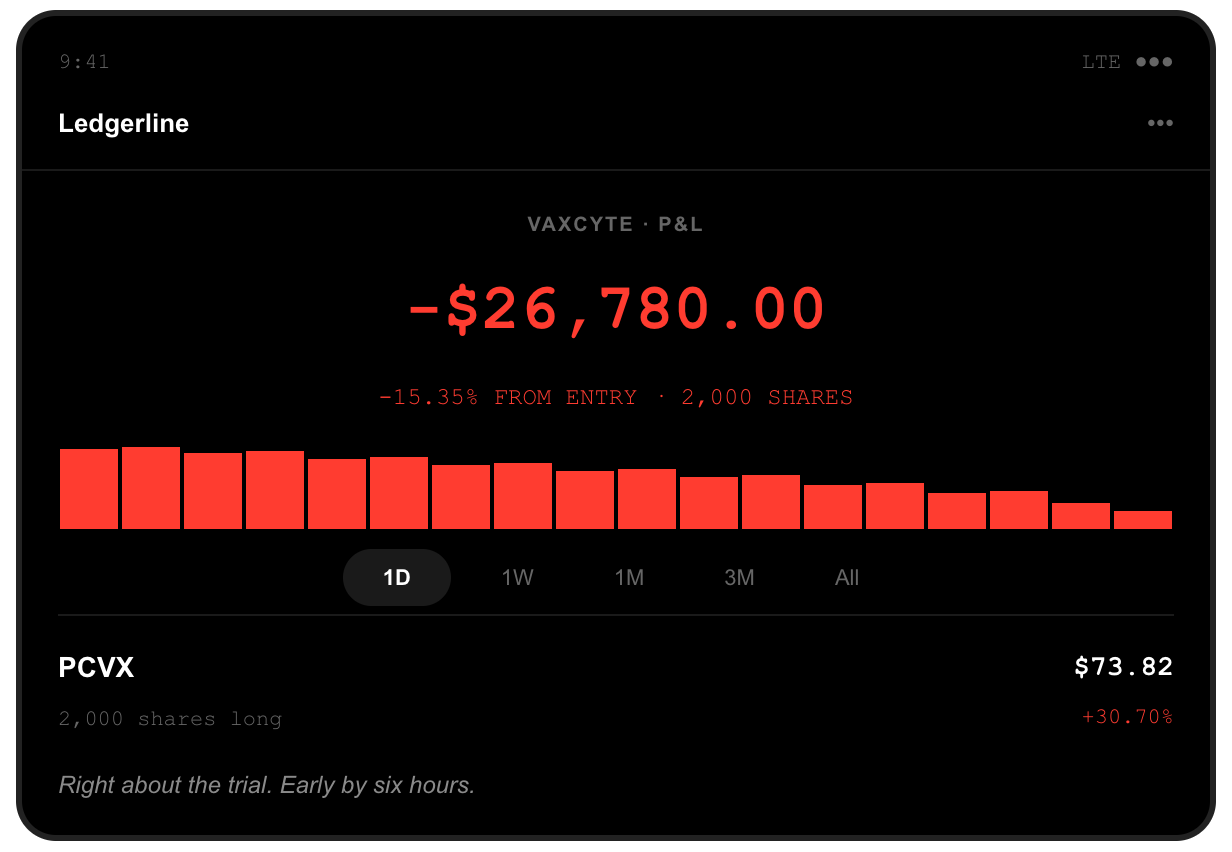
Casualty #2: The Man Who Was Right At 9:30 u/i_bought_the_phase_three bought 2,000 shares of Vaxcyte at $87.21 in the first minutes of Monday's session, about $174,420. He had every reason to. Before the open, the company reported topline data from OPUS-1, the pivotal adult Phase 3 trial of its thirty-one-valent pneumococcal vaccine. It met all thirty-two pre-specified primary immunogenicity assessments. It immunobridged across age groups. Safety was comparable to the existing vaccines. This is not a hedged result. Jefferies called it the blue-sky case and sized the opportunity at $3 billion to $6 billion of the pneumococcal market. Needham went to $122 from $110 and Guggenheim to $125 from $116. The stock opened enormously higher, traded as high as $90.75, and then spent the rest of the day going down. Vaxcyte closed at $73.82, up 30.70% on the day and down $13.39 from where he bought it. 2,000 shares is $26,780. He was right about the science, right about the company and right about the direction. He was wrong about one thing only, which was the minute. Then, after the close, Vaxcyte launched a $1.0 billion raise: $500 million of stock and pre-funded warrants alongside $500 million of convertible notes due 2032. The shares fell another 3.3% in after-hours trading. Perfect data is also the best moment a company will ever have to sell you more of itself.
Here's the thing. The opening auction after a binary readout is not a market price in the usual sense. It is the clearing level for everyone who decided overnight that they must own the stock today, matched against the far smaller group willing to sell into a result nobody has finished reading. That imbalance resolves over hours, not seconds, and it resolves downward almost every time, because the buyers who had to be there are gone by ten and the sellers keep arriving. The thing to understand about a 30% close is that it is still an enormous day. The loss here belongs entirely to the decision about when, not the decision about what. That is the part worth understanding, and it cost him $26,780 to learn that good news is free and the price of acting on it immediately is not.
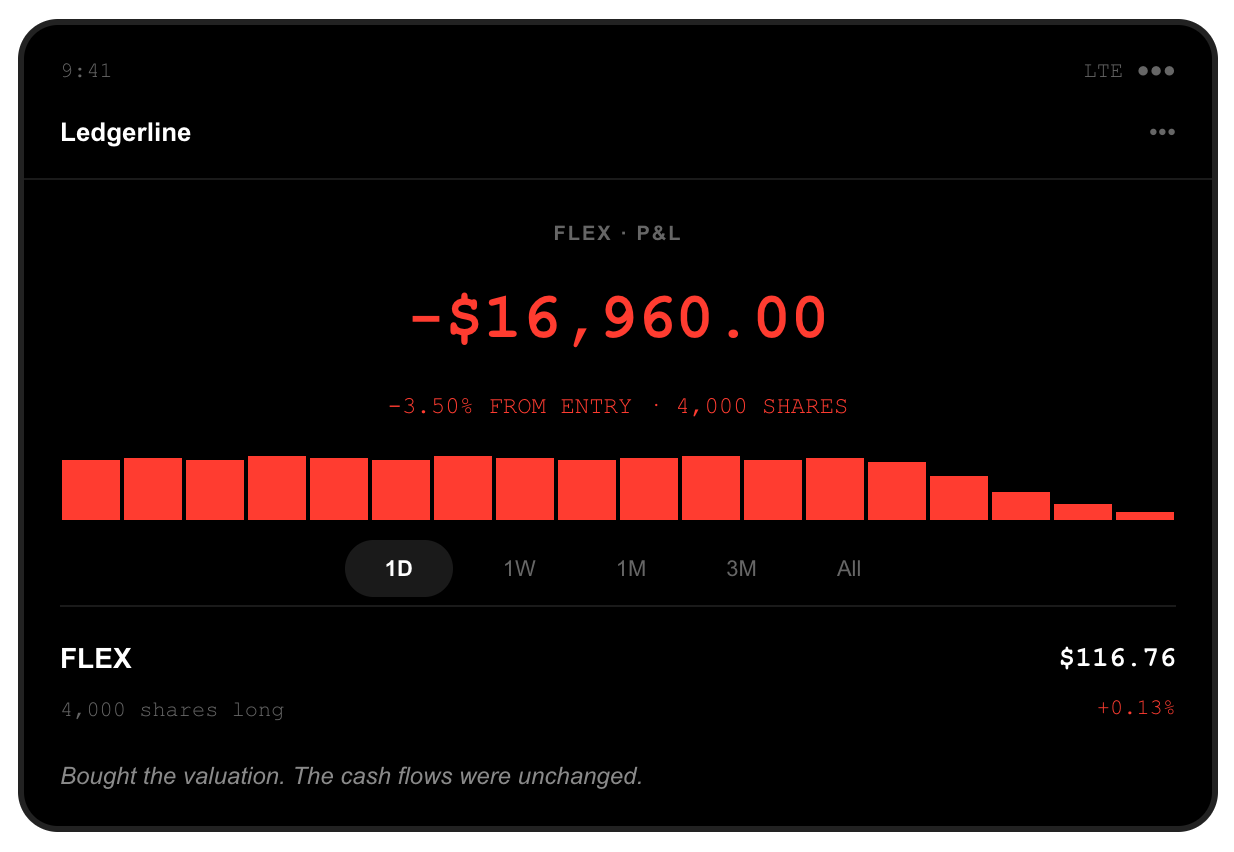
Casualty #3: The Man Who Bought A Valuation u/parts_are_worth_more bought 4,000 shares of Flex at $121.00 on Monday morning, about $484,000, after what looked like the clearest sum-of-the-parts news of the year. Flex announced a $2.0 billion convertible preferred investment into Axiom, its cloud and power infrastructure business, led by General Catalyst alongside Koch Equity Development. The investment put an initial enterprise value of $37.5 billion on Axiom. Flex, the entire company, was worth about $46.2 billion on an enterprise basis at Monday's close. So an outside investor had just written down a number for one division worth roughly four-fifths of the parent. Axiom is due to be separated in the first quarter of 2027. The arithmetic looked like free money and the stock agreed for about an hour. Flex traded as high as $121.48 and closed at $116.76, up 15 cents, or 0.13%. 4,000 shares, down $4.24 each from where he bought, is $16,960. There is a detail in the terms that explains some of it. The preferred pays 10.0% a year in cash before the separation, dropping to 6.0% cash or 7.0% in kind afterwards. Some of the proceeds go to funding Axiom's pending $4.4 billion EPC Power acquisition and repaying bridge financing, which is to say the $2 billion is expensive money with jobs already assigned to it.
The mistake here is treating a valuation as though it were a cash flow. Nothing about what Flex earns changed on Monday. A sophisticated investor agreed a price for a minority stake in a division, which is information about what that division might fetch, not money arriving in anybody's account. And the market had plenty of time to think about it. The separation has been public for weeks and the registration statement was filed on September 15. A sum-of-the-parts case only pays you if the market has not already done the sum. When a stock is up about 108% in twelve months, assume it has. That is the part worth understanding, and it cost him $16,960 to learn that a number in a press release is a measurement, not a transfer.
THIS WEEK BY THE NUMBERS 📏 We track the data because the data is funnier than anything we could make up.
The S&P 500 rose 0.7% to 7,773.95, the Dow 0.2% to 51,267.90, the Nasdaq 1.1% to 27,477.31 and the Russell 2000 0.5% to 2,847.14. The Nasdaq closed at a record. The S&P finished within 0.3% of the high it set in the summer, and Nvidia closed at a record for the third straight session. Three more things from Monday.
An index at a record, a services survey with a 74 handle on prices, and a bond market demanding more to lend for thirty years is three different opinions about the same economy.
BITE-SIZED COPIUM FOR THE ROAD 😔 The best part of any loss thread isn't the screenshot, it's the comments section. Here are this week's greatest hits.
Translation: four people who read the news correctly and misjudged what was left in it for them.
DUMB MEMES 😹 Every newsletter needs a meme section. Ours just hits different when every catalyst on the page was somebody else's win.
POV: you sized a coin flip like a conclusion
nobody tell him what an opening auction is for If you laughed, you're coping. If you didn't laugh, take the next piece of good news you plan to trade and decide, before it lands, what price would make it a bad buy. See you next issue. Good news. Wrong side of it. Traders and P&L screenshots are satirical composites. Market data, price moves and quotations are real and dated October 2 to October 5, 2026. Not financial advice. Obviously. Look at us. Stay liquid, |
Everything on this page was good news. For somebody else.
An election surprised, a vaccine trial hit every endpoint, a logistics company bought a rival at a 29% premium, and an investor put $37.5 billion on a division nobody can buy yet. Four traders were standing on the far side of all of it.