GM. This is The Financial Darwin Awards, the only financial newsletter with a 100% loss rate. Tuesday was a record day. The S&P 500 and the Nasdaq both closed at all-time highs, ten of the eleven sectors rose, and the Russell 2000 quietly fell 0.59%. Four traders lost $135,710 between them, and all four were holding a reason that had already finished happening. The index buying was done by Monday night, and the new price target was reached within pennies and then abandoned. The outbreak was assessed and downgraded by the people whose job that is. And one of them bought a record high on information that had been sitting in a court filing since June. The traders are composites. The moves are not. Here's what we've got today:
THIS WEEK'S DAMAGE REPORT 📑
The first number is the sum of the four stories below. The second is the day before Twilio joined the S&P 500, when the index funds did their buying. On Tuesday, the day it actually joined, 4.0 million shares traded and the stock fell 6.81%.
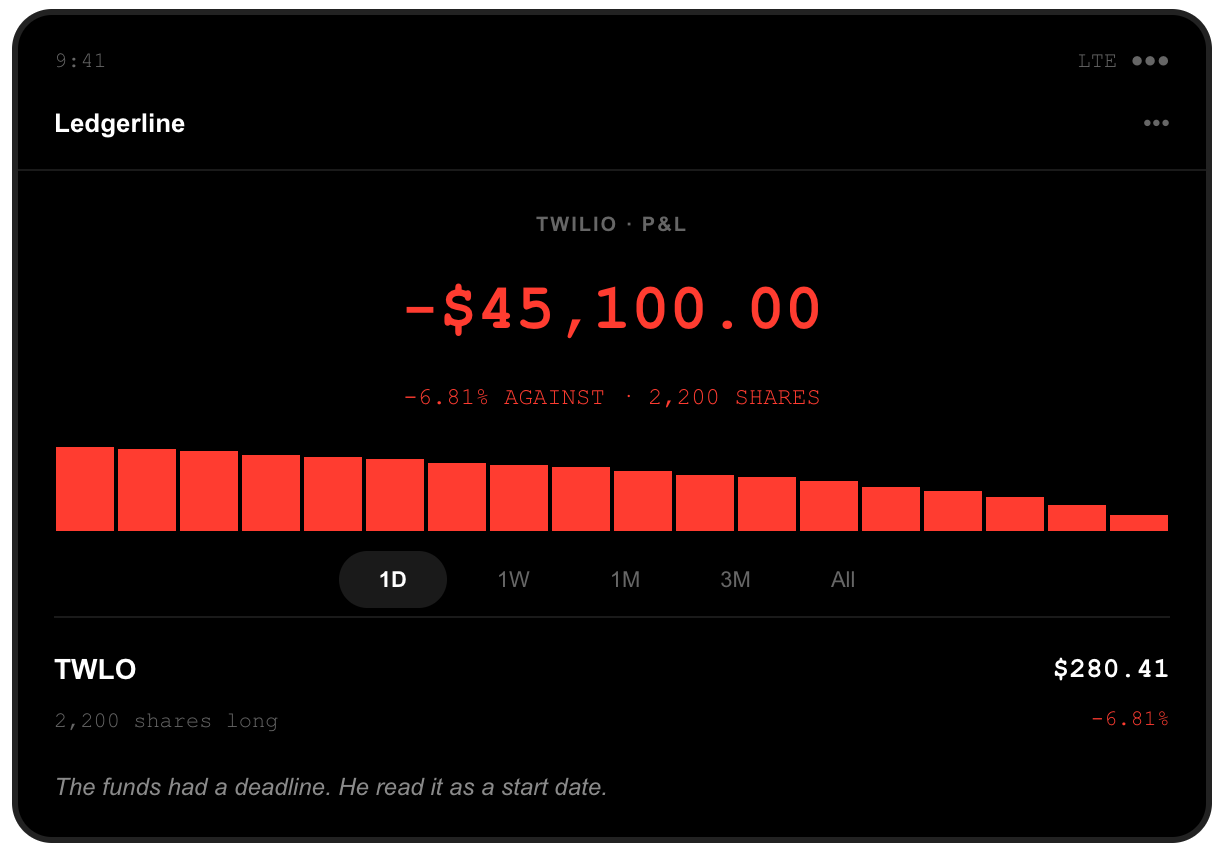
DARWIN AWARD OF THE WEEK 🏆 Every issue we crown the single worst financial decision on the internet. This week it goes to a man who bought a stock because index funds had to buy it, during the very hour they were buying it. Here's the setup. u/effective_at_the_open owned 2,200 shares of Twilio from Monday's close of $300.91, about $662,002. The thesis was mechanical and, as far as it went, correct. On October 1, S&P Dow Jones Indices announced that Twilio would join the S&P 500 effective before the open on October 6, replacing Warner Bros. Discovery. The seat came free because Paramount completed its acquisition of that company on the very same day. Every fund tracking the index now had to own Twilio. That is billions of dollars of buying with a published deadline, which is about as close to a sure thing as a stock market offers. He was right that the buying would happen. He was wrong that any of it was left for him. Look at the volume.
The index funds bought on Monday, because that is what index funds do: they match the index at the close before the change takes effect, so their tracking error is zero on day one. By Tuesday morning there was nobody left who had to buy anything. Twilio printed a 52-week high of $308.40 on its first day as a member and closed at $280.41, down $20.50, or 6.81%. 2,200 shares is $45,100. Volume on the day it joined the most-tracked index in the world was one-eighth of the volume on the day before.
Here's the thing. An index addition is the most thoroughly telegraphed buying event in public markets, and that is exactly why there is nothing in it. The announcement comes with a date on it and everybody can read it. The demand is large, known and entirely in the past by the time the membership actually begins. There is a second layer that makes this worse than a simple timing error. The price he paid on Monday was set by the index funds themselves. He was not buying ahead of the flow. He was buying in the middle of it, from traders who had bought it in the first week of October and were selling into the only guaranteed bid of the year. That is the part worth understanding, and it cost him $45,100 to learn that a known buyer with a published deadline is not an opportunity, it is a counterparty.
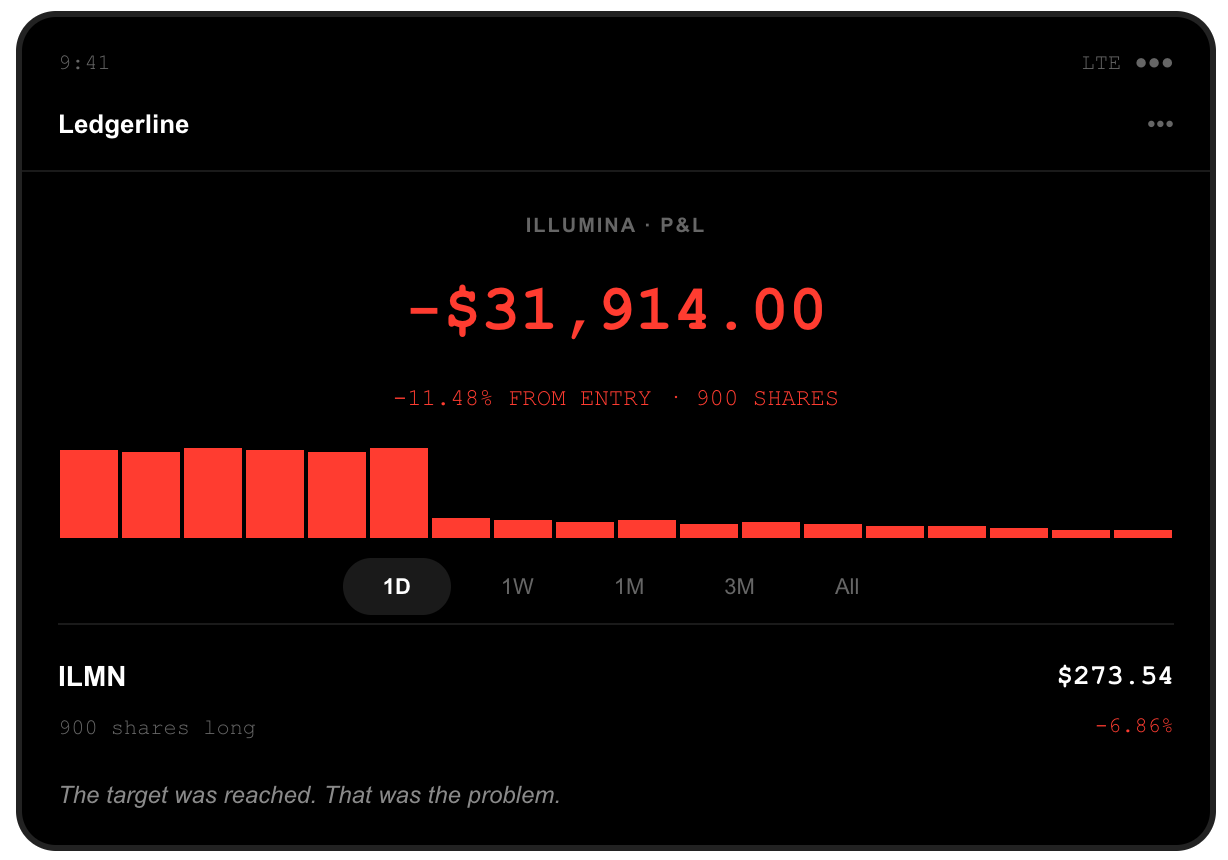
THIS WEEK'S CASUALTIES 💀 Not everybody can be Darwin Award of the week. These three gave it a real shot. Let's run through the tape. Casualty #1: The Man Who Got The Target On Monday, RBC Capital raised its price target on Illumina to $310 from $230, and the stock rose 7.56% to a fresh high. u/the_target_was_three_ten bought 900 shares at $309.00 on Tuesday morning, about $278,100, as the stock went looking for the rest of it. It got within 65 cents. Illumina printed $309.35, which was the high of the year, and then spent the rest of the session falling. It closed at $273.54, down $20.15, or 6.86%, which is a low of $271.55 and change. 900 shares, down $35.46 each from where he bought, is $31,914. RBC was not alone, either. Guggenheim and Piper Sandler had both moved to $305. Here is the number none of them changed. The average price target across the whole analyst group is $223.85, which is 18% below Tuesday's close and 28% below where he bought. Three houses had raised their targets into a stock that was already trading well above what everybody else thought it was worth.
The useful distinction is between a price target and a price. A target is a forecast with a twelve-month horizon attached, published by one analyst at one bank. When a stock reaches it in two sessions, the forecast has not been validated. It has been consumed. And there is a mechanical reason the target acts as a ceiling rather than a floor. Everybody who bought on the upgrade now has their profit, the analyst who published it has no further room to be bullish without writing another note, and the next buyer has to believe something nobody has written down yet. That is the part worth understanding, and it cost him $31,914 to learn that the most dangerous moment for a price target is the minute it is hit.
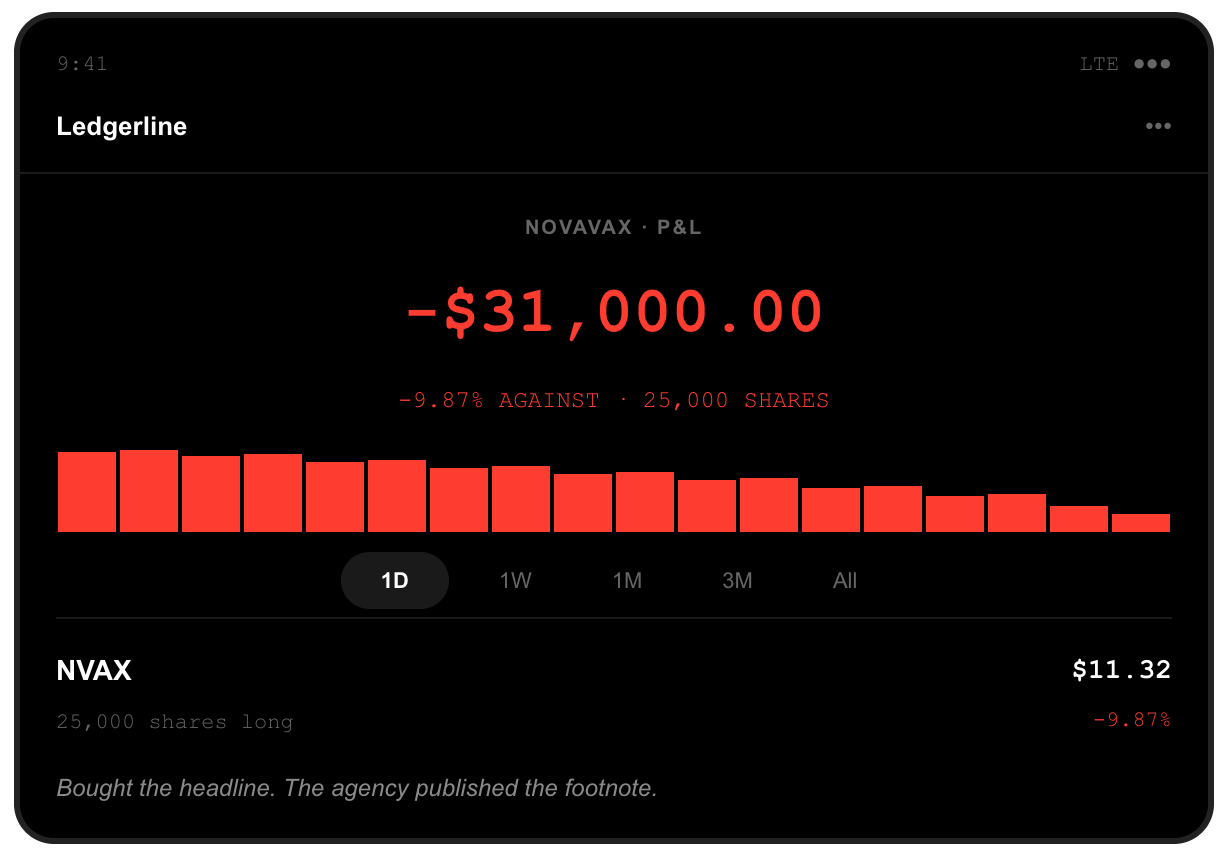
Casualty #2: The Man Who Bought A Plague Last week a 28-year-old laboratory technician at the Irkutsk Anti-Plague Research Institute of Siberia and the Far East died of pneumonia of unknown origin. The World Health Organization began investigating whether pneumonic plague had caused it. On Monday, vaccine stocks went vertical. Novavax rose 20% and Moderna rose 7%. u/i_bought_the_outbreak bought 25,000 shares of Novavax at Monday's close of $12.56, about $314,000, on the second day of a story he had learned about on the first. On Tuesday the WHO spokesperson, Christian Lindmeier, gave the assessment. The risk, he said, is "moderate to low for Irkutsk, a low risk for the Russian Federation as a whole and very low for the WHO European region." Of the contacts identified and monitored, "none to date have shown symptoms of illness." Novavax closed at $11.32, down $1.24, or 9.87%. 25,000 shares is $31,000. Moderna fell 7.75% beside it. Pfizer did not move and BioNTech fell about 2%. That last detail is the one worth keeping. The company with the largest vaccine business in the world was unchanged. The two with the most speculative shareholders did all of the moving, in both directions.
Here's the thing. An outbreak trade is a bet on uncertainty rather than on an outcome, and uncertainty has a very short shelf life once professionals start looking. The entire move was the gap between a frightening headline and an assessment nobody had made yet, and public health agencies are quite fast at making assessments. Look at who moved and who did not. Pfizer, which manufactures vaccines at a scale neither of Monday's winners approaches, finished the session unchanged. The stocks that moved were the ones whose shareholders are there for the next headline, which tells you that this was never a trade about vaccines. That is the part worth understanding, and it cost him $31,000 to learn that buying fear on day two means paying somebody who bought it on day one, in a position whose thesis is that nothing gets clarified.
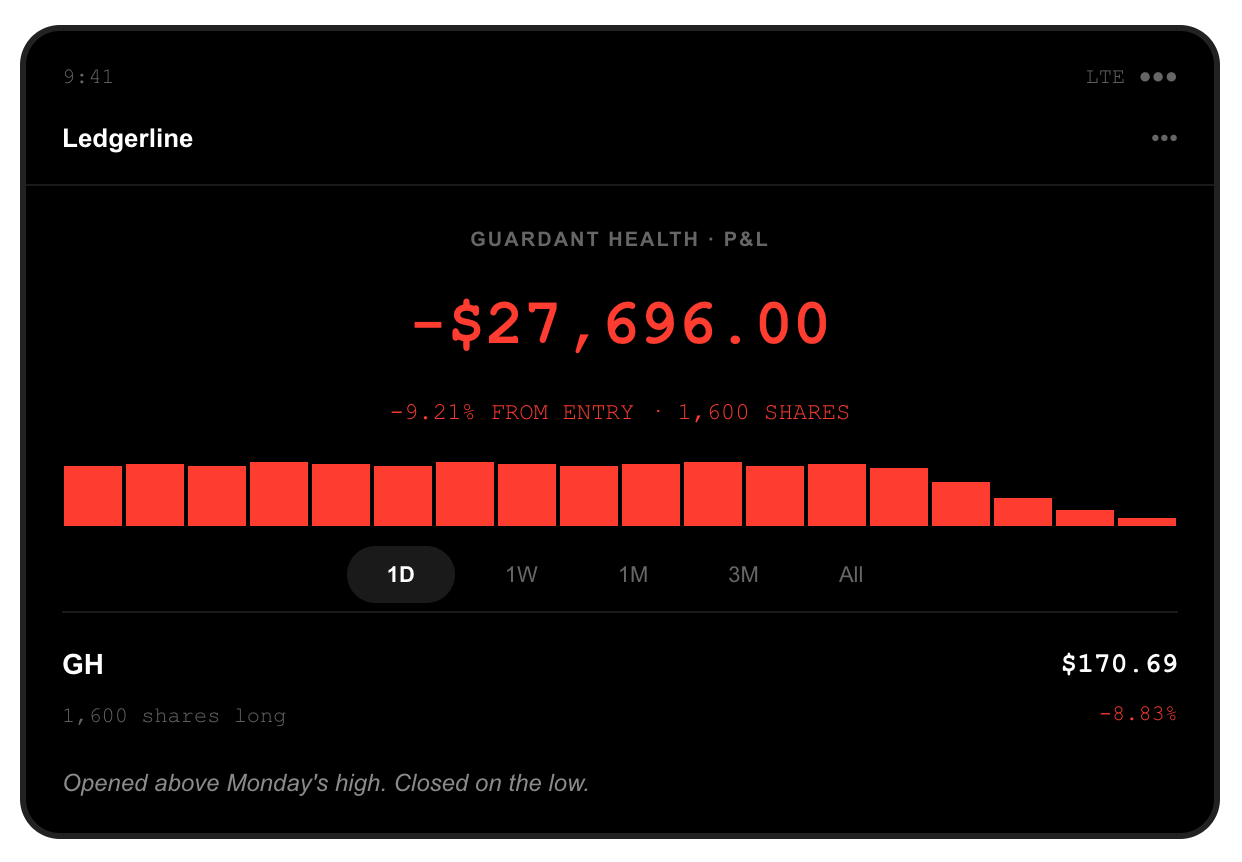
Casualty #3: The Man Who Bought The High u/opened_at_an_all_time_high bought 1,600 shares of Guardant Health at Tuesday's open of $188.00, about $300,800. The setup was momentum and nothing else. The stock had risen 1.75% on Friday and 5.30% on Monday, closing Monday at $187.22, which was 47 cents off the top of Monday's range. Tuesday opened higher still, ran to $191.05, and that was a 52-week high. Guardant Health closed at $170.69, down $16.53, or 8.83%, and 64 cents off the low of the day. 1,600 shares, down $17.31 each, is $27,696. Volume doubled, from 1.7 million shares to 3.4 million. There was no announcement, no filing, no downgrade and no data. Here is what was already public, and had been since June. A federal court in Delaware entered judgment against Guardant for $245.2 million in a DNA sequencing patent case brought by TwinStrand Biosciences and the University of Washington. The judgment also carries a 6% ongoing royalty on eleven products through March 2033. The company strongly disagrees and is appealing. None of that was news on Tuesday. It was simply true, and had been true for four months, while the stock went to a record.
A session that opens at its high, closes at its low and doubles its volume is not a mystery just because no headline explains it. It is the shape of somebody large deciding to be finished, and the absence of news is what makes it legible rather than what makes it strange. When there is a catalyst, a fall tells you what the market now thinks about that catalyst. When there is none, a fall on double volume tells you about supply, and supply at a record high is the only thing a record high can produce. The other half of this is the judgment. A $245.2 million liability and a royalty running to 2033 does not become urgent on any particular day, so it never generates a headline and it never stops being true. That is the part worth understanding, and it cost him $27,696 to learn that the information you have not read is more dangerous than the information you disagree with.
THIS WEEK BY THE NUMBERS 💯 We track the data because the data is funnier than anything we could make up.
The stock that got demoted on Tuesday rose 12.27%. The one that got promoted fell 6.81%. Corteva closed at $13.91 in its first session as a member of the S&P MidCap 400, having been dropped from the S&P 500 the week before when it spun off its seed business. It did not rise because of the index change, either. JPMorgan upgraded it to overweight that morning. Which is the whole point. A research note moved the demoted stock up 12%, and membership of the largest index in the world moved the promoted one down 7%. If you had done the obvious index trade in both directions on Tuesday, you would have been wrong twice. The S&P 500 rose 0.58% to 7,818.93 and the Nasdaq 0.45% to 27,599.79, both records. The Dow rose 0.49% to 51,521.28 and the Russell 2000 fell 0.59% to 2,830.30. Utilities led, up 2.98%, because Google agreed to buy 3.6 gigawatts of nuclear power from Constellation Energy over twenty years. Constellation rose 12.25%, Vistra 10.77% and NRG 7.02%. Three more things from Tuesday.
A record close in two indexes, the widest trade deficit in eighteen months and a long bond at 5.64% is a market that has decided to look at exactly one of those three things.
BITE-SIZED COPIUM FOR THE ROAD 😳 The best part of any loss thread isn't the screenshot, it's the comments section. Here are this week's greatest hits.
Translation: four people who bought the part of the story that was already over.
DUMB MEMES 😆 Every newsletter needs a meme section. Ours just hits different when two indexes closed at records and this page still filled itself.
POV: the buying finished before you started
the target was a ceiling, not a floor If you laughed, you're coping. If you didn't laugh, take the next sure thing you hear about and work out who already owns it. See you next issue. Every reason on this page had already finished. Traders and P&L screenshots are satirical composites. Market data, price moves and quotations are real and dated October 1 to October 6, 2026. Not financial advice. Obviously. Look at us. Stay liquid, |
Twilio joined the S&P 500 on Tuesday morning and fell 6.81% by the close.
The index funds had finished buying on Monday. A price target was reached in the first minute and never seen again. A plague scare was assessed and downgraded. And a stock went to a record high on information that had been public since June.