GM. This is The Financial Darwin Awards, the only financial newsletter with a 100% loss rate. Wednesday closed the quarter in the most confusing way available. Inflation came in below forecast on every measure it has, and the ten-year Treasury yield traded above 5.30% for the first time since 2002. Both of those things are true, and the gap between them is the first story below. The other three are about documents: one published after the closing bell, one nobody is allowed to read, and one read in the wrong order. Four traders lost $93,033 between them, and the one who lost the least made the worst decision. He got the forecast right. He had simply not read the footnote explaining why it was going to be wrong. The traders are composites. The moves are not. Here's what we've got today:
THIS WEEK'S DAMAGE REPORT 📉
The first number is the sum of the four stories below. The second is the whole issue: August core PCE printed 3.0% against a 3.3% forecast, and the same morning's revision put July at 3.0% too. The forecast was the old July number.
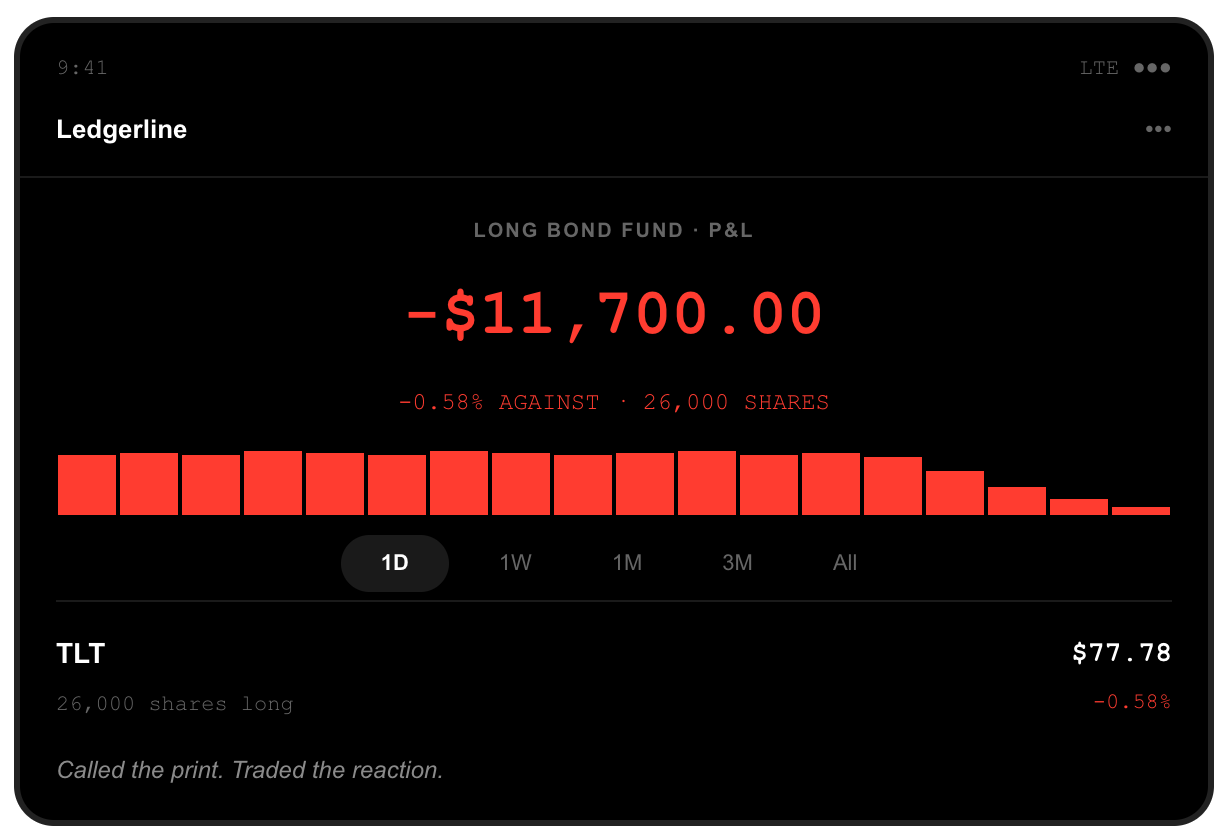
DARWIN AWARD OF THE WEEK 🏆 Every issue we crown the single worst financial decision on the internet. This week it goes to a man who predicted the inflation number correctly and lost money on it anyway. Here's the setup. u/the_print_came_in_cooler bought 26,000 shares of the twenty-year-plus Treasury bond fund on Tuesday afternoon, on margin, about $2.0 million at that day's close of $78.23. He bought it for one reason. The August inflation report was due at 8:30 the next morning, he thought it would be soft, and soft inflation is supposed to stop bonds falling. He was right about the number. All four of them, in fact.
A clean sweep. The ten-year yield fell in the first minutes after the release. Then the market read the rest of the release. That same morning the Bureau of Economic Analysis published its 2026 annual update, which changed how it measures prices in three service categories: portfolio management and investment advice, legal services, and computer software. The change is retroactive to 2021. It lowered July's core reading from 3.3% to 3.0%, and July's headline from 3.7% to 3.4%. August printed 3.0% and 3.4%, which is exactly where July had just been moved to. Inflation did not slow in August at all, and the forecasts had been collected against the old series. On the monthly series it was worse than flat. Core prices rose 0.2% in August against a revised 0.1% in July, which is an acceleration. None of this was a surprise to anyone who had been reading. RBC Economics published a note on September 24 warning against reading Wednesday's number as disinflation, and put the effect at about 18 basis points on the annual pace of core. Goldman Sachs and JPMorgan had published their own estimates of the same thing in June, at about 20 basis points and about 10. All three undershot. The revision took a full 30 basis points off July, which means there was something genuinely new in Wednesday's number, just nowhere near as much as a 3.3% forecast implied. Meanwhile the parts of the morning that were actually new were both strong. ADP had counted 90,000 private jobs in September against a forecast of 70,000, and a separate release at the same hour revised second-quarter growth up to 2.2% from 1.5%. The ten-year crossed 5.30% intraday, a level it had not seen in 24 years, and rose about five basis points on the session to 5.29%. The thirty-year went to about 5.63% from 5.59%. The fund closed at $77.78, down 45 cents, or 0.58%, at a 52-week low. 26,000 shares, down $0.45 each, is $11,700. It is the smallest loss on this page. It is also the only one where the man had the answer in advance and traded the wrong half of it.
Here's the thing. A scheduled data release is not one event, it is two, and most people only trade the first. The first is the number. The second is the distance between that number and what was already in the price, which is the only one the market pays out on. On Wednesday those two pointed in opposite directions, because the number was soft and the distance was close to zero. The softness had been published as a methodology note in June and priced by three research desks before the release. And the genuinely new information pointed the other way: growth in the spring revised up by seven tenths, hiring above forecast, and a saving rate down to 4.1% from 4.6%. That is the part worth understanding, and it cost him $11,700 to learn that a forecast you can make from a public footnote is mostly consensus with a delay on it.
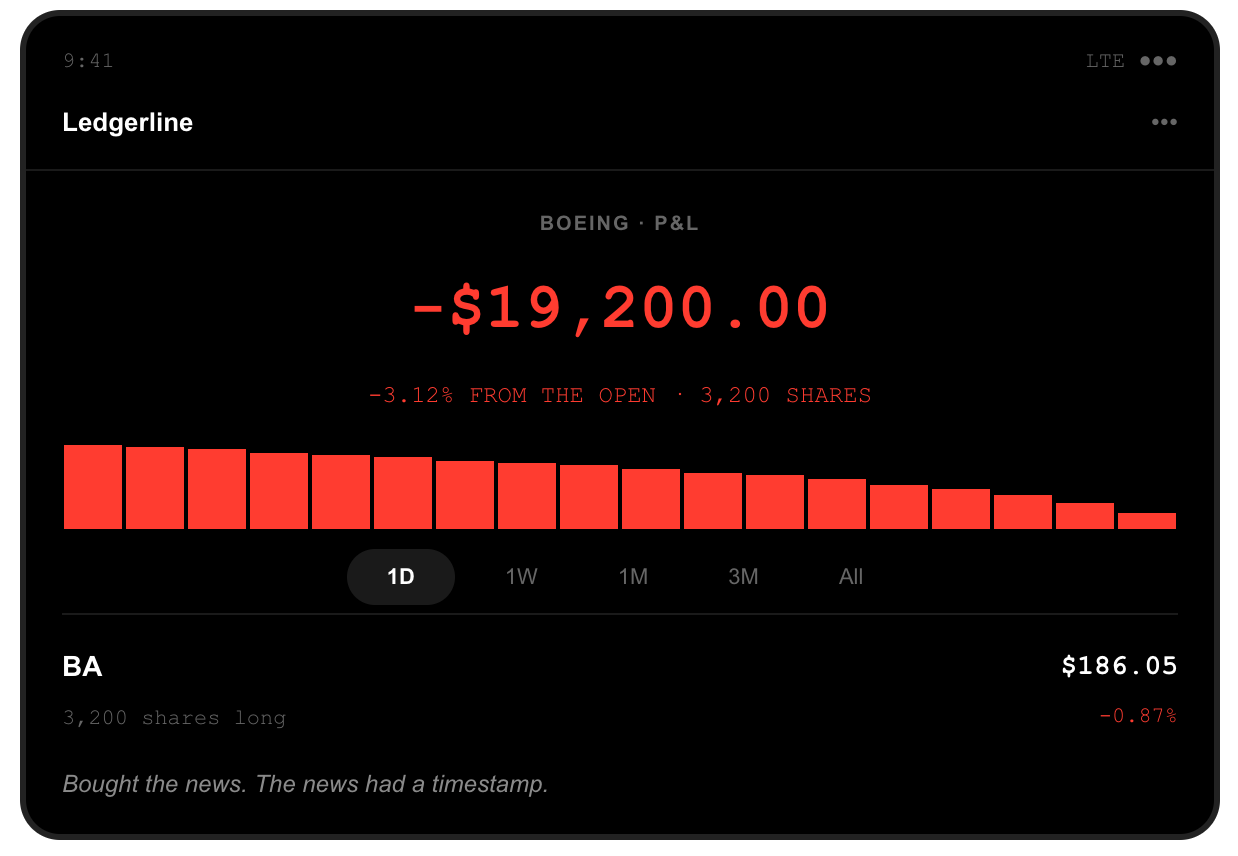
THIS WEEK'S CASUALTIES 💀 Not everybody can be Darwin Award of the week. These three gave it a real shot. Let's run through the tape. Casualty #1: The Man Who Bought The Winner u/i_bought_the_contract_win bought 3,200 shares of Boeing at Wednesday's opening print of $192.05, about $615,000. He had a reason, and it was a good one. On Tuesday evening the US Navy selected Boeing to build the F/A-XX, its sixth-generation carrier fighter, in a development contract reported at more than $20 billion. It replaces the Super Hornet, and Boeing already holds the Air Force equivalent, so one company now has both American sixth-generation fighter programs. The timing is the whole story. The award was announced at about 5:40 in the evening, roughly 100 minutes after Tuesday's close, so the news had fifteen and a half hours to find every buyer who wanted it before the exchange opened. Boeing opened at $192.05, up 2.3%, and touched $192.99 in the first minutes. Then it went down for the rest of the day. Boeing closed at $186.05, down $1.63, or 0.87%, below Tuesday's close of $187.68 and below where it traded before anybody knew it had won. 3,200 shares, down $6.00 each from the open, is $19,200.
Here's the thing. Good news released into a closed market does not wait politely for the opening bell, it gets priced overnight by the people who can trade it. The opening print is already the answer rather than the question. There is a second layer that matters more than the timing. Nobody has disclosed whether this contract is cost-plus or fixed-price, because Boeing says the programmatic details are classified. That is not a footnote for this company. Fixed-price development contracts are the mechanism that has cost Boeing billions on defense programs over the past decade. So the market spent Wednesday holding a $20 billion award with no way to know whether it is a profit stream or an obligation, and marked it accordingly. That is the part worth understanding, and it cost him $19,200 to learn that the size of a contract tells you about revenue, and the structure of it tells you about everything else.
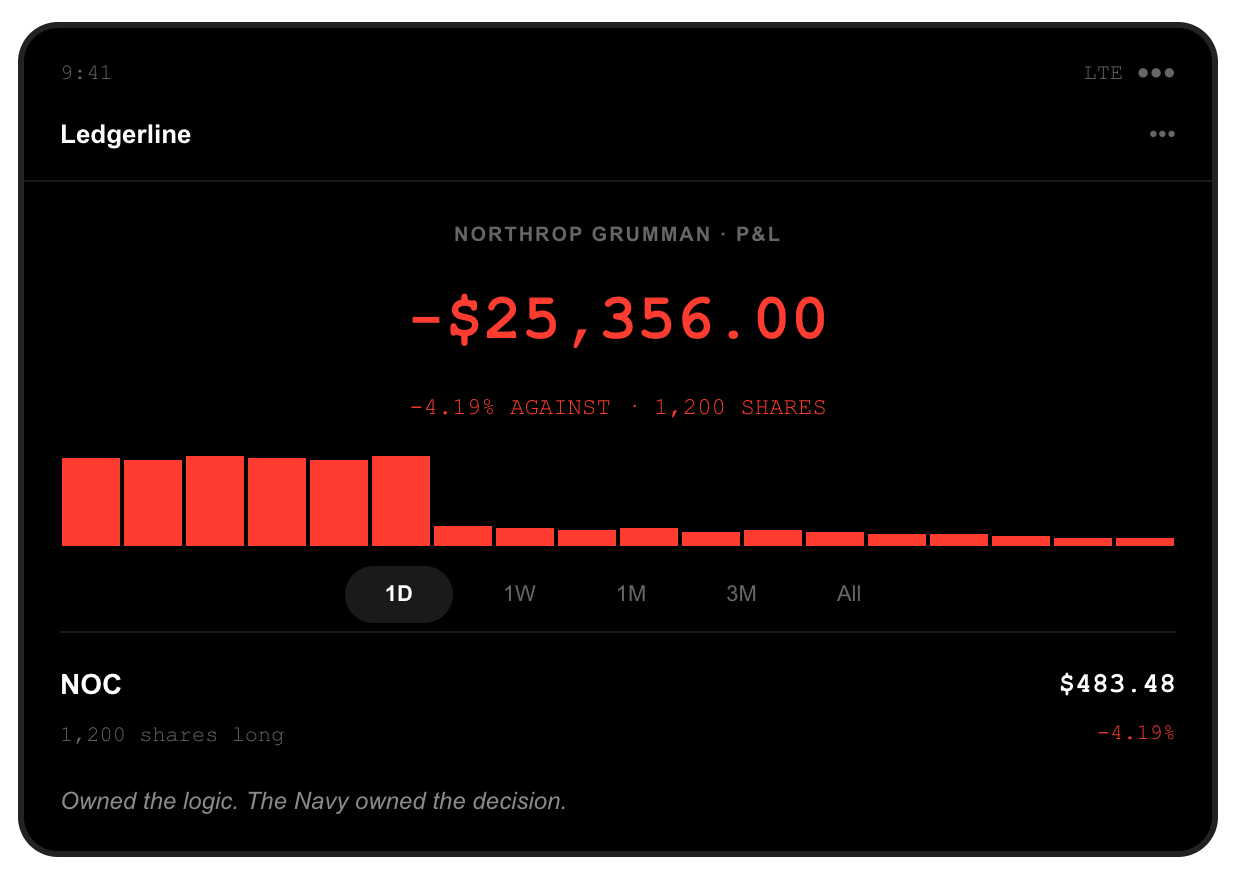
Casualty #2: The Man Who Owned The Favorite u/boeing_cannot_build_both owned 1,200 shares of Northrop Grumman, about $605,000 at Tuesday's close of $504.61. His thesis was the street's thesis, and it had a respectable origin. In March 2025 Lockheed Martin was eliminated from the Navy competition, and in the same month Boeing won the Air Force's sixth-generation fighter. Analysts at RBC Capital wrote at the time that the Air Force win made Northrop the favorite for the Navy one. The argument was industrial capacity. No American manufacturer had built two clean-sheet sixth-generation fighters at once, so the company that had just taken the first order could not plausibly take the second. Here is the part the argument left out, and it was on the public record the whole time. The Navy's most senior officer had said one of the contractors on this program could not deliver in the timeframe the Navy needed, and named nobody. It was reported at the time as a remark about Northrop. So the one piece of public evidence about capacity pointed at the company the consensus was long, not at the one it had ruled out. The program itself nearly died. The Pentagon tried to shelve it in mid-2025 with about $75 million, and Congress put roughly $897 million back and barred any spending on a pause or a cancellation. The Navy had told everyone it would decide by August 2026. It announced on September 29, a month late, and gave both fighters to the same company. Northrop opened at $483.00, having closed Tuesday at $504.61, traded in an $8.56 range all day, and closed at $483.48, down $21.13, or 4.19%. 1,200 shares, down $21.13 each, is $25,356. It was the lowest close the stock had seen in at least a year.
Here's the thing. The capacity argument was sound engineering reasoning and completely irrelevant, because it reasoned about the supplier in a decision that belonged to the customer. A buyer weighing two bids is not obliged to accept your model of what the bidders can manage, and this one had already said in public which bidder worried it. Northrop is not in trouble here. It still has the B-21 bomber and the Sentinel missile program, and at least one analyst argued the loss does not significantly damage the company. The fair reading is that the backlog is intact and the growth story got narrower, and the narrowing repriced in a single opening print. That is the part worth understanding, and it cost him $25,356 to learn that a consensus about who should win is not information about who will.
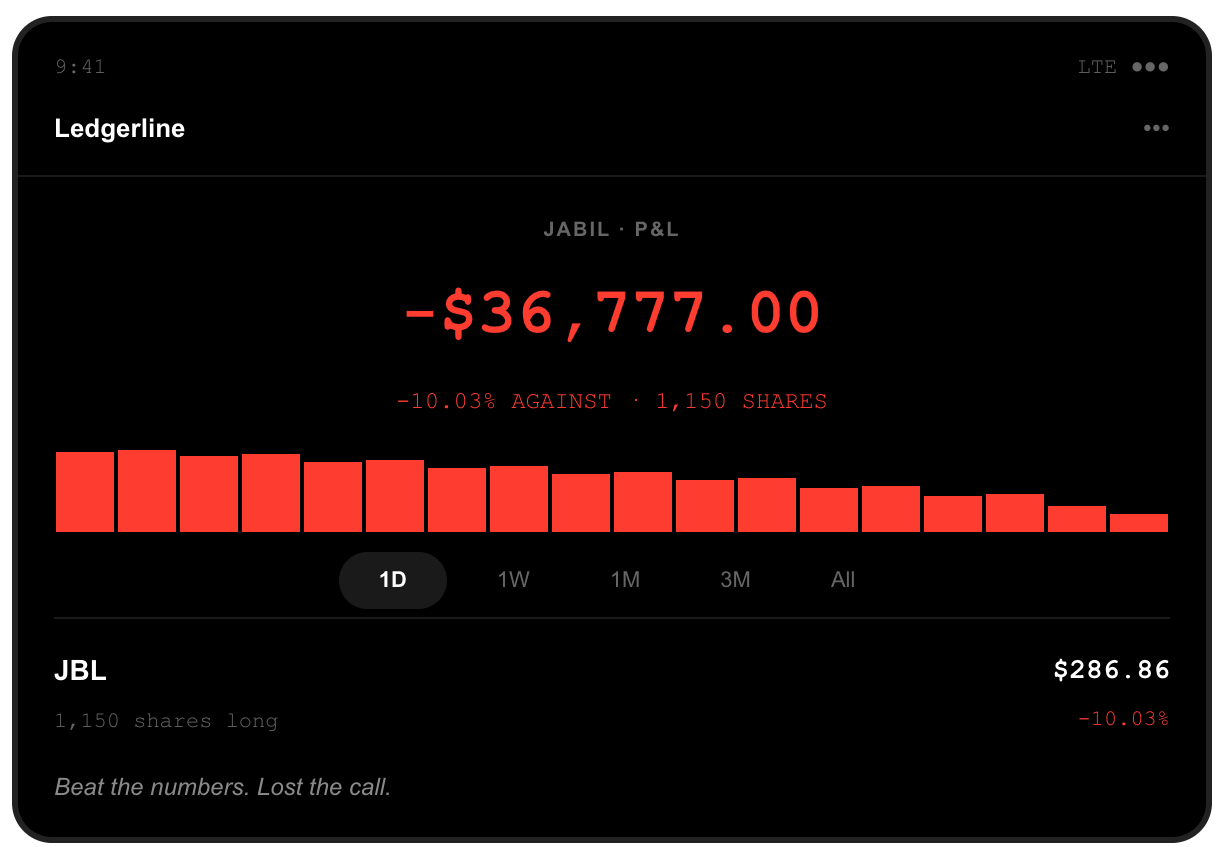
Casualty #3: The Man Who Beat Every Number u/beat_and_raised owned 1,150 shares of Jabil, about $367,000 at Tuesday's close of $318.84. He was holding into a results day and the results were excellent.
Every published number was beaten and the forward numbers were raised. The release and the call both landed before the market opened, which is the detail that explains everything that happened next. On the call, the executive who runs supply chain and procurement, Frank McKay, said the company is seeing real constraints today. Memory in particular, he said, is being reallocated toward artificial intelligence and hyperscale demand, tightening supply across many of the diversified end markets the company serves. Then the exchange opened, and the stock went to three different prices in one session.
Jabil finished down $31.98 on a day it beat on earnings, beat on revenue and raised its outlook. 1,150 shares, down $31.98 each, is $36,777.
Here's the thing. The press release reports a quarter that has finished. The call is where the company describes the ones that have not, and only one of the two is written by the investor relations department with a lawyer present. What makes this disclosure expensive is where it sits. A supply constraint is not a demand problem, so none of the demand figures that just beat are wrong. It is a ceiling. The company can sell more than it can build, and the shortage is in a component being bid away by customers with deeper pockets than the diversified business has. That is the part worth understanding, and it cost him $36,777 to learn that the company is usually first to publish the bear case, in the half of the event nobody models.
THIS WEEK BY THE NUMBERS 🧮 We track the data because the data is funnier than anything we could make up.
The S&P 500 fell 0.3% to 7,651.54 on Wednesday, the Dow 0.9% to 50,906.05 and the Russell 2000 0.4% to 2,796.86. The Nasdaq rose 0.2% to 26,861.06. Three more numbers from Wednesday morning, for anybody wondering why bonds behaved that way.
An economy growing faster than you thought, hiring more than you thought and funding its consumption out of savings is not one the long end of the bond market enjoys, whatever the inflation line says.
BITE-SIZED COPIUM FOR THE ROAD 🥴 The best part of any loss thread isn't the screenshot, it's the comments section. Here are this week's greatest hits.
Translation: four people who understood their story perfectly and held the wrong end of it.
DUMB MEMES 🙃 Every newsletter needs a meme section. Ours just hits different when the inflation number was below forecast in every direction.
POV: you beat a forecast that was measuring something else
the market, pricing a contract nobody is allowed to read If you laughed, you're coping. If you didn't laugh, take the next scheduled number you plan to trade and write down what would make a correct forecast lose money. See you next issue. The number was lower. Nothing it measures was. Traders and P&L screenshots are satirical composites. Market data, price moves and quotations are real and dated September 29 to September 30, 2026. Not financial advice. Obviously. Look at us. Stay liquid, |
Inflation came in below forecast on all four measures. The ten-year yield went to a 24-year high.
The August inflation beat was the size of a measurement change the government had announced in advance. Bonds worked it out by lunchtime. Boeing won a $20bn fighter contract and closed down. Northrop lost it and closed down more.