|
GM. This is The Financial Darwin Awards, rounding up the internet's biggest Ls so you don't make them yourself. The Fed raised rates 25 basis points yesterday to 3.75% to 4.00%, its first hike since July 2023. The vote was 12 to 0. Everyone saw it coming. Three people who saw it coming lost money anyway. Three people lost $69,390 between them. None of their positions was actually a bet on the Fed. They just thought it was. The traders are composites. The moves are not. Here's what we've got today:
THIS WEEK'S DAMAGE REPORT 📊
The first number is the sum of the three stories below. The second is real: the national average for diesel reached $6.31 a gallon on Wednesday, an all-time high, after rising nearly 69 cents in the fortnight to September 14.
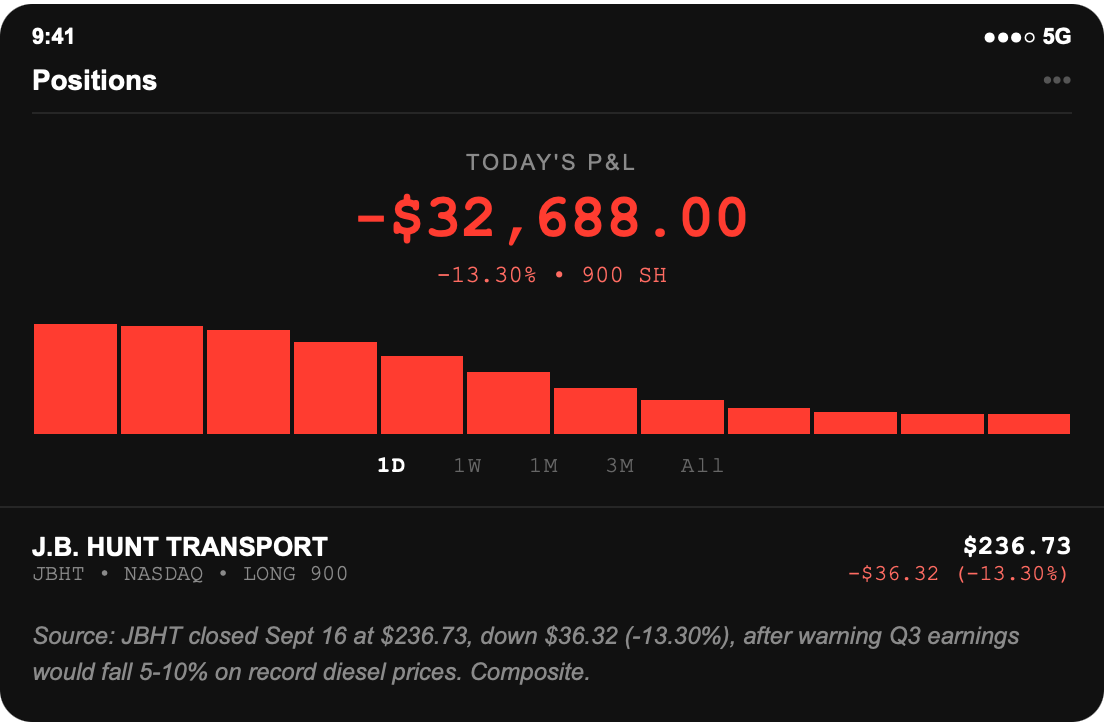
DARWIN AWARD OF THE WEEK 🏆 Every issue we crown the single worst financial decision on the internet. This week it goes to a man who spent the day watching the Fed while his position was being decided at a truck stop. Here's the setup. u/the_surcharge_covers_it owned 900 J.B. Hunt shares, about $245,745, at Tuesday's close of $273.05. His thesis was sound and widely held. Trucking companies bill fuel separately, so when diesel rises the surcharge rises with it and the carrier is roughly neutral. That is true across a year. It is not true across a quarter. Surcharges reset on a lag, they are negotiated against benchmark prices rather than the pump, and on contract freight the customer has already signed. Diesel first crossed $6 a gallon on September 11. On Wednesday the national average hit $6.31, an all-time high, beating the $5.81 record set in June 2022. California went past $8. At a Morgan Stanley conference that morning, finance chief Brad Delco warned that earnings would fall 5% to 10% from the second quarter to the third, citing "some of the most radical and abnormal swings in fuel prices that I think we've ever seen." J.B. Hunt closed at $236.73, down $36.32, or 13.30%. 900 shares, down $36.32 each, is $32,688. He was positioned for a Fed meeting. He was short a commodity he did not know he owned.
Here's the thing. A cost that is contractually passed on is still a cost you carry for the length of the contract, and that gap is where a quarter gets lost. That is the part worth understanding, and it cost him $32,688 to learn that a pass-through is a timing difference, not a hedge.
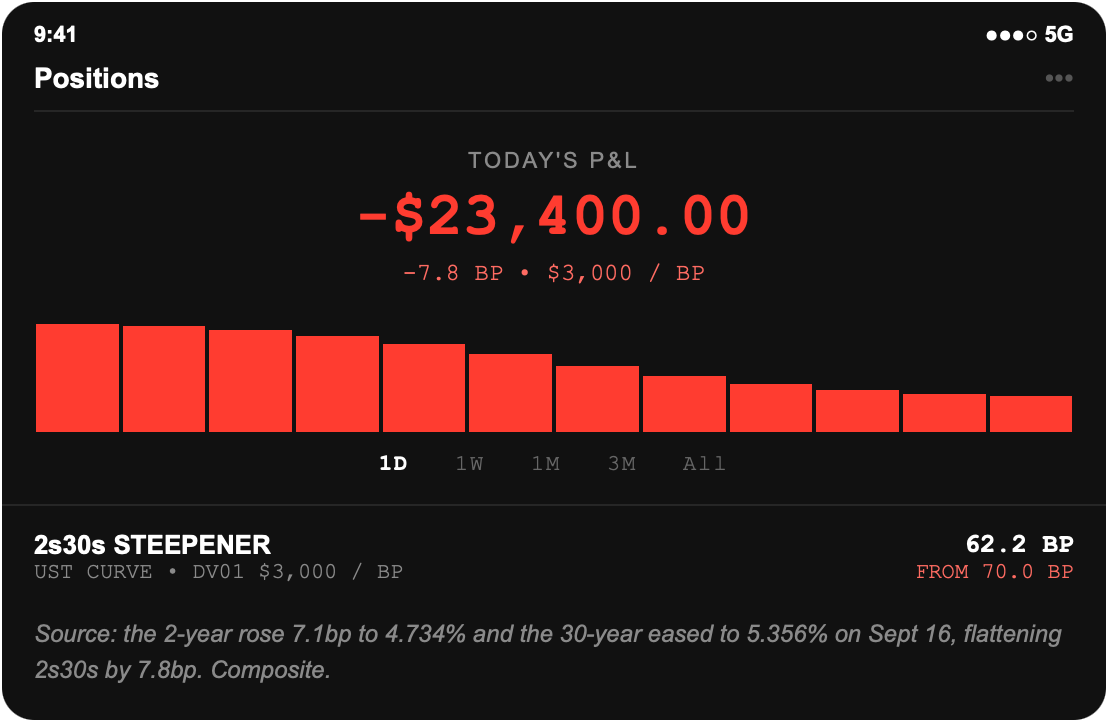
THIS WEEK'S CASUALTIES 💀 Not everybody can be Darwin Award of the week. These two were watching the right event. Casualty #1: The Man Who Was Right About The Fed u/hiking_steepens_it was in a two-year against thirty-year steepener, sized at $3,000 a basis point. The trade is a bet that the gap between short and long yields widens. His reasoning was ordinary and almost right. A central bank hiking into 3% inflation should scare the long end, because bond buyers thirty years out are the ones who pay for inflation. He had the hike correct. The Fed went 25 basis points to 3.75% to 4.00% on a unanimous vote, and the median official in the dot plot put another hike before the year is out. And the long end fell. The two-year rose 7.1 basis points to 4.734%. The thirty-year eased to 5.356%. That is what a credible hike does. The bond market had been asking for one, and a central bank that acts on inflation lowers the inflation you have to be paid for over thirty years. The gap went from 70.0 basis points to 62.2. It flattened by 7.8. 7.8 basis points, at $3,000 each, is $23,400.
Here's the thing. The long end does not price the policy rate, it prices confidence that somebody is minding the policy rate, and those two move in opposite directions. That is the part worth understanding, and it cost him $23,400 to learn that hawkish and steeper are not the same word.
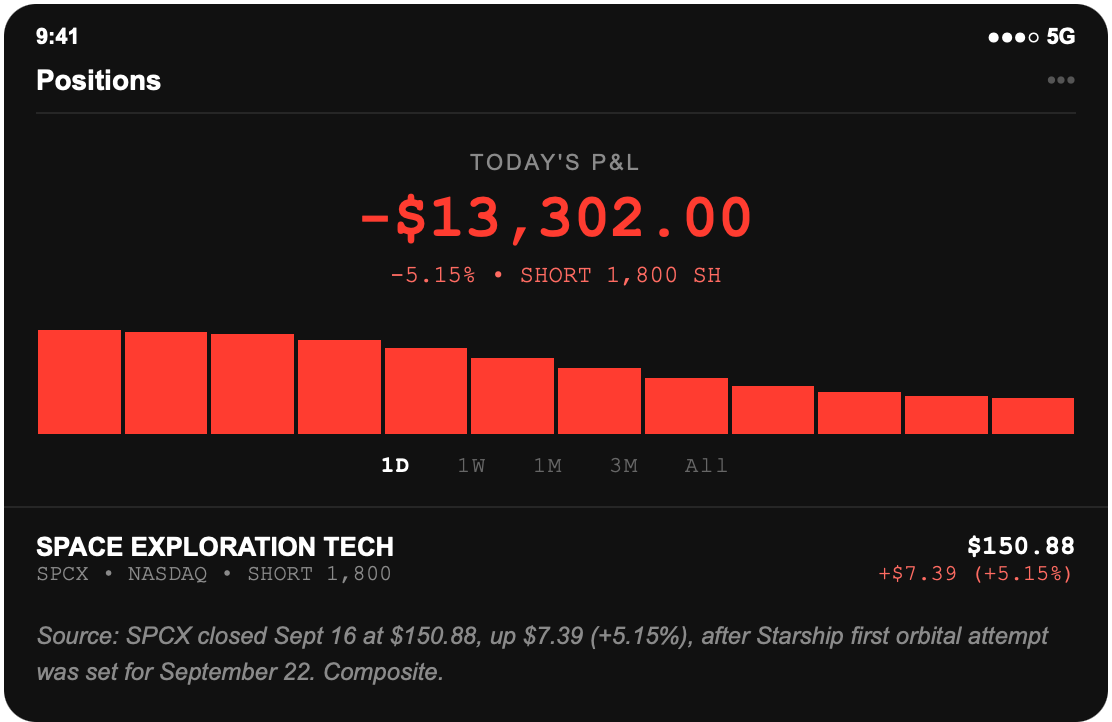
Casualty #2: The Man Who Was Right About The Rocket u/it_always_slips was short 1,800 SpaceX shares, about $258,282, from Tuesday's close of $143.49. His record on the engineering was excellent. Starship timelines had slipped repeatedly, and he had been paid for saying so more than once. On Wednesday, SpaceX did not launch anything. It announced that the first orbital attempt would be on September 22. SpaceX closed at $150.88, up $7.39, or 5.15%. 1,800 shares, against him by $7.39 each, is $13,302. He is still short into a launch that has not happened yet, which is the part he should be thinking about.
Here's the thing. A company with a story and no earnings is repriced by news about the story, and a confirmed date is news even though nothing has been built or proved. That is the part worth understanding, and it cost him $13,302 to learn that a schedule is an event.
THIS WEEK BY THE NUMBERS 📊 We track the data because the data is funnier than anything we could invent.
The Dow fell 631 points, or 1.2%, while the Nasdaq finished almost exactly flat. The index that owns the machinery had a bad day. The index that owns the software did not notice.
BITE-SIZED COPIUM FOR THE ROAD 🍪 The best part of any loss thread is the comments.
Translation: three correct opinions about the world, three wrong opinions about the price.
DUMB MEMES 🤣 Ours hits different when you called the event and still paid.
POV: your hedge resets monthly and diesel does not
u/hiking_steepens_it, right about everything except the sign If you laughed, you're coping. If you didn't, go and work out which input your biggest position is really short of. See you next issue. Everybody called the hike. Nobody got paid. Traders and P&L screenshots are satirical composites. Market data, Federal Reserve decisions and price moves are real and dated September 16, 2026. Not financial advice. Stay liquid, |
Everybody called the hike. Nobody got paid.
The Fed raised rates 25 basis points on a unanimous vote, exactly as priced. A trucker lost 13.30% to diesel at a record $6.31, a curve trade lost money because the hike worked, and a short lost to a launch date. None of the three was really a bet on the Fed.