GM. This is The Financial Darwin Awards, the only financial newsletter with a 100% loss rate. Friday brought the weakest payrolls print of the cycle. The economy added 29,000 jobs against a forecast of 90,000, unemployment went to 4.2%, and July was revised from a gain of 21,000 to a loss of 10,000. The Nasdaq rose 1.2% and the Nasdaq 100 closed at a record. Four traders lost $138,097 across Thursday and Friday, and the jobs report had nothing to do with any of the four losses. They were taken out by a Japanese press release, a plant that flooded in July, a weather map, and in the Darwin's case by nothing at all. No news, no announcement, no filing. That is the largest total this newsletter has printed, on a page where the biggest economic story of the month is a spectator. The traders are composites. The moves are not. Here's what we've got today:
THIS WEEK'S DAMAGE REPORT 📋
The first number is the sum of the four stories below. The second is the release everybody spent the week waiting for, which turned out to be the least expensive thing that happened to anyone on this page.
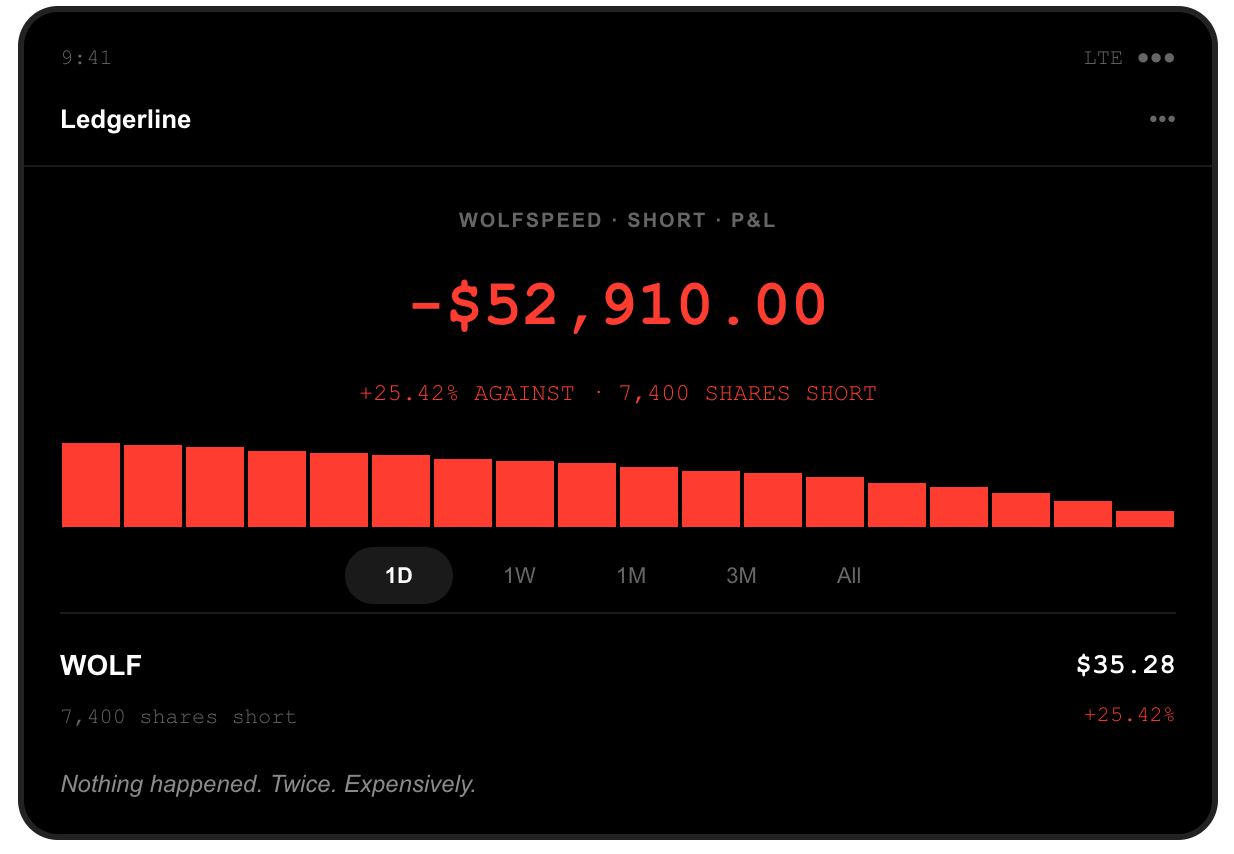
DARWIN AWARD OF THE WEEK 🏆 Every issue we crown the single worst financial decision on the internet. This week it goes to a man whose analysis of a company was correct, thorough, and completely beside the point. Here's the setup. u/there_was_no_catalyst was short 7,400 shares of Wolfspeed from Wednesday's close of $28.13, about $208,162 of stock. His case against the company is not in dispute, and it is not a small case.
He also knew the one fact that should have stopped him, because it is published every two weeks. About half of Wolfspeed's shares outstanding were sold short, and close to four-fifths of the tradeable float. Then came two sessions in which Wolfspeed did nothing whatsoever. On Thursday it rose 10.81% to $31.17. The company had announced nothing; the move followed Micron's results from the evening before, which lifted the whole semiconductor complex. On Friday it rose another 13.19% to $35.28, and this time there was no sector story and no company story either. The only Wolfspeed announcement that week was a new 200-millimetre wafer substrate, published the previous Sunday. $28.13 to $35.28 is 25.42% in two sessions with no news in them. 7,400 shares short, against by $7.15 each, is $52,910. Volume tells you what it was. Wednesday traded 4.1 million shares, Thursday 3.1 million, Friday 7.3 million. At Friday's high of $36.49 the position was down $61,864.
Here's the thing. When close to four-fifths of a company's tradeable shares have been borrowed and sold, the price has stopped being an argument about the company. It has become an argument among the people who are short, and the question that decides it is which of them loses patience first. What makes this one instructive is that nobody was forced out. Borrowing Wolfspeed stock cost about 1.4% a year through the move, and there were shares available to borrow all week. So this was not a margin clerk emptying the trade. It was a very large crowd standing in one doorway, and some of them decided to leave. Look at what each day actually was. Thursday was somebody else's earnings report, and Friday was Thursday. Neither contained a single fact about Wolfspeed, which is the whole point: a crowd this size does not need a reason to move, it needs an absence of reasons to stay. That is the part worth understanding, and it cost him $52,910 to learn that a correct bear case and a crowded trade are two different positions, and he only sized one of them.
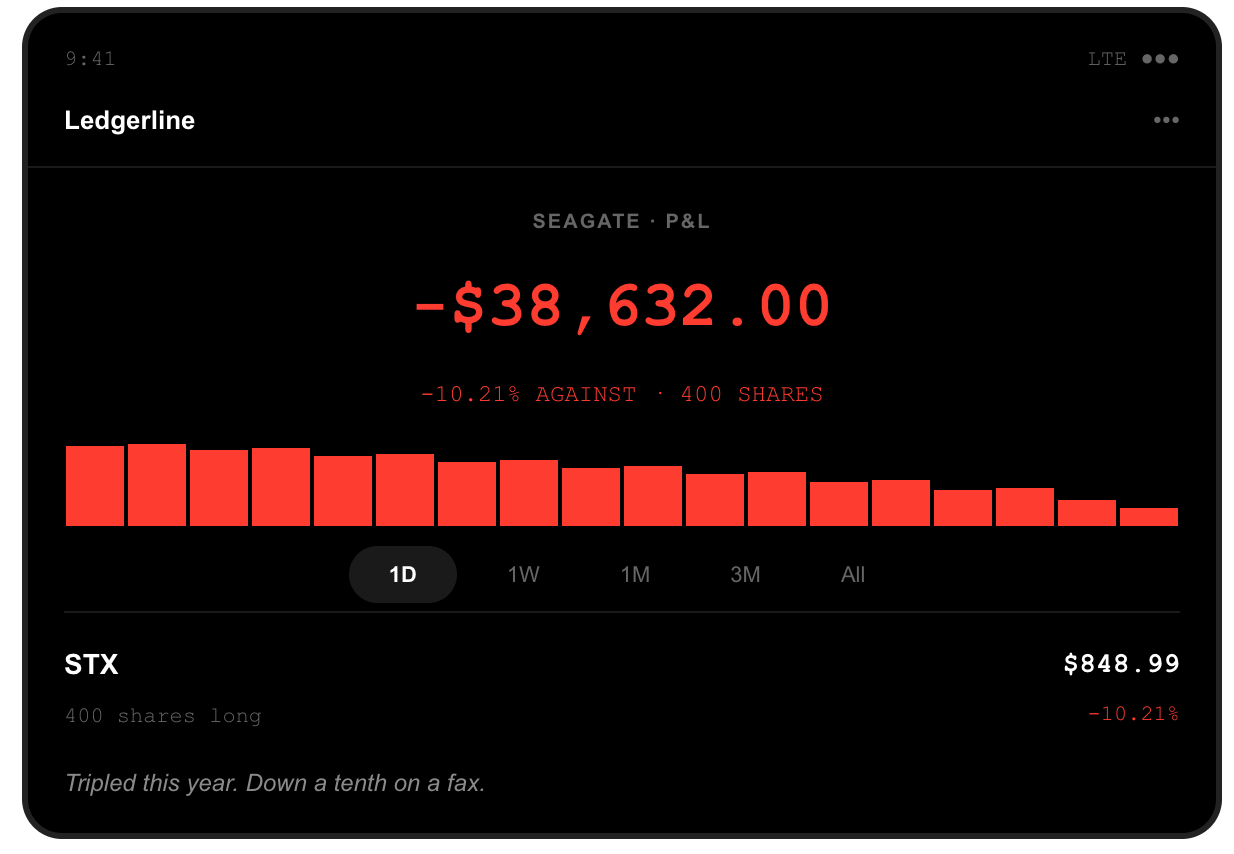
THIS WEEK'S CASUALTIES 💀 Not everybody can be Darwin Award of the week. These three gave it a real shot. Let's run through the tape. Casualty #1: The Man Who Had More Than Tripled u/up_two_hundred_percent owned 400 shares of Seagate, about $378,228 at Thursday's close of $945.57. He had earned it. Seagate was one of the best large trades of 2026, up more than 200% on the year, because artificial intelligence data centers need somewhere to put the data and there are only three companies that make the drives. Late on Thursday, which was Friday morning in Tokyo, Nikkei reported that the third of those companies had a plan. Toshiba intends to spend about 60 billion yen, roughly $380 million, doubling hard drive output at its plant in the Philippines by fiscal 2027. It holds a little over 10% of industry capacity by storage today and says it wants 30% over the medium term. Seagate closed Friday at $848.99, down $96.58, or 10.21%. Western Digital fell 10.22% beside it. 400 shares, down $96.58 each, is $38,632. At the day's low of $791.75 it was $61,528. Here is the part that should bother him more than the loss. Two research desks spent Friday explaining that the news did not mean very much.
So the stock lost a tenth of its value on a report whose own author said the shortage would persist.
The useful question is not whether Toshiba matters. It is why a $380 million announcement was able to take about $22 billion off one company's market value in a morning. A price that has tripled in nine months has no valuation floor under it, because the thing holding it up is the expectation of scarcity rather than any multiple anybody would defend out loud. Remove a sliver of the scarcity and there is nothing for the price to land on, which is why the size of the news and the size of the move do not have to match. Worth noting what the rating agency said eight days earlier. On September 24 S&P Global raised Western Digital's outlook to positive, and named the risk in the same breath. It would go back to stable, it said, if a sudden retrenchment in artificial intelligence spending created industry oversupply. The agency wrote down the exact shape of the thing that then happened to the sector eight days later. That is the part worth understanding, and it cost him $38,632 to learn that the news only has to be the right shape, not the right size.
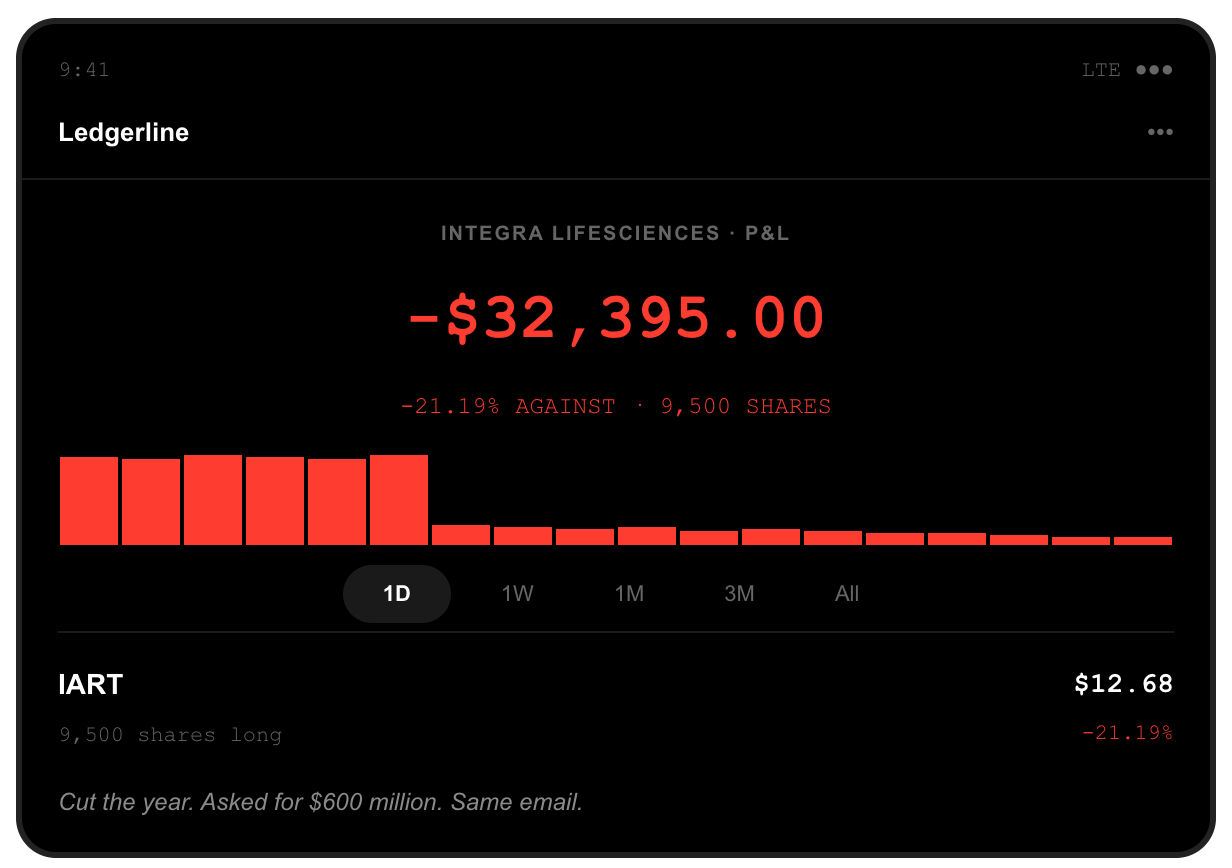
Casualty #2: The Man Who Found Out In October u/a_plant_flooded_in_july owned 9,500 shares of Integra LifeSciences, about $152,855 at Thursday's close of $16.09. Friday morning, before the open, the company pre-announced its third quarter and cut its year.
The flood happened in July. The guidance came down in October. Read those two dates again in that order, because the gap between them is the story. In the same announcement, the company proposed a $600 million seven-year senior secured term loan to refinance its debt. Integra closed at $12.68, down $3.41, or 21.19%, which took the whole company to a $986 million market value. 9,500 shares, down $3.41 each, is $32,395. The stock traded between $12.63 and $14.00 all day, so there was no moment at which the market wanted to think about it again. Wells Fargo cut its target to $15 from $18 on the back of it. In fairness to the company, it says it has activated alternate supply for some products and carries property and business-interruption insurance it expects to cover a substantial part of the earnings hit.
Here's the thing. The revenue shortfall against the street was somewhere between $4 million and $6 million, on a company guiding to over $1.6 billion. A miss that small does not take a fifth off a share price. What did the damage was everything the miss implied about the gap between July and October. And the loan is the detail that makes it expensive rather than merely disappointing. A company arriving at the credit market on the morning it lowers its own numbers is asking to be priced by people who have just been given a reason to charge more. Equity holders sit behind that negotiation and find out the result later. That is the part worth understanding, and it cost him $32,395 to learn that the market prices what a disclosure reveals about the company's habits, not the size of the number in it.
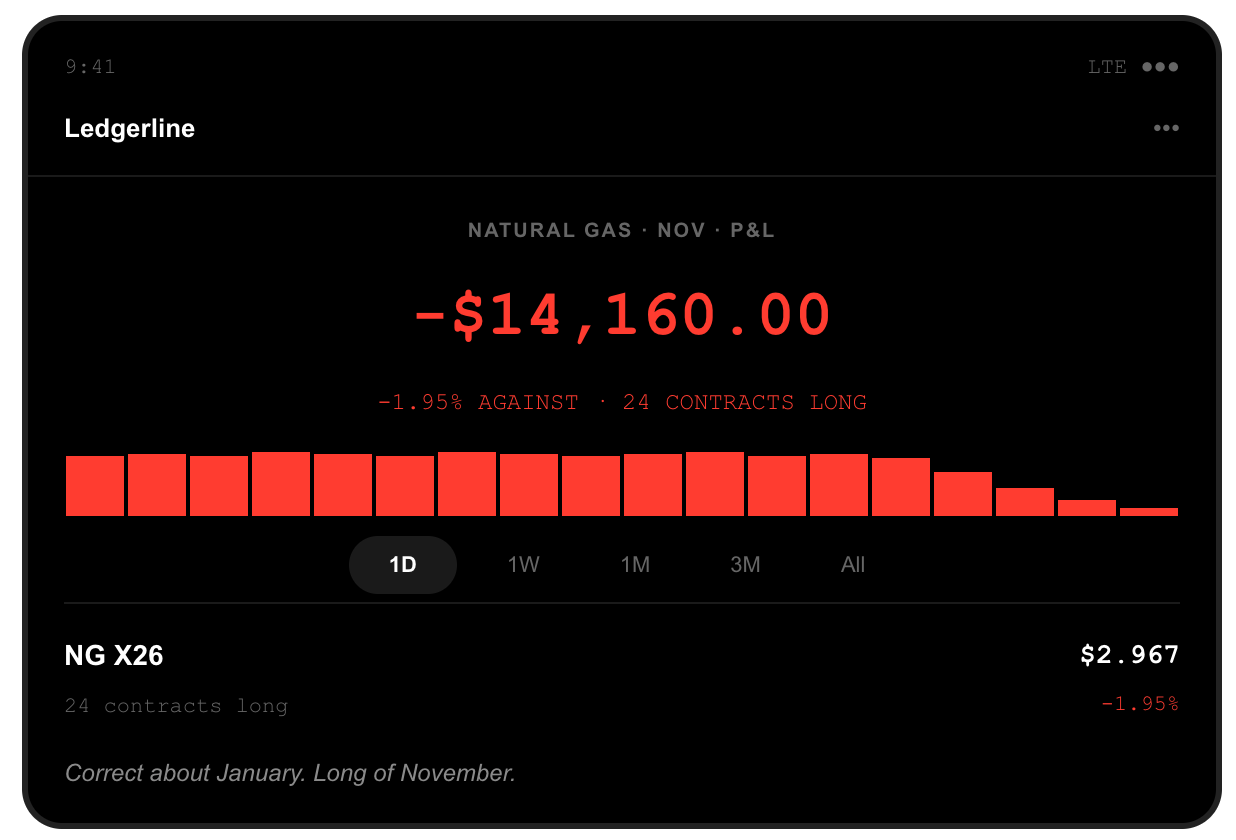
Casualty #3: The Man Who Was Early For Winter u/heating_season_is_coming was long 24 contracts of November natural gas, 240,000 million British thermal units, about $726,240 of notional at Wednesday's settlement of $3.026. The reasoning was seasonal, which is not a bad instinct. Gas is a heating fuel, the fourth quarter is when heating happens, and the balance was genuinely tightening. He even had the storage number. Thursday's government report showed a build of 64 billion cubic feet for the week ended September 25, well under the five-year average of 80. Gas settled Thursday at $2.967, down 5.9 cents, or about 2%. Here is what he was long against. Producers in the Lower 48 averaged a record 113.3 billion cubic feet a day in September, and the forecast through October 16 was near-normal weather with nothing cold in it. A tight storage figure describes a week that ended six days earlier. A record production run and a blank weather map describe the four weeks the November contract has left to live. 240,000 million British thermal units, down 5.9 cents each, is $14,160.
A seasonal view is a statement about a quarter, and a futures contract is a statement about a month. November gas does not care what January does, because it will have stopped existing by then. There is a second trap underneath the first one. Storage figures are reported with a lag and describe a week that has already happened, so a bullish print is history. Production and the weather model are the only two things that describe the days the position still has to survive, and on Thursday one of them was at a record and the other had nothing in it. That is the part worth understanding, and it cost him $14,160 to learn that being right about the season does not help if your contract retires before it arrives.
THIS WEEK BY THE NUMBERS 🔎 We track the data because the data is funnier than anything we could make up.
Friday's jobs report was the weakest of the cycle and the index went up because of it. The S&P 500 rose 0.7% to 7,722.72, the Dow 0.5% to 51,176.96, the Nasdaq 1.2% to 27,190.86 and the Russell 2000 0.9% to 2,832.90. Eight of the eleven sectors closed higher and the Nasdaq 100 set a record. The logic is the inverse of the one most people carry around. This Federal Reserve has spent the autumn debating whether to raise rates again, so a weak labor market reads as one fewer increase rather than as a recession. Odds of an October hike had been above 70% in late September. They finished Friday near 23%. Three more things from the two sessions.
So the labor market got weaker, the policy risk got smaller, and the long end of the bond market closed higher anyway. Three things pointing three ways is what a turning point usually looks like from inside it.
BITE-SIZED COPIUM FOR THE ROAD 😶 The best part of any loss thread isn't the screenshot, it's the comments section. Here are this week's greatest hits.
Translation: four people who understood the facts and misread which facts were setting the price.
DUMB MEMES 😅 Every newsletter needs a meme section. Ours just hits different when the most expensive event of the week was an absence of events.
POV: half the float is short and nobody wants to go second
the loan market reads your bad news too If you laughed, you're coping. If you didn't laugh, open your largest position and write down who else is in it. See you next issue. Nothing happened. It cost a fortune. Traders and P&L screenshots are satirical composites. Market data, price moves and quotations are real and dated September 30 to October 2, 2026. Not financial advice. Obviously. Look at us. Stay liquid, |
Payrolls Missed By 61,000 And Nothing Here Cared
The weakest payrolls print of the cycle sent the Nasdaq 100 to a record. Four traders lost $138,097 to a press release, a flood and no news.