Skip to content
The Financial Darwin Awards logo The Financial Darwin Awards

His memory chip thesis was flawless. Nobody modelled the patent docket.

A lawsuit that beat an earnings model, a tariff four months away that got priced today, and $3 billion of shorts on the wrong side of one rally.
GM. This is The Financial Darwin Awards, rounding up the internet's biggest Ls so you don't make them yourself.

Monday was a lesson in where risk actually lives.

Not in the earnings model. In a patent filing, in an effective date four months out, and in a crowded position nobody thought was crowded.

Chip stocks sold off, Ford dropped on a tariff that starts in 2027, and $3.5 billion in crypto positions got liquidated in a day.

Four people lost $75,050 between them, and not one of them lost it to the thing they were actually watching.

The traders are composites. The moves are not.

Here's what we've got today:

📉His memory chip thesis was flawless. Nobody modelled the patent docket.
💸Bought the automaker because the tariff starts in 2027. The market disagreed about the timing.
🧨Shorted a quiet market. $3 billion of shorts found out together.
💰Bought silver because gold was rallying. Silver had other jobs.
🤡Dumb memes from the trenches.
 
🧨
 

THIS WEEK'S DAMAGE REPORT 📊

$75K

Lost This Week

$3.5B

24-Hour Crypto Liquidations

Lessons Ignored

The first number is the sum of the four stories below. The second is real: crypto markets saw about $3.5 billion in liquidations over 24 hours, more than $3 billion of it short positions, after bitcoin posted its biggest single day gain since March.

 
🏆
 

DARWIN AWARD OF THE WEEK 🏆

Every issue we crown the single worst financial decision on the internet.

This week it goes to a man whose research was genuinely excellent and pointed at the wrong document.

Here's the setup.

u/the_model_had_no_lawyers had done the work on Micron. Real work.

He had the DDR5 supply numbers, the data center upgrade cycle, the pricing curve, and a spreadsheet he was proud of.

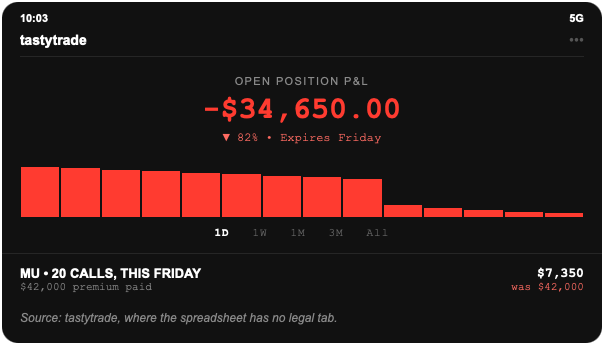
So he bought 20 near-dated call contracts, $42,000 of premium, on the memory supercycle.

On Monday, Netlist filed new patent actions against Micron at the International Trade Commission and in federal court, targeting the exact DDR5 RDIMM and MRDIMM products at the centre of his thesis.

Netlist is seeking exclusion orders, which would block the allegedly infringing memory from being imported into or sold in the United States.

Micron fell as much as 5.83% on the day, to $910.43.

His calls are down $34,650, about 82% of the premium, and the trial calendar has barely started.

He modelled demand, supply, pricing and margin. There is no cell in that spreadsheet for a docket number.

Micron options screenshot: 20 calls expiring Friday, open position down $34,650.00 or 82 percent of premium, after MU fell on new Netlist patent filings.
T u/the_model_had_no_lawyers
r/wallstreetbets • 4h ago

Built the perfect memory cycle model. Netlist built a better filing.

I had every number right. Supply, pricing, the upgrade cycle, all of it.

Then a patent suit asked a court to ban the product from being sold here.

"My thesis was about how many they could make. The lawsuit is about whether they are allowed to."

 
⬆ 14.6k    💬 3.8k    🏆 688 awards

Here's the thing. He was not wrong about the business.

He was wrong about the list of things that can go wrong.

An earnings model is a machine for pricing commercial outcomes. Litigation is not a commercial outcome.

A patent case does not care what the demand curve looks like. It asks whether the product can be sold at all.

That is the part worth understanding, and it cost him $34,650 to find the question his model never asked.

An ITC exclusion order, stated plainly: The International Trade Commission can block products that infringe US patents from being imported into the country, which for a company with overseas fabrication is close to a sales ban on the affected line. The ITC moves considerably faster than ordinary patent litigation, often reaching a decision inside eighteen months, and it does not award damages. It awards or denies the block. That makes it a binary, product-level risk sitting entirely outside revenue, margin and guidance, which is where almost every retail model lives. A company can be executing perfectly and still lose the right to sell its best product in its biggest market.

 
💀
 

THIS WEEK'S CASUALTIES 💀

Not everybody can be Darwin Award of the week. These three gave it a real shot.

Let's run through the tape.

Casualty #1: The Effective Date Guy

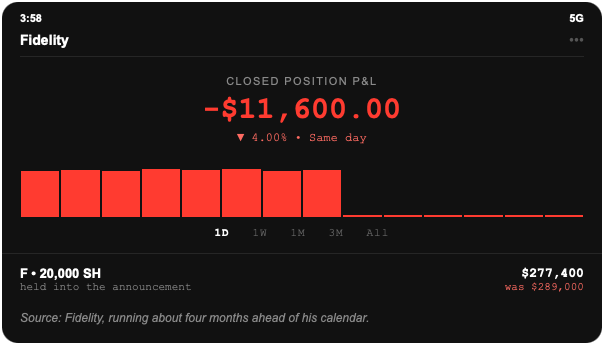
u/january_is_far_away held 20,000 shares of Ford, about $289,000 worth, and Monday brought the news he had been waiting for.

Trump set a 50% duty on Canadian vehicles and parts. Effective January 1, 2027.

He read that date and saw four months of clear air. Four months to watch, decide, and get out if it got real.

Ford fell 4% to $13.87 that day. Stellantis fell 4% to $5.19, and General Motors slipped 2% to $86.28.

The four months he was counting on cost him $11,600 in one afternoon.

The tariff starts in 2027. The repricing started on Monday, which is a different calendar entirely.

Ford equity screenshot: 20,000 shares, closed position down $11,600.00 or 4 percent, after F fell to $13.87 on the 50 percent Canadian auto tariff.
J u/january_is_far_away
r/investing • 7h ago

The tariff starts in 2027. Somebody should tell the stock.

Genuinely thought I had until the new year to make a decision. The market made it for me in about ninety minutes.

"An effective date tells you when the money moves. It does not tell you when the price moves."

 
⬆ 8.6k    💬 2.2k    💸 repriced

Pricing in the future, stated plainly: A share price is not a report on what a company earns today. It is the market's running estimate of everything it expects the company to earn from here on. When a cost that starts in 2027 becomes certain enough to model, that cost enters the estimate immediately, because the estimate has always covered 2027. This is why stocks move on guidance, on approvals, on legislation, on anything that changes the future without changing this quarter. An effective date is a deadline for the company. For the share price, the deadline was the announcement.

Casualty #2: The Quiet Market Guy

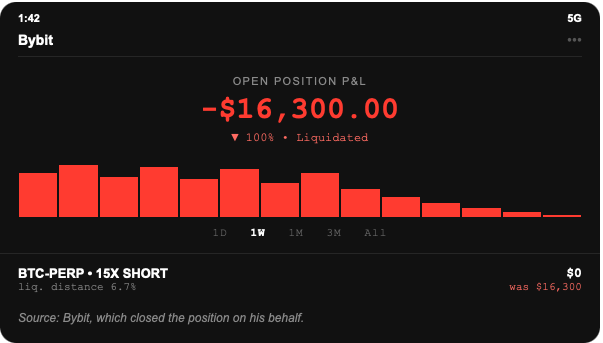
u/borrowed_to_short_it was short bitcoin on perpetual futures at 15x leverage, betting a range-bound market would drift lower.

It had been quiet for weeks. Quiet is the part that gets people.

Then the Treasury said it would at least double the single-operation cap on liquidity-support repurchases of 10 to 30 year bonds, from $2 billion to $4 billion, and Trump told crypto and fintech executives the government had ended its conflict with the industry.

Bitcoin rose nearly 8% in a day, its biggest single day gain since March, to around $78,000.

At 15x leverage his liquidation sat about 6.7% away. The move was 8%.

His entire $16,300 margin was gone, and he was one of roughly $3 billion in short liquidations that day.

The squeeze does not just cost you the move. It buys the move, using your money, on your behalf.

Bitcoin perpetual futures screenshot: 15x short, liquidated for a full loss of $16,300.00, after BTC rose nearly 8 percent to about $78,000.
B u/borrowed_to_short_it
r/CryptoCurrency • 3h ago

Shorted a boring market at 15x. Three billion dollars of us found out at the same time.

It had been range-bound for six weeks, and I thought that was information.

It was just the setup.

"Every short is a buy order the market gets to trigger whenever it feels like it."

 
⬆ 9.4k    💬 2.6k    💀 liquidated

A short squeeze, stated plainly: Closing a short position means buying the asset back, so when a price rises far enough to force shorts out, those forced exits arrive as buy orders. Those buys push the price higher, which forces out the next tier of shorts, which produces more buying. The mechanism feeds itself. This is why a crowded short is dangerous even when the underlying view is reasonable: the crowd is not a second opinion, it is fuel. More than $3 billion of Monday's $3.5 billion in liquidations were shorts, which is the same event described from the other side.

Casualty #3: The Correlation Guy

u/silver_follows_gold watched gold climb to a 15 week high and drew the obvious conclusion.

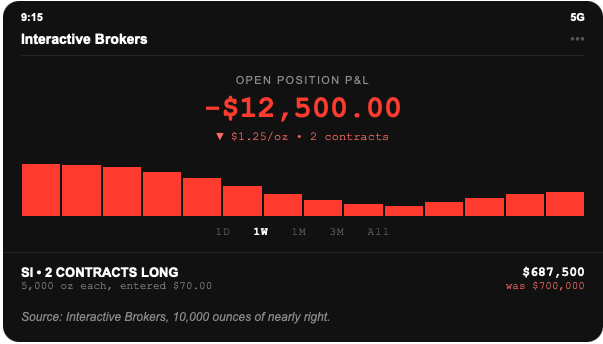
Silver is the cheaper metal that does the same job, so he bought two silver futures contracts at $70.00 an ounce on Friday, expecting it to follow.

Gold did keep climbing. It rose 1.00% Tuesday to $4,648.40, helped by a soft dollar near 98.7 and the 10 year yield around 4.70%.

Silver went the other way, slipping 0.16% Tuesday to $68.75 as traders took profits after Friday's test above $70.

That leaves his entry $1.25 an ounce above the market.

At 5,000 ounces per contract, $1.25 costs $6,250, and he bought two. Down $12,500.

Gold got the safe haven bid. Silver got a profit-taking session, because silver has a day job in industry that gold has never had.

Silver futures screenshot: 2 contracts long at $70.00, open position down $12,500.00, after silver slipped to $68.75 while gold rallied.
S u/silver_follows_gold
r/Commodities • 5h ago

Bought silver because gold was ripping. Turns out they only agree sometimes.

Gold up one percent, silver down. I had been treating them as the same trade with a different price tag.

"Two things moving together for a year is a habit, not a rule."

 
⬆ 6.9k    💬 1.8k    📉 decoupled

Why silver and gold split up, stated plainly: Gold is overwhelmingly a monetary and safe haven asset, so it responds to the dollar, to real yields and to fear. Silver shares those drivers but earns roughly half its demand from industry, in solar panels, electronics and wiring, which ties it to the economic cycle in a way gold is not tied. Most of the time those two engines pull the same direction and the metals look like one trade. On the days they disagree, the correlation that made the trade look safe is exactly what breaks. Trading one asset as a proxy for another means owning every difference between them, including the ones that only matter occasionally.

 
📊
 

THIS WEEK BY THE NUMBERS 📊

We track the data because the data is funnier than anything we could make up.

📉

-5.83%

Micron's drop as Netlist sought orders blocking its DDR5 memory from US sale

💸

50%

new US duty on Canadian vehicles and parts, effective January 1, 2027

🧨

$3.5B

crypto liquidated in 24 hours, more than $3B of it short positions

💰

$4,648

gold's price per ounce Tuesday, a 15 week high, up 1.00%

Every one of this week's four was watching the right asset and the wrong risk.

The thing that got them was never on the chart they had open.

 
🎰
 

BITE-SIZED COPIUM FOR THE ROAD 🍪

The best part of any loss thread isn't the screenshot. It's the comments section.

Here are this week's greatest hits.

"Patent suits take years to resolve." The stock repriced in about six hours. (u/patents_are_just_paperwork)
"The tariff literally does not start until 2027." Correct, and irrelevant to a stock that prices 2027 today. (u/effective_date_matters)
"A quiet market is a safe market." It is a market with a lot of people leaning the same way. (u/quiet_means_safe)
"Silver is just gold with more upside." And more industrial demand, which is a different sentence. (u/it_always_tracks_gold)

Translation: everybody was watching a real risk. Nobody was watching the one that showed up.


DUMB MEMES 🤣

Every newsletter needs a meme section.

Ours just hits different when the thing that broke was never in the model.

📊➡️❓➡️😭

(perfect spreadsheet, one court filing, tears)

POV: your thesis was right and the product got a lawsuit

🧮➡️📉➡️🤡

(four months of clear air, priced in immediately)

u/january_is_far_away, checking the calendar one more time

If you laughed, you're coping.

If you didn't laugh, go find the risk in your best position that has no line in your model.

See you next issue.

Different mechanisms. Same blind spot.


Traders and P&L screenshots are satirical composites. Market data, prices and policy announcements are real and dated August 20 to 25, 2026. Not financial advice. Obviously. Look at us.

Stay liquid,
The Financial Darwin Awards

Free, 4x a week

Learn from other people's worst trades.

Five minutes of reading. A lifetime of bad decisions to study. Your portfolio will thank you, eventually.

No spam. Just other people's mistakes.

Almost there. Check your inbox to confirm.