|
GM. This is The Financial Darwin Awards, the only financial newsletter with a 100% loss rate. The S&P 500 finished Tuesday six hundredths of a point below where it started, which is as close to nothing as an index gets. Underneath it the financials sector closed down 1.9%, at its lowest since July, and a gym chain fell 9.46%. On Monday Meta's new agent made chipmakers rich. On Tuesday the market sat down and worked out who was going to pay for it. Four traders lost $114,257 between them, and two of them owned businesses whose best asset was you forgetting to cancel. The other two owned a drug that worked and a laboratory that bills Medicare. The traders are composites. The moves are not. Here's what we've got today:
THIS WEEK'S DAMAGE REPORT 📊
The first number is the sum of the four stories below. The second is real: Celldex reported two successful Phase 3 trials on Tuesday morning and closed the day at $33.50, down 11.59%.
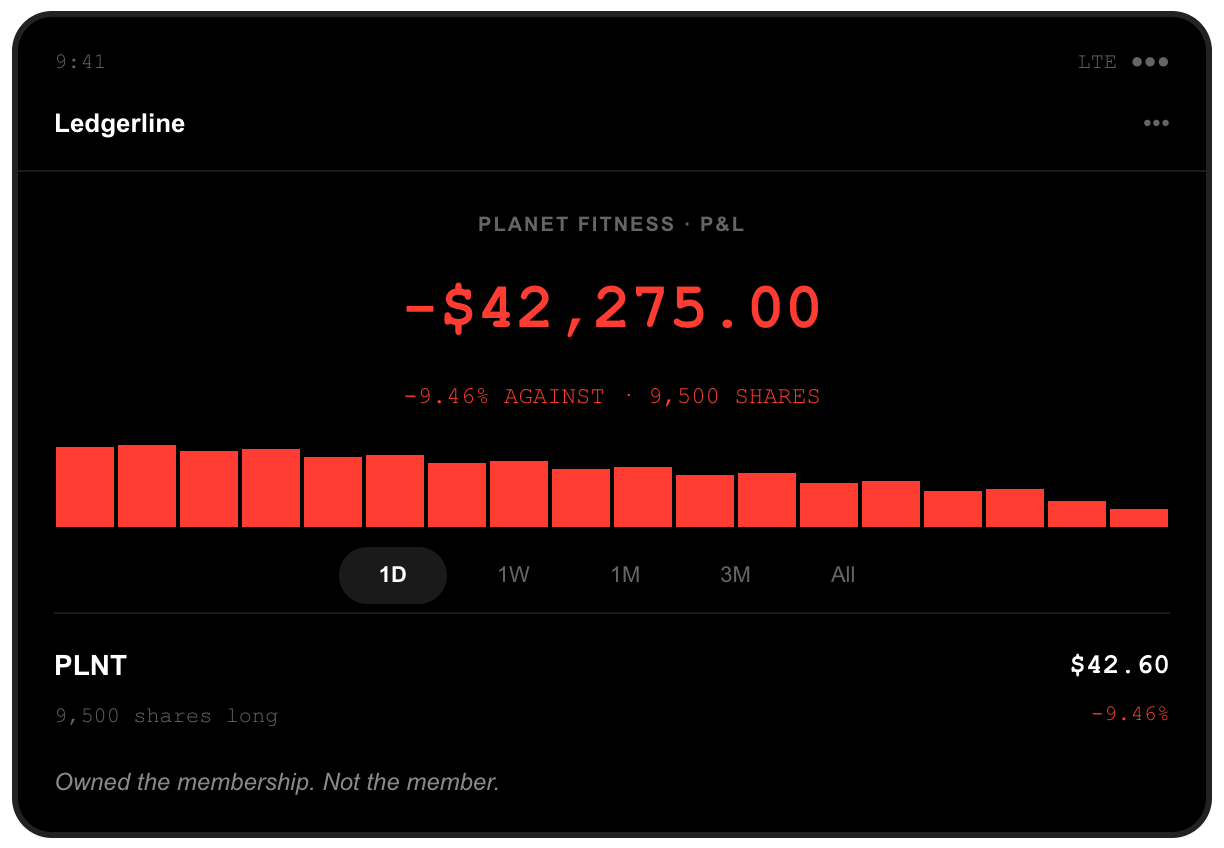
DARWIN AWARD OF THE WEEK 🏆 Every issue we crown the single worst financial decision on the internet. This week it goes to a man who owned a business whose best customer is the one who never turns up. Here's the setup. u/nobody_cancels_anything owned 9,500 shares of Planet Fitness, about $447,000 at Monday's close of $47.05. He liked it for the reason everybody likes it. A gym is a capacity business, and the cheapest member to serve is the one who signs up in January and is never seen again. Two things complicate that. Planet Fitness is mostly a franchisor, so it collects those economics as royalties rather than directly, and its actual 2026 problem is at the other end of the funnel. In May it cut full-year guidance, blamed slower than planned net member growth in the peak sign-up period and paused a planned Black Card price increase. By Monday, Meta's agent Muse had gone to number one on the American app store, and the stock fell 4.93% on a day the Nasdaq rose 2.26%. On Tuesday the market read the feature list properly. Muse cancels unused memberships, renegotiates telecom plans, moves cash into higher-yielding accounts and switches policies when a cheaper rate appears. Goldman Sachs warned about industries that live on recurring bills, add-ons and customer passivity, naming the telecom carriers in particular. Bloomberg ran the whole selloff under the phrase consumer inertia. Planet Fitness closed at $42.60, down $4.45, or 9.46%, having been down as much as 11% during the session. 9,500 shares, down $4.45 each, is $42,275. He thought he owned a fitness company. He owned the gap between deciding to cancel and getting round to it, and somebody had just written software that closes it.
Here's the thing. A recurring-revenue business has two kinds of customer, and only one of them is a relationship. The other kind is a standing instruction that nobody has got round to cancelling, and it looks identical on the revenue line right up until it stops. For decades that second group was safe, because cancelling required a phone call, a login you had forgotten, or a form in a place you did not want to go. The friction was never a product. It was a tax on attention, and it was collected by whoever happened to be on the other end of the direct debit. That is the part worth understanding, and it cost him $42,275 to learn that a moat made of inconvenience lasts exactly as long as nobody automates the inconvenience.
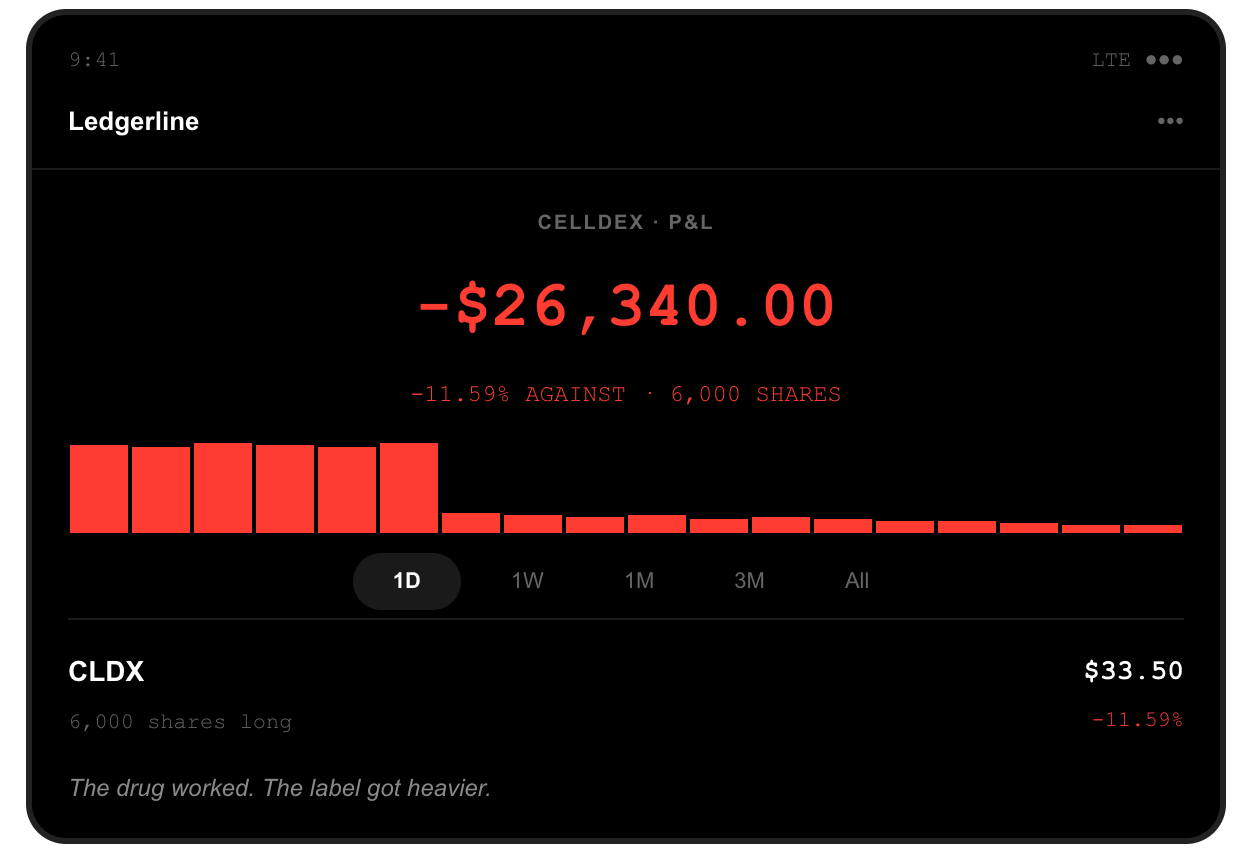
THIS WEEK'S CASUALTIES 💀 Not everybody can be Darwin Award of the week. These three gave it a real shot. Let's run through the tape. Casualty #1: The Man Who Read The Efficacy Table u/the_endpoint_was_the_point owned 6,000 shares of Celldex, about $227,000 at Monday's close of $37.89. He was waiting for two Phase 3 trials, EMBARQ CSU1 and CSU2, testing barzolvolimab in chronic spontaneous urticaria, which is hives that will not go away. On Tuesday morning the results arrived and they were excellent. About half the treated patients had no itch and no hives at all at 24 weeks, against 15 to 18 percent on placebo. Cantor Fitzgerald's Kristen Kluska called it the best Phase 3 data set she had seen across all pivotal studies and modelled peak sales of $4.8 billion. Then the market read the other table. There were two life-threatening anaphylaxis cases in one dosing group, with one further case after placebo. The chief executive called the incidence extremely low across roughly 2,400 patients treated to date, which is both true and not the point. Celldex closed at $33.50, down $4.39, or 11.59%, having been down 13% in early trading. 6,000 shares, down $4.39 each, is $26,340. Stifel still expects meaningful sales even if the drug arrives with a boxed warning, which is another way of saying the drug got smaller on Tuesday without getting worse.
Here's the thing. A pivotal trial produces two documents and retail investors reliably read one of them. The efficacy table tells you whether the drug does something. The safety table tells you who is allowed to take it, how closely they have to be watched, and what has to be printed on the box. Those two answers determine completely different things. The first decides whether there is a product and the second decides how large it is. A boxed warning does not usually stop a drug. It narrows the eligible population, adds monitoring requirements and hands every competitor a slide. That is the part worth understanding, and it cost him $26,340 to learn that hitting the endpoint buys you an approval conversation rather than a market.
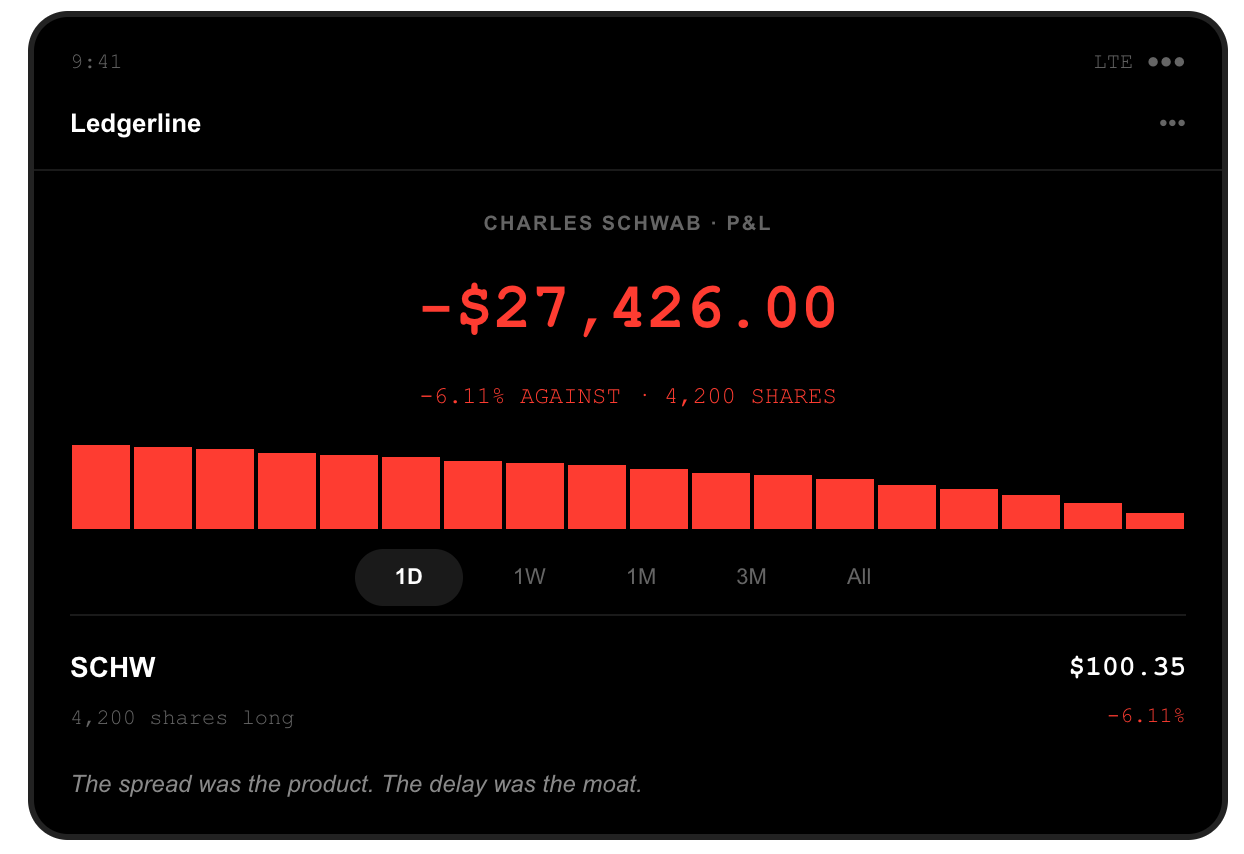
Casualty #2: The Man Who Owned The Cash That Never Moves u/cash_sitting_still owned 4,200 shares of Charles Schwab, about $449,000 at Monday's close of $106.88. It is a good business and he understood it. A broker of that kind earns a large part of its money on net interest, which is the spread between what it makes on client cash and what it pays out on it. That spread exists because cash sits still. Somebody sells a position, the proceeds land in the account, and then life happens. One of the things Meta's agent demonstrated was moving cash into higher-yielding accounts, automatically, without being asked twice. The whole sector went with it. Financials fell as much as 2.4% during the session and closed down 1.9%, the lowest close since July. Wells Fargo fell 3.92%, JPMorgan 3.42% and Morgan Stanley 2.88%, and not one of them announced anything. Schwab closed at $100.35, down $6.53, or 6.11%, on more than three times Monday's volume. 4,200 shares, down $6.53 each, is $27,426. Nothing happened to Schwab on Tuesday. Something happened to the assumption that money is lazy.
Here's the thing. Every revenue line has an implicit assumption about human behaviour somewhere underneath it, and most of them are never written down. Net interest on idle balances assumes the balances stay idle, and a renewal price assumes the customer does not reshop. An add-on assumes nobody reads the itemised bill, and a late fee assumes the reminder went to an inbox nobody opens. None of those assumptions are dishonest and all of them have been true for a long time, which is exactly why nobody stress-tests them. An agent does not need to be better than a human at any of this. It only needs to be more diligent than a human who is busy. That is the part worth understanding, and it cost him $27,426 to learn that the most valuable thing his brokerage owned was the pause between a decision and the paperwork.
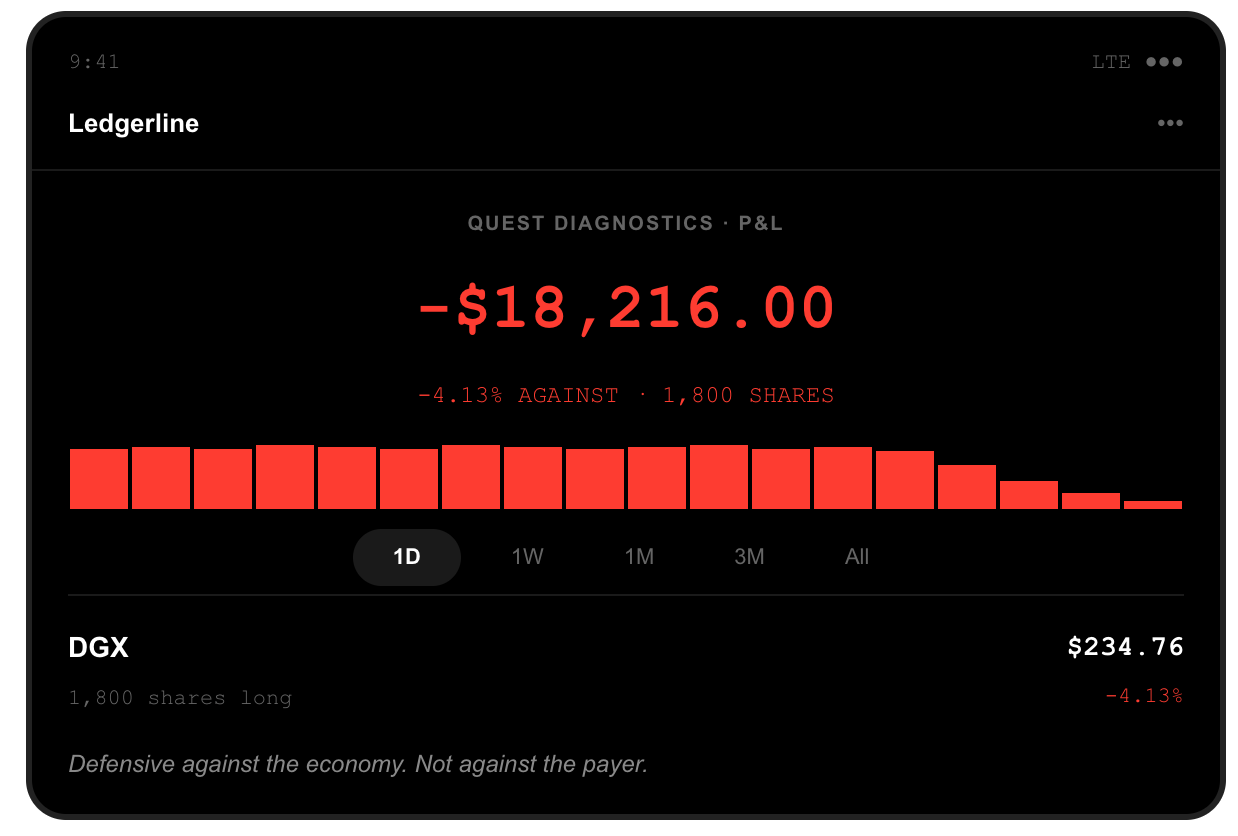
Casualty #3: The Man Whose Biggest Customer Sets The Price u/medicare_always_pays owned 1,800 shares of Quest Diagnostics, about $441,000 at Monday's close of $244.88. He held it as a defensive position. People get blood tests in every economy, and the bills are paid by insurers and by the government. That second payer turned out to be the problem, because it does not negotiate. It publishes. On Monday the Centers for Medicare and Medicaid Services published preliminary 2027 rates for the clinical laboratory fee schedule, with cuts capped at 15% a year and phased through 2029. More than 1,100 test codes come out below this year's rate, the industry's trade body counts 775 of them at the full 15%, and CMS puts the saving at around $1 billion a year. The stated reason was blunt. CMS calculated that Medicare has been paying roughly 16% more in total for laboratory services than private payers do. Quest closed at $234.76, down $10.12, or 4.13%. Labcorp closed at $311.54, down $9.45, or 2.94%. 1,800 shares, down $10.12 each, is $18,216. The rates are preliminary. There is a thirty-day comment period running to about 21 October and final rates are expected in November. That is genuinely worth something, and it is not the same thing as worth nothing happening.
Here's the thing. Defensive usually means the volume holds up when the economy does not, and that is only half of a revenue line. A laboratory can run exactly the same number of tests next year and be materially less valuable, because the other half of the arithmetic is set in Baltimore rather than in the market. An administered price has no negotiation in it. There is a methodology, a consultation, a published schedule, and then there is what you are paid. That is a different risk from competition and it behaves differently too, arriving as a document on a Tuesday rather than as a slow loss of share. That is the part worth understanding, and it cost him $18,216 to learn that a business with a guaranteed customer does not have pricing power, it has a counterparty with a printing press.
THIS WEEK BY THE NUMBERS 📊 We track the data because the data is funnier than anything we could make up.
The S&P 500 finished Tuesday unchanged to a hundredth of a percent. The Nasdaq rose 0.45% to a record close. Yesterday this newsletter gave its Darwin Award to a man who was short Intel on the day Muse made the whole chip complex rally. Tuesday was the invoice for that rally, and it was sent to the companies that had been quietly billing people for not paying attention.
BITE-SIZED COPIUM FOR THE ROAD 🍩 The best part of any loss thread isn't the screenshot. It's the comments section. Here are this week's greatest hits.
Translation: nobody argued that the news was wrong. They argued that people are lazy.
DUMB MEMES 🙃 Every newsletter needs a meme section. Ours just hits different when the moat was your own inattention.
POV: you were long the forgetting
u/the_endpoint_was_the_point, reading page two If you laughed, you're coping. If you didn't laugh, open your bank statement and count the recurring payments you would not sign up for again today. See you next issue. The moat was your inattention. Somebody just shipped a tool for that. Traders and P&L screenshots are satirical composites. Market data, price moves and quotations are real and dated September 21 to September 22, 2026. Not financial advice. Obviously. Look at us. Stay liquid, |
Tuesday the market went hunting for inertia. Four people were standing in it.
The S&P 500 finished flat while financials closed at a July low. A gym chain lost 9.46% because an app can cancel memberships, a biotech lost 11.59% on a trial that worked, and Medicare published a price list.