|
GM. This is The Financial Darwin Awards, the only financial newsletter with a 100% loss rate. Wednesday was a rebound. The S&P 500 rose 0.46%, nine of the eleven sectors closed higher, and the Russell 2000 put on 1.13% after three losing sessions. Four traders lost $111,291 anyway. Two of them owned companies that beat every number they had been given. The traders are composites. The moves are not. Here's what we've got today:
THIS WEEK'S DAMAGE REPORT 📊
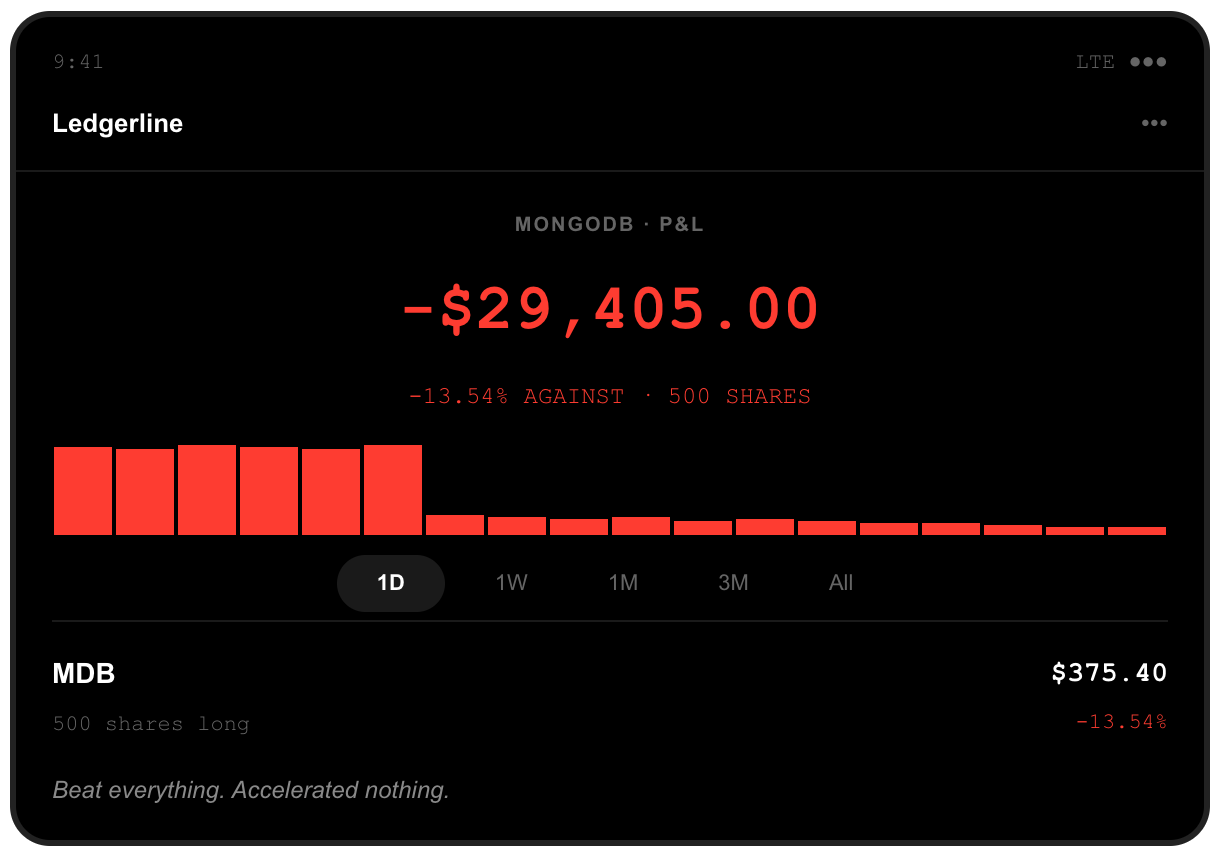
The first number is the sum of the four stories below. The second is real: MongoDB beat on revenue and on earnings, raised its full-year guidance, and closed Wednesday down 13.54% at $375.40.
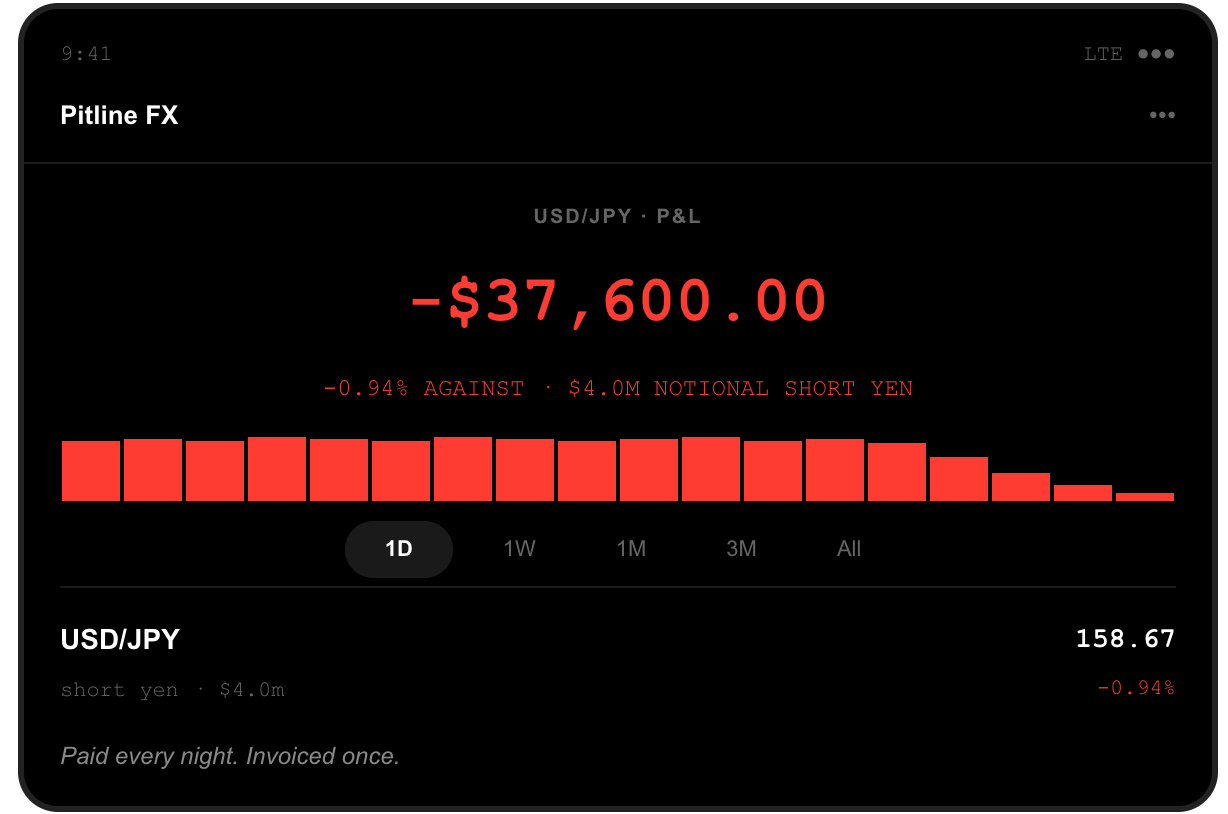
DARWIN AWARD OF THE WEEK 🏆 Every issue we crown the single worst financial decision on the internet. This week it goes to a man who was being paid to hold a position and could not bring himself to stop being paid. Here's the setup. u/it_pays_me_every_night was short the Japanese yen, about $4 million of notional, in the oldest trade in the currency market. You borrow in the currency with the low interest rate, hold the one with the high rate, and the difference is credited to your account every night. It is not really a view on Japan. It is an income. On Tuesday the Bank of Japan governor, Kazuo Ueda, signalled a strong chance of a rate rise this month. On Wednesday the board's leading hawk, Hajime Takata, said the bank should raise rates "nimbly" rather than on a fixed schedule. The yen gained 0.94% against the dollar and closed at 158.67, having been as weak as 160.39 earlier in the session. Traders then spent the afternoon arguing about whether Japan had actually intervened or merely run a rate check, which is when officials ask for quotes without trading. $4 million of notional, moved 0.94% the wrong way, is $37,600. He knew about Ueda on Tuesday. He was still short on Wednesday. The carry did not make him wrong. It made him slow.
Here's the thing. A carry trade pays a small amount very reliably and takes a large amount very rarely. That shape is the entire problem, because it reads as income right up until the afternoon it reads as a loss. Under one percent is a rounding error in a stock. In a currency position it is months of carry. The yen touched a forty year low of 163.98 before Japan intervened in late July, and it has been a policy problem ever since. That is the part worth understanding, and it cost him $37,600 to learn that being paid to hold a position is not the same as being right to hold it.
THIS WEEK'S CASUALTIES 💀 Not everybody can be Darwin Award of the week. These three gave it a real shot. Let's run through the tape. Casualty #1: The Man Who Beat Every Number u/they_beat_every_number owned 500 shares of MongoDB, about $217,000 at Tuesday's close of $434.21. On Tuesday evening MongoDB reported revenue of $771.8 million against a $734.4 million consensus, a $37 million beat and 30.5% growth. Adjusted earnings came in at $1.90 a share against $1.61 expected. Remaining performance obligations, which is contracted work not yet recognised as revenue, jumped 91% to $1.52 billion. The company then raised full-year revenue guidance to a range of $2.99 billion to $3.03 billion. MongoDB closed Wednesday at $375.40, down $58.81, or 13.54%. 500 shares, down $58.81 each, is $29,405. The number that did it was Atlas, the cloud database that is most of the company. It grew about 29%, which is roughly what it grew in each of the four quarters before this one. Nothing got worse. Nothing got better either, and the price had been paying for better.
Here's the thing. A company growing 30% on a growth multiple is not being paid for growing 30%. It is being paid for the possibility that 30% becomes 35%. Once the same rate turns up five quarters running, the market stops reading it as a trajectory and starts reading it as a level. Levels are worth a great deal less than trajectories, which is how a beat, a raise and a 91% jump in contracted work fail to save a share price. That is the part worth understanding, and it cost him $29,405 to learn that the market prices the second derivative.
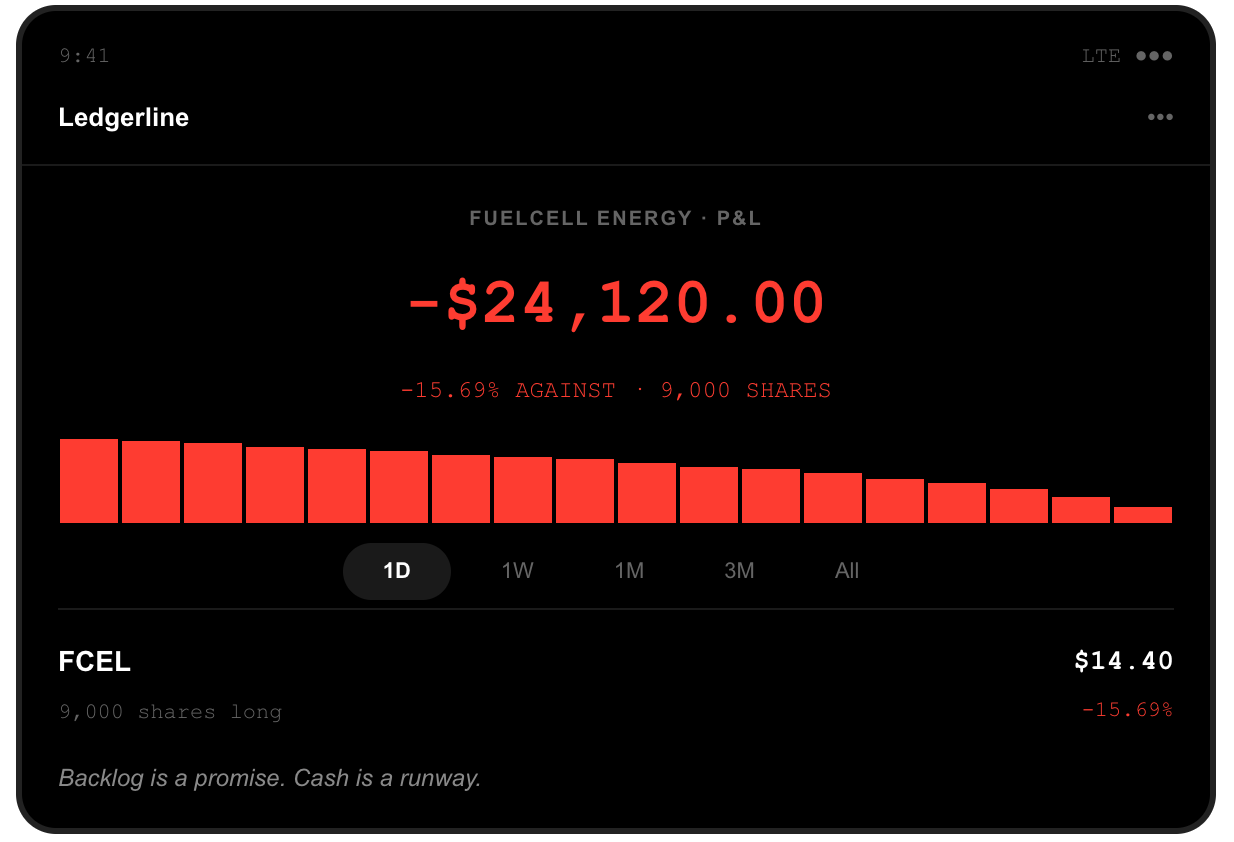
Casualty #2: The Man Who Owned The Backlog u/next_year_is_the_year owned 9,000 shares of FuelCell Energy, about $153,700 at Tuesday's close of $17.08. The story is a genuinely good one. FuelCell makes stationary power, data centres are desperate for stationary power, and the company reported a combined backlog of $3.65 billion. It also announced a first data centre capacity reservation of 75 megawatts in Texas. Then there is the other set of numbers. Revenue for the quarter was $33.0 million, down 29% from $46.7 million a year earlier. Adjusted EBITDA was a loss of $36.7 million, against a $16.4 million loss a year ago. FuelCell closed at $14.40, down $2.68, or 15.69%. 9,000 shares, down $2.68 each, is $24,120. The company holds $658.1 million of unrestricted cash, which sounds like a cushion and works like a clock. The headline net loss actually halved, to $45.3 million from $91.9 million. The operating loss roughly doubled.
Here's the thing. A backlog is a schedule of work somebody intends to do, and revenue is work that has been done and paid for. $3.65 billion of the first against $33.0 million of the second is not a contradiction, it is a timing difference whose length nobody has told you. The two loss numbers point in opposite directions on purpose, and the operating one is the one that describes this quarter's trading. A company recognising $33 million of revenue while losing $36.7 million at the EBITDA line is being funded by its balance sheet rather than by its customers. That is the part worth understanding, and it cost him $24,120 to learn that a cash pile in a cash-burning company is a countdown with a dollar sign in front of it.
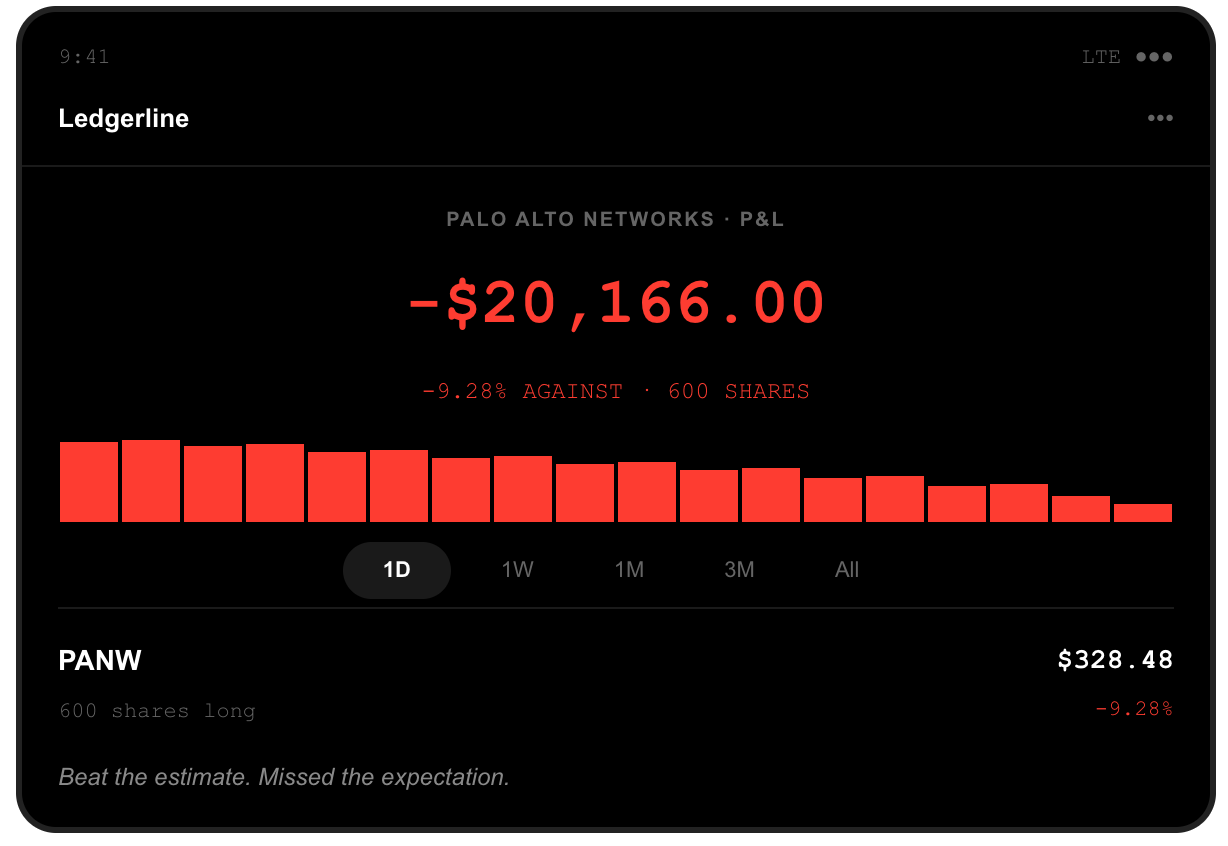
Casualty #3: The Man Who Beat By Sixty And Missed By Fifty u/price_target_went_up_though owned 600 shares of Palo Alto Networks, about $217,000 at Tuesday's close of $362.09. The quarter was, by every published measure, excellent. Revenue of $3.41 billion, up 34%, against a $3.35 billion consensus. Adjusted earnings of $1.02 against $0.98 expected, and remaining performance obligations up 34% to $21.2 billion. Next-generation security annual recurring revenue reached $9.1 billion, up 63%, with roughly a billion dollars of net new ARR added in the quarter. Palo Alto closed at $328.48, down $33.61, or 9.28%. 600 shares, down $33.61 each, is $20,166. Raymond James put the problem in four words: the beat decelerated. On their arithmetic, next-generation ARR needed to be about $9.15 billion to show growth still accelerating. It arrived at $9.1 billion. He beat the number that was published by $60 million and missed one that was not by $50 million. The stock had roughly doubled this year going into the print, which is another way of saying the price already contained an excellent quarter.
Here's the thing. Consensus is the number the sell side publishes, and the bar is the number the buy side is already positioned for. They are rarely the same, and only one of the two is written down anywhere you can read it. The gap between them widens with every month a stock outperforms, because the people who bought it at half the price need more to stay. CrowdStrike fell about 3% and Fortinet more than 5% the same afternoon, and neither of them had reported anything at all. That is the part worth understanding, and it cost him $20,166 to learn that a stock which has doubled in a year has already been paid for the good quarter.
THIS WEEK BY THE NUMBERS 📊 We track the data because the data is funnier than anything we could make up.
Nine of the eleven S&P 500 sectors closed higher on Wednesday. Everything on this page happened anyway, to four people who had each chosen something very specific to own.
BITE-SIZED COPIUM FOR THE ROAD 🍪 The best part of any loss thread isn't the screenshot. It's the comments section. Here are this week's greatest hits.
Translation: every one of these was a good number attached to the wrong expectation.
DUMB MEMES 🤣 Every newsletter needs a meme section. Ours just hits different when the quarter was fine and the stock was not.
POV: Atlas grew twenty nine percent again
u/it_pays_me_every_night, meeting the Bank of Japan If you laughed, you're coping. If you didn't laugh, go and find the one number your largest position is actually priced on. See you next issue. Green day. Red screen. Traders and P&L screenshots are satirical composites. Market data, price moves and quotations are real and dated September 1 to 2, 2026. Not financial advice. Obviously. Look at us. Stay liquid, |
Everything was green on Wednesday. Four people found the red
A carry trade that met a hawkish Bank of Japan, a company that beat every estimate and fell 13.54%, a $3.65 billion backlog attached to $33 million of revenue, and a stock that beat by $60 million and missed by $50 million.