|
GM. This is The Financial Darwin Awards, the only financial newsletter with a 100% loss rate. Monday was a good day. The S&P 500 rose 1.49%, the Nasdaq 2.26%, and last week's oil scare quietly went home. Not one of the four losses below was caused by a company reporting results. One was caused by a possible meeting, one by an app that sorts your email, one by a slide about 2035, and one by a company that declined to forecast next year at all. Four traders lost $112,072 between them, and every one of them was beaten by a story rather than a number. The traders are composites. The moves are not. Here's what we've got today:
THIS WEEK'S DAMAGE REPORT 📊
The first number is the sum of the four stories below. The second is real: Intel closed Monday at $121.78, up 12.14%, on a product announcement made by Meta.
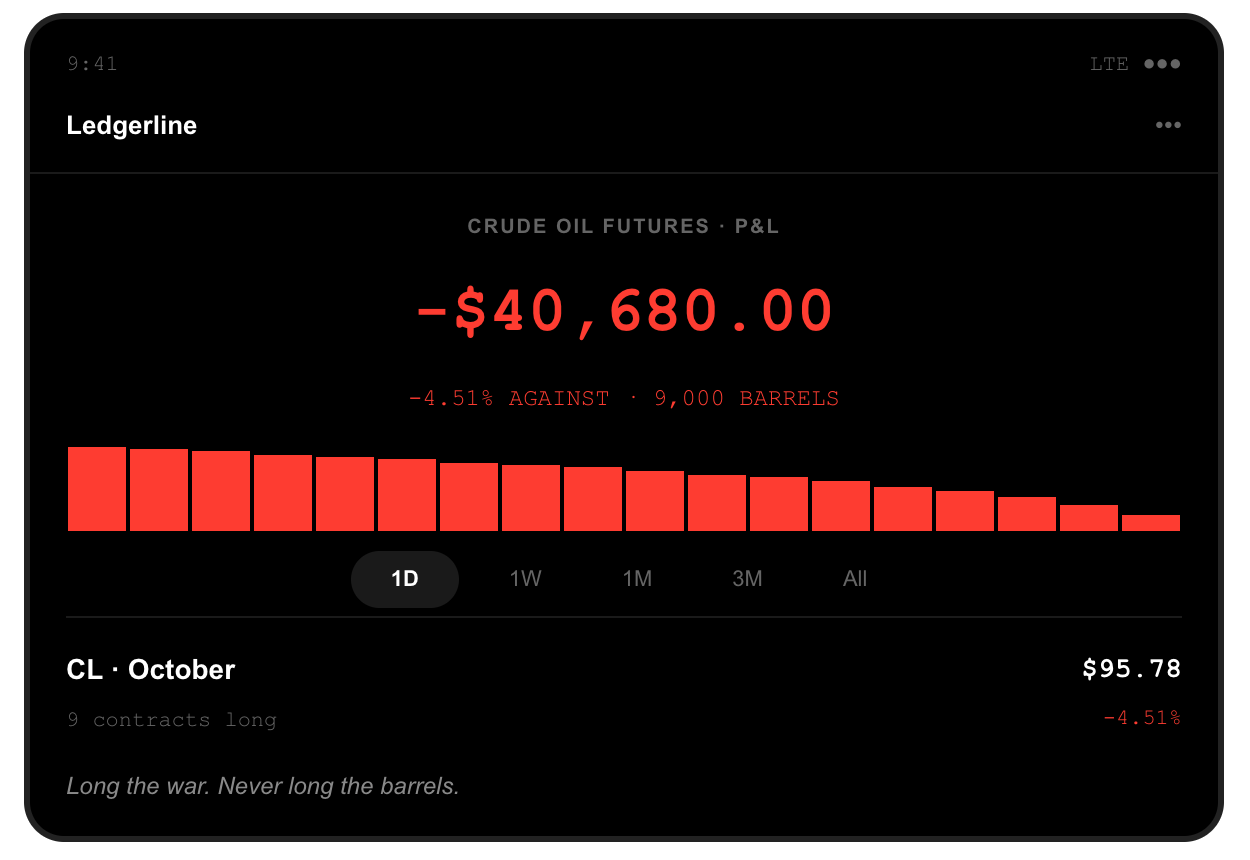
DARWIN AWARD OF THE WEEK 🏆 Every issue we crown the single worst financial decision on the internet. This week it goes to a man who was long a war premium and thought it was a position. Here's the setup. u/the_premium_only_goes_up was long nine October crude contracts, which is nine thousand barrels of West Texas Intermediate. At Friday's settlement of $100.30 that is about $902,700 of oil, held by someone whose entire thesis was that the fighting between the United States and Iran was not going to stop. He had a reasonable week behind him. Crude had run hard on the war and the whole market had been rattled by it. Then on Monday the President indicated he was open to meeting the Iranian leadership at the United Nations General Assembly. Saudi exports were also recovering, which is the part of the move that involved actual barrels. West Texas Intermediate settled at $95.78, down $4.52, or 4.51%. Brent settled at $100.34, down $3.53. Both benchmarks closed at their lowest since September 9. Nine thousand barrels, down $4.52 each, is $40,680. He was never long oil. He was long the absence of a meeting, and nobody had told him what that was worth until it was taken away.
Here's the thing. A geopolitical risk premium is not a return, it is a price you are paying for the chance that things get worse. When you buy crude in the middle of a war, part of what you buy is oil and part of what you buy is fear, and only one of those two has a supply curve. The fear component can be removed by a sentence. It does not need a ceasefire, a treaty or a single barrel to change hands. It needs the market to think the distribution of outcomes got slightly less bad, and on Monday the distribution moved because somebody said they would be willing to sit down. That is the part worth understanding, and it cost him $40,680 to learn that the premium he was collecting was the premium he was paying.
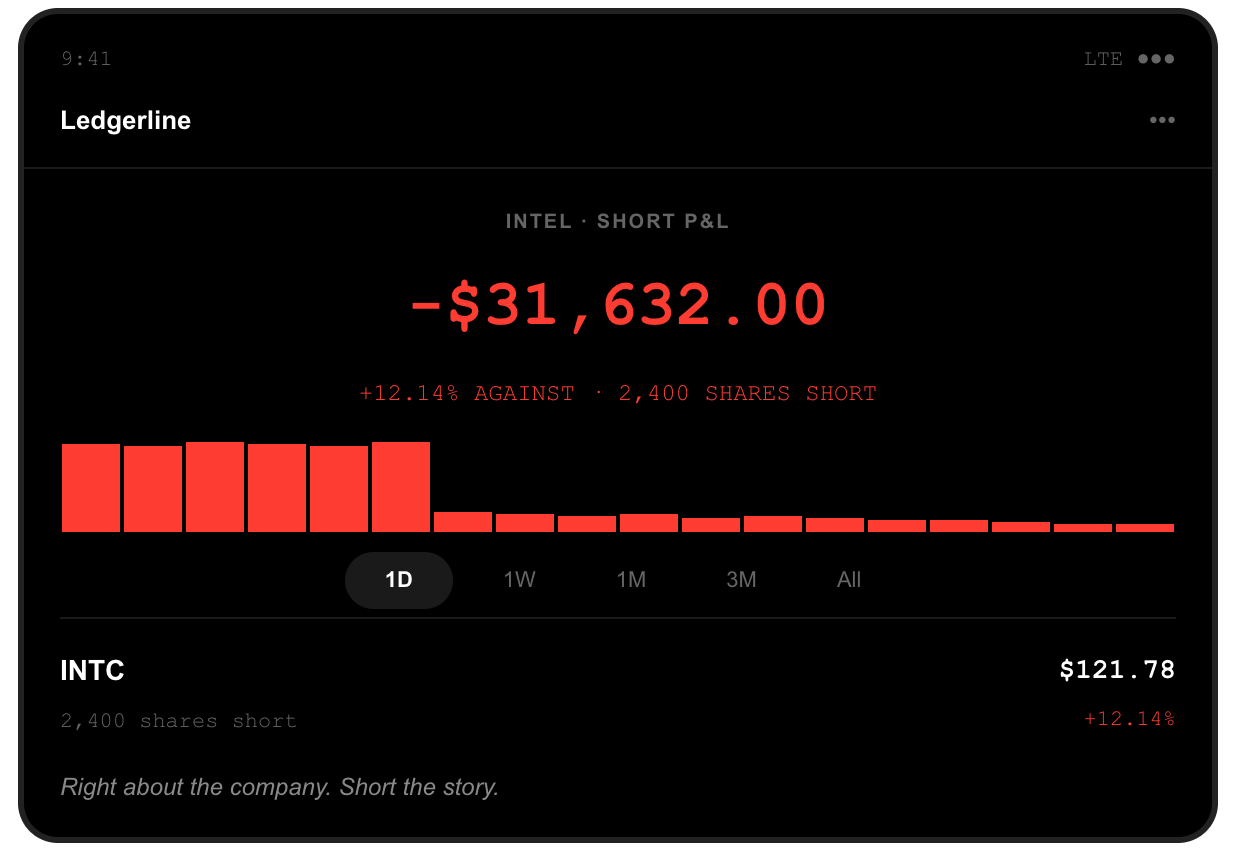
THIS WEEK'S CASUALTIES 💀 Not everybody can be Darwin Award of the week. These three gave it a real shot. Let's run through the tape. Casualty #1: The Man Who Was Short The Boring Chip u/nobody_needs_a_cpu was short 2,400 shares of Intel, about $260,600 of exposure at Friday's close of $108.60. His thesis was not stupid. The artificial intelligence build-out has been a graphics processor story for three years, and Intel has spent that period reporting losses at the bottom line and giving up processor share to AMD. The trade had already gone against him once. Intel closed up 7.67% on Thursday, at $108.80, and then did nothing at all on Friday. He read the flat Friday as the excitement burning off, which is a thing shorts say on the second day of a move. Over the weekend Meta's personal agent, Muse, sat at the top of the United States free iPhone chart, where it had been since Friday. Muse sorts email, books restaurants and manages calendars, and the market spent Monday working out what that kind of software actually runs on. The answer the market arrived at was inference, planning and orchestration, which lean harder on central processors than model training ever did. Intel closed at $121.78, up $13.18, or 12.14%. Arm rose 17.16%, AMD 9.95%, and Meta itself 11.43%. 2,400 shares short, up $13.18 each, is $31,632. Intel announced nothing on Monday. Somebody else released an app, and the market repriced what Intel's existing products might be for.
Here's the thing. A short is a position on a price, and a price is a story plus a number. You can be completely right about the number and still lose, because the story is the part that moves first and the part that moves furthest. The specific danger with a neglected asset is that neglect is cheap to reverse. Nobody has to build anything for a market to remember that a category exists. And the reversal tends to be violent precisely because the thing was neglected, since everyone who wanted to be short already was. That is the part worth understanding, and it cost him $31,632 to learn that being short an old story is the same as being short a new one arriving.
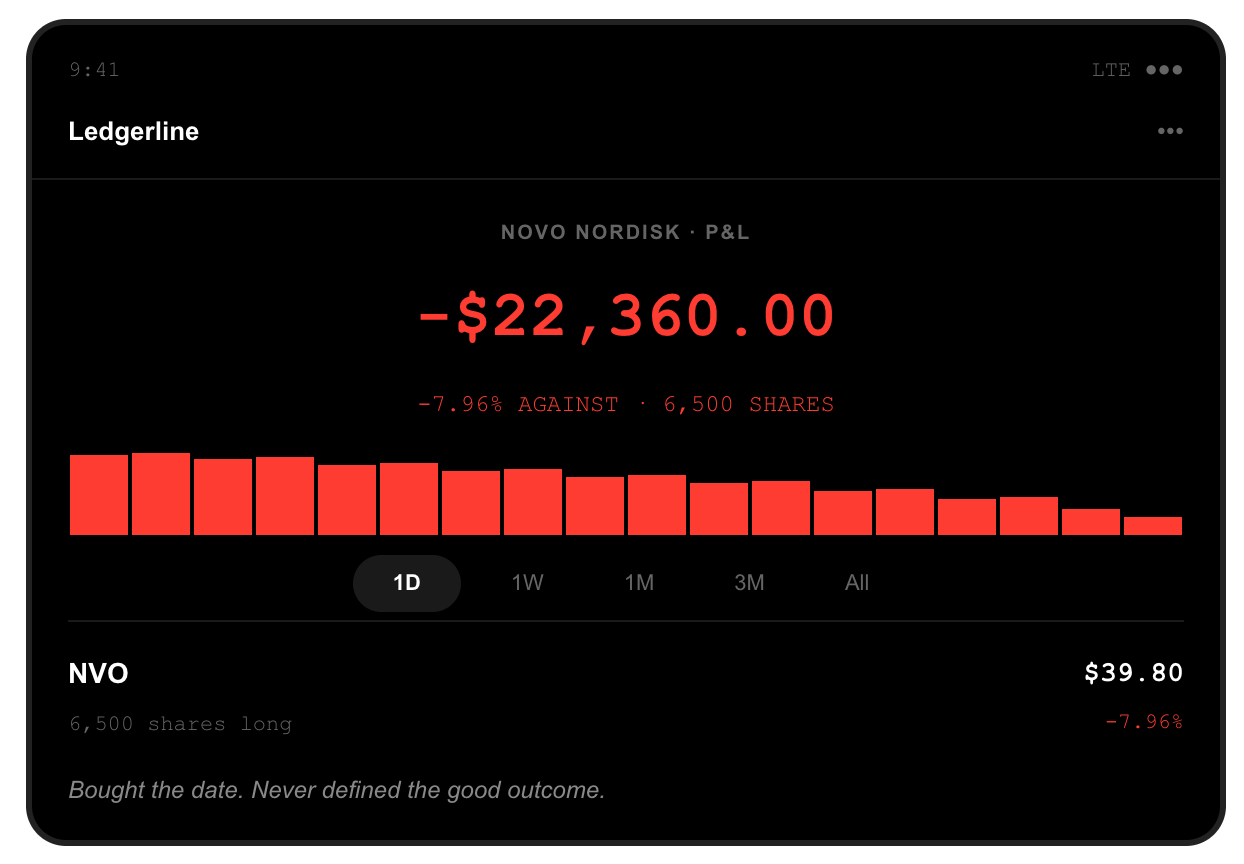
Casualty #2: The Man Who Bought The Date u/i_showed_up_for_the_catalyst owned 6,500 shares of Novo Nordisk, about $281,000 at Friday's close of $43.24. He bought it for Monday. Novo held its capital markets day in London, and a capital markets day is a date on a calendar that a certain kind of investor treats as a catalyst. The stock had already been through a great deal, and was trading on single-digit earnings, which made the setup feel like a coiled spring rather than a falling one. The company did not disappoint on ambition. It promised more than five multi-blockbuster launches by 2030 and at least ten Phase 3 programmes running at once. It said it would scale capacity to serve ten times as many people with obesity on oral GLP-1, and to reach more than sixty million patients globally by 2030. It put a figure on the pipeline: more than 150 billion Danish kroner of risk-adjusted sales, by in 2035. And then it said the thing that did the damage, which was that revenue would compound between 2026 and 2030 in line with its industry peers, on a broadly stable operating margin. The New York listing settled at $39.80, down $3.44, or 7.96%. 6,500 shares, down $3.44 each, is $22,360.
Here's the thing. He did not own Novo Nordisk, he owned Monday afternoon, and those are different assets with different risks. A company that describes 2030 in the language of its peer group has told you it no longer expects to be described separately from them. That is a multiple statement rather than an earnings statement, and multiples are what actually move share prices on days with no results in them. The 2035 figure is the tell. A number nine years out is a number nobody in the room will ever be scored against, and the market discounts it accordingly. That is the part worth understanding, and it cost him $22,360 to learn that buying a catalyst without defining the good outcome is just buying volatility and hoping.
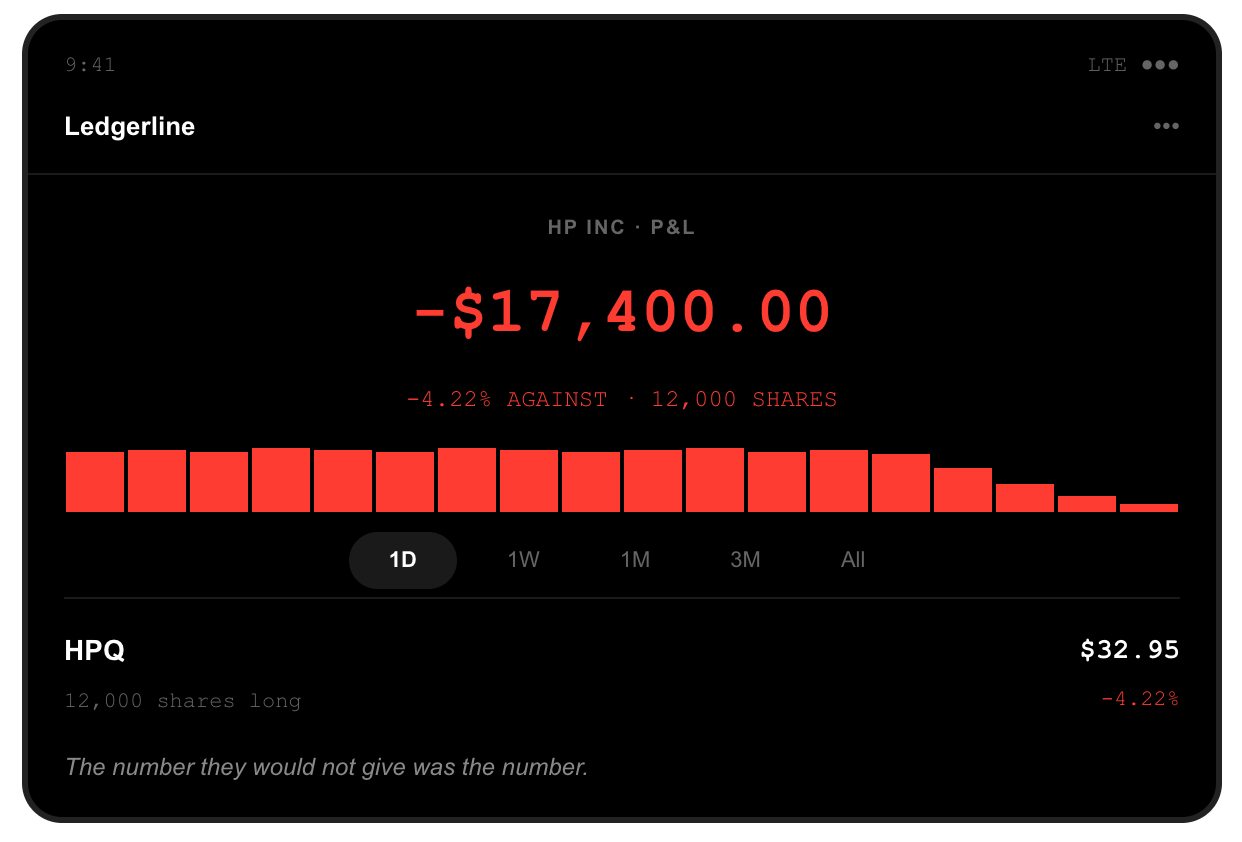
Casualty #3: The Man Who Wanted A Number And Got A Planning Period u/twelve_times_earnings_is_free owned 12,000 shares of HP, about $412,800 at Friday's close of $34.40. He owned it for the arithmetic. About thirteen times trailing earnings, a $1.20 annual dividend, and a business that sells things people demonstrably keep buying. The stock had also just jumped 5.99% on Thursday, which he read as the market coming round to his view. On Monday there was no investor day, no analyst meeting and no earnings release. HP filed an 8-K with the Securities and Exchange Commission. In it the company declined to give financial guidance for fiscal 2027 at all, saying it remains in its planning period and that specific outlook metrics would be premature. It did offer one number, and it was the wrong kind: industry-wide personal computer unit volumes declining roughly mid single digits in calendar 2027 against 2026. Even that came with a caveat, flagged as an assumption subject to how the second half of this year turns out. HP closed at $32.95, down $1.45, or 4.22%, on a day the Nasdaq rose 2.26%. 12,000 shares, down $1.45 each, is $17,400. He came for a cheap multiple and discovered that the denominator had been declared unavailable.
Here's the thing. Refusing to forecast is a forecast, and every professional in the room reads it the same way. A management team that is confident gives a wide range and takes the credit for the top of it. A management team that withholds is telling you the bottom of its own range is not something it wants to say out loud. The low multiple was never the bargain he thought it was, because a multiple is a price divided by a forecast and he had only ever verified the price. Monday he found out the other half of the fraction was still being negotiated internally, which is the least comfortable place a value case can live. That is the part worth understanding, and it cost him $17,400 to learn that cheap is a claim about the future and the company had just declined to make it.
THIS WEEK BY THE NUMBERS 📊 We track the data because the data is funnier than anything we could make up.
The S&P 500 rose 1.49% on Monday and the Nasdaq 2.26%. Three weeks ago this newsletter handed a casualty slot to a man who was short crude into a weekend strike, and lost $28,320 because the war got worse. Monday's winner lost more than that on the other side of the same boat, because it might be about to get better.
BITE-SIZED COPIUM FOR THE ROAD 🍿 The best part of any loss thread isn't the screenshot. It's the comments section. Here are this week's greatest hits.
Translation: four men owned a narrative and filed it under research.
DUMB MEMES 😂 Every newsletter needs a meme section. Ours just hits different when the only thing that moved was the story.
POV: you were long the absence of diplomacy
u/nobody_needs_a_cpu, refreshing the tape If you laughed, you're coping. If you didn't laugh, go and look at your largest position and write down which part of it is the asset and which part is the story. See you next issue. Nothing was reported. Everything was repriced. Traders and P&L screenshots are satirical composites. Market data, price moves and quotations are real and dated September 17 to September 21, 2026. Not financial advice. Obviously. Look at us. Stay liquid, |
Nobody reported a number on Monday. Four people lost $112,072 anyway
A possible meeting took $4.52 a barrel out of crude, an email-sorting app put 12.14% on Intel, Novo's plan for 2035 cost 7.96% in an afternoon, and HP declined to forecast next year at all.