|
GM. This is The Financial Darwin Awards, rounding up the internet's biggest Ls so you don't make them yourself. The Fed hiked on Wednesday, stocks fell, and then spent Thursday and Friday deciding it was fine. Underneath that, three people found out that knowing what a company does tells you very little about what is in its price. Three people lost $70,180 between them. All three could have described their company accurately. None of them could have described the position. The traders are composites. The moves are not. Here's what we've got today:
THIS WEEK'S DAMAGE REPORT 📊
The first number is the sum of the three stories below. The second is real: Xenon Pharmaceuticals closed Friday down 30.69%, on a day its epilepsy filing was reported to be on track.
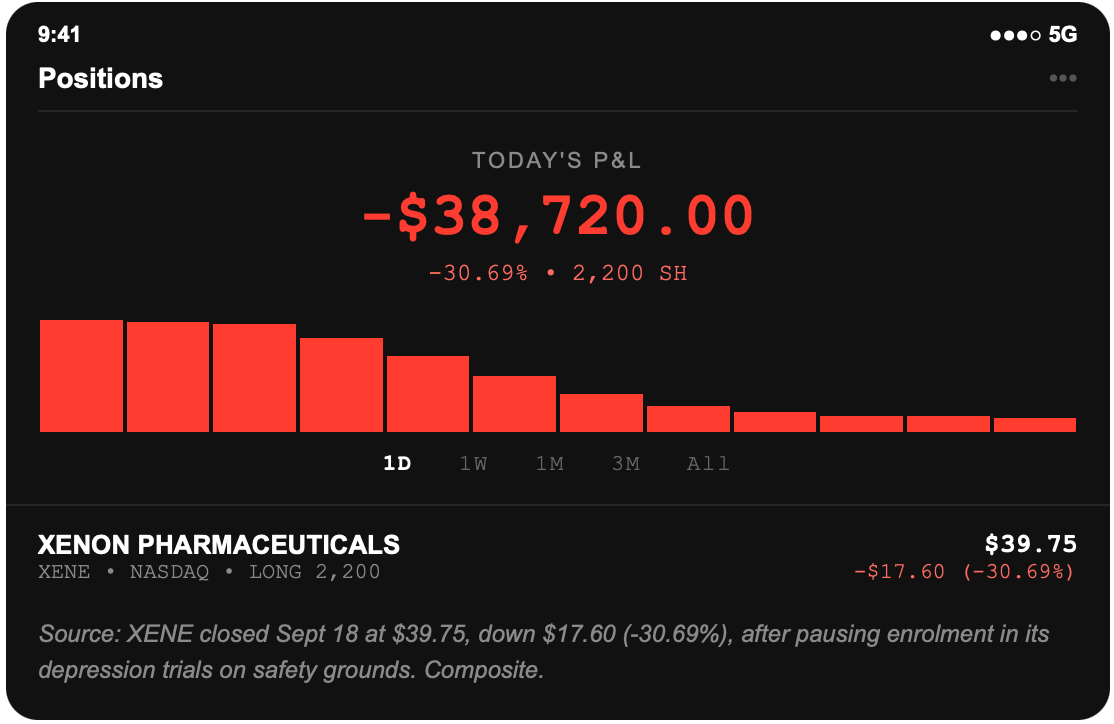
DARWIN AWARD OF THE WEEK 🏆 Every issue we crown the single worst financial decision on the internet. This week it goes to a man who counted his shots on goal without checking how many balls he had. Here's the setup. u/two_shots_on_goal owned 2,200 Xenon Pharmaceuticals shares, about $126,170, at Thursday's close of $57.35. Xenon has one important drug, azetukalner. It is being developed for two things at once. The first is epilepsy, where the regulatory filing for focal onset seizures is the near-term event. The second is major depressive disorder, a far larger market and the reason the stock carried the valuation it did. He described this to himself as two shots on goal. Two indications, two chances, one price. On Friday the company paused new patient enrolment in the depression trials, citing emerging reports of adverse neuropsychiatric side effects seen during patient monitoring. That is not one shot missing. It is a finding about the molecule. The same compound is in both programmes, and the regulator reading the epilepsy application also reads the depression safety data. Xenon closed at $39.75, down $17.60, or 30.69%. 2,200 shares, down $17.60 each, is $38,720. RBC kept an Outperform rating and cut its target to $70, which tells you the analysts think the epilepsy drug still works. The market was never paying for the epilepsy drug.
Here's the thing. Two indications for one compound are not two bets, they are one bet on the compound and two bets on the market for it. That is the part worth understanding, and it cost him $38,720 to learn that a safety signal does not stay in the trial where it was found.
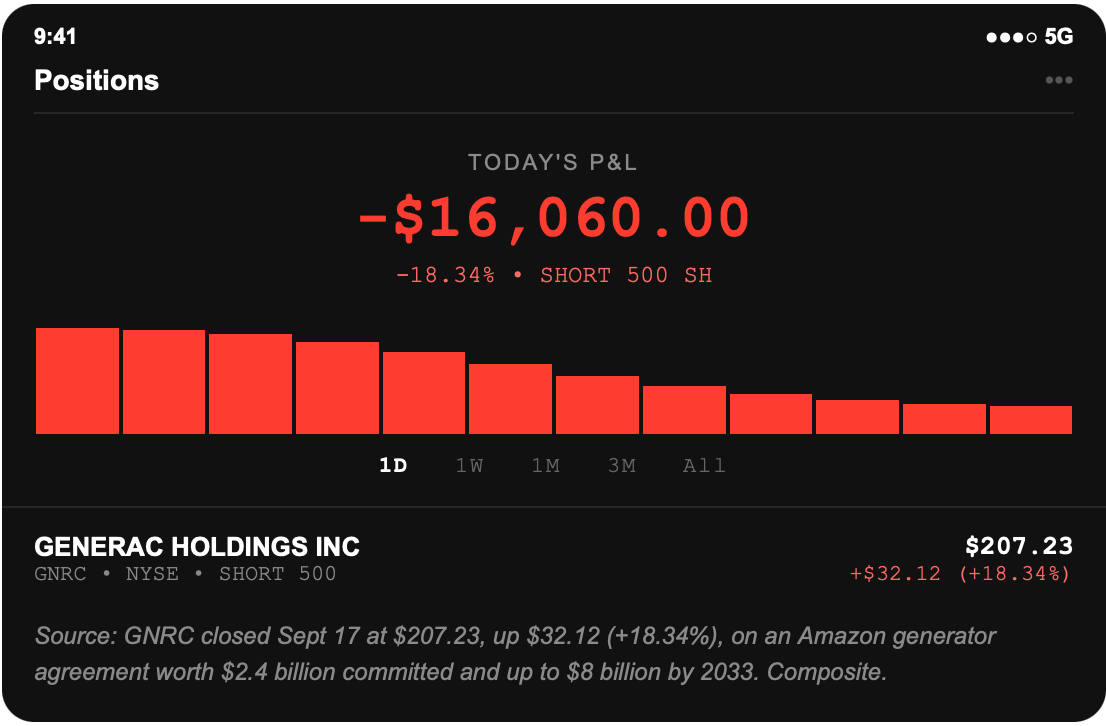
THIS WEEK'S CASUALTIES 💀 Not everybody can be Darwin Award of the week. These two also read the business correctly. Casualty #1: The Man Who Shorted A Generator Company u/it_makes_generators was short 500 Generac shares, about $87,555, from Wednesday's close of $175.11. His case was tidy. Generac sells standby generators to houses and small businesses, demand tracks storms and outages, and the stock had run. That description of the company was accurate on Wednesday and useless on Thursday. Generac disclosed an agreement to supply backup generators for Amazon data centres: $2.4 billion committed across 2027 and 2028, inside a framework that could reach $8 billion by 2033. Amazon also took a warrant over up to 1.69 million Generac shares at $200.93. Most of it vests in tranches as Amazon buys more generators. Read that last part again. The customer gets paid in the supplier's stock for being a bigger customer. Generac closed at $207.23, up $32.12, or 18.34%. 500 shares, against him by $32.12 each, is $16,060. It traded as high as $223.23 during the session, which would have been its best day on record.
Here's the thing. The AI build-out needs electricity long before the grid can supply it, so the money keeps arriving at unglamorous companies that already make the boring equipment. That is the part worth understanding, and it cost him $16,060 to learn that a company is what its customers decide it is.
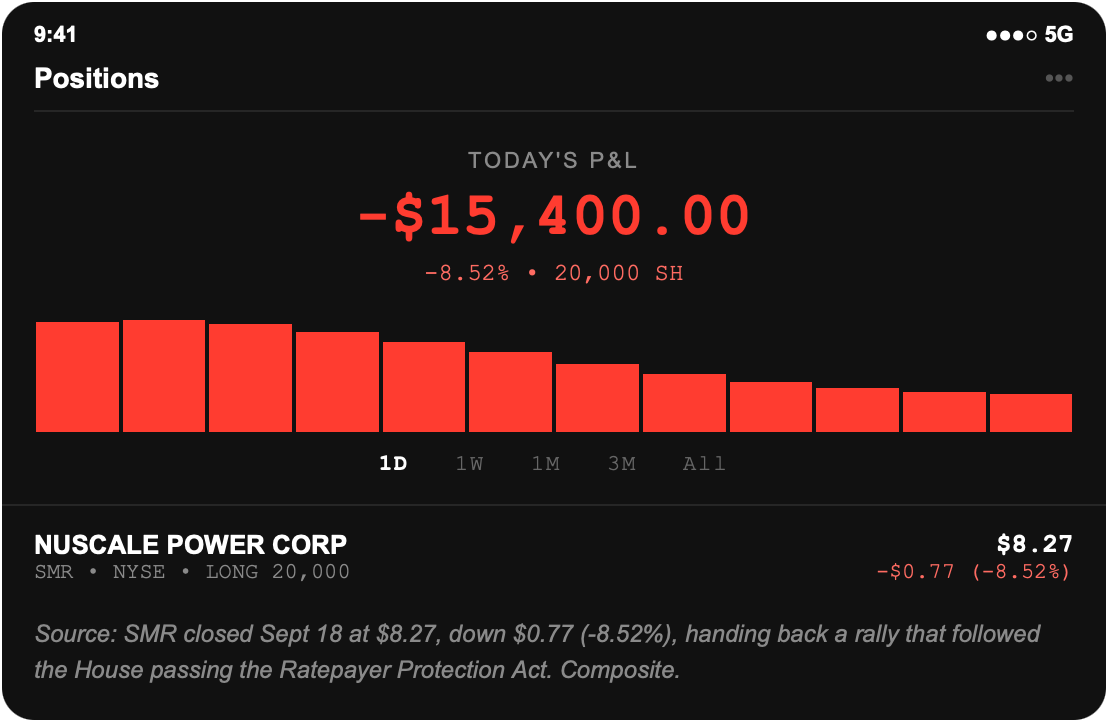
Casualty #2: The Man Who Traded The Legislature u/policy_is_a_catalyst owned 20,000 NuScale Power shares, about $180,800, at Thursday's close of $9.04. He had bought them that morning, and for a good reason. The House had passed the Ratepayer Protection Act on Wednesday by 417 votes to 3, requiring large energy users such as data centres to cover the generation, transmission and grid upgrades they need rather than spreading the cost across every other bill payer. That makes dedicated power more attractive, which makes small modular reactors more attractive. Nuclear names rallied on Thursday. Then Friday arrived and the sector handed it straight back, Oklo and Centrus Energy along with it. NuScale closed at $8.27, down $0.77, or 8.52%. 20,000 shares, down 77 cents each, is $15,400. The bill has passed one chamber. NuScale will not sell a reactor because of it this year, or next.
Here's the thing. Legislation changes what is profitable years out, and a stock that moves on the vote is pricing the sentiment rather than the cash flow. That is the part worth understanding, and it cost him $15,400 to learn that one chamber is not a law and a law is not a customer.
THIS WEEK BY THE NUMBERS 📊 We track the data because the data is funnier than anything we could invent.
The S&P 500 rose 1.14% on Thursday and 0.17% on Friday, finishing the week at 7,650.50. The index spent two sessions undoing Wednesday. None of these three got the benefit.
BITE-SIZED COPIUM FOR THE ROAD 🍪 The best part of any loss thread is the comments.
Translation: three accurate descriptions, three prices about something else.
DUMB MEMES 🤣 Ours hits different when you could have passed the company quiz.
POV: your spare tyre is made of the same rubber
u/it_makes_generators, correct about the product If you laughed, you're coping. If you didn't, go and write down what your largest position is actually priced for. See you next issue. The business you own is not the story in the price. Traders and P&L screenshots are satirical composites. Market data, company announcements and price moves are real and dated September 17 and 18, 2026. Not financial advice. Stay liquid, |
The business you own is not the story in the price.
A biotech filed the application for its lead drug and fell 30.69%, a generator company was repriced as AI infrastructure on a $2.4 billion Amazon deal, and a reactor developer handed back a rally that a bill in the House had given it.