|
GM. This is The Financial Darwin Awards, the only financial newsletter with a 100% loss rate. Friday was a good day and a good week. The S&P 500 rose 0.51% and finished within about 0.7% of its record, after the first winning week in three. The four people below managed to lose money in it, and they have something in common. Each of them could quote you a number that supported the position, and in each case it was not the number holding the price up. Four traders lost $122,388 between them, and not one of the numbers they were quoting was wrong. They were just load-bearing in the way a picture hook is load-bearing. The traders are composites. The moves are not. Here's what we've got today:
THIS WEEK'S DAMAGE REPORT 📊
The first number is the sum of the four stories below. The second is real: Leslie's closed Friday at $0.29 while preparing to file for Chapter 11, and the average price target on it is still $2.38, from two analysts, last updated in May.
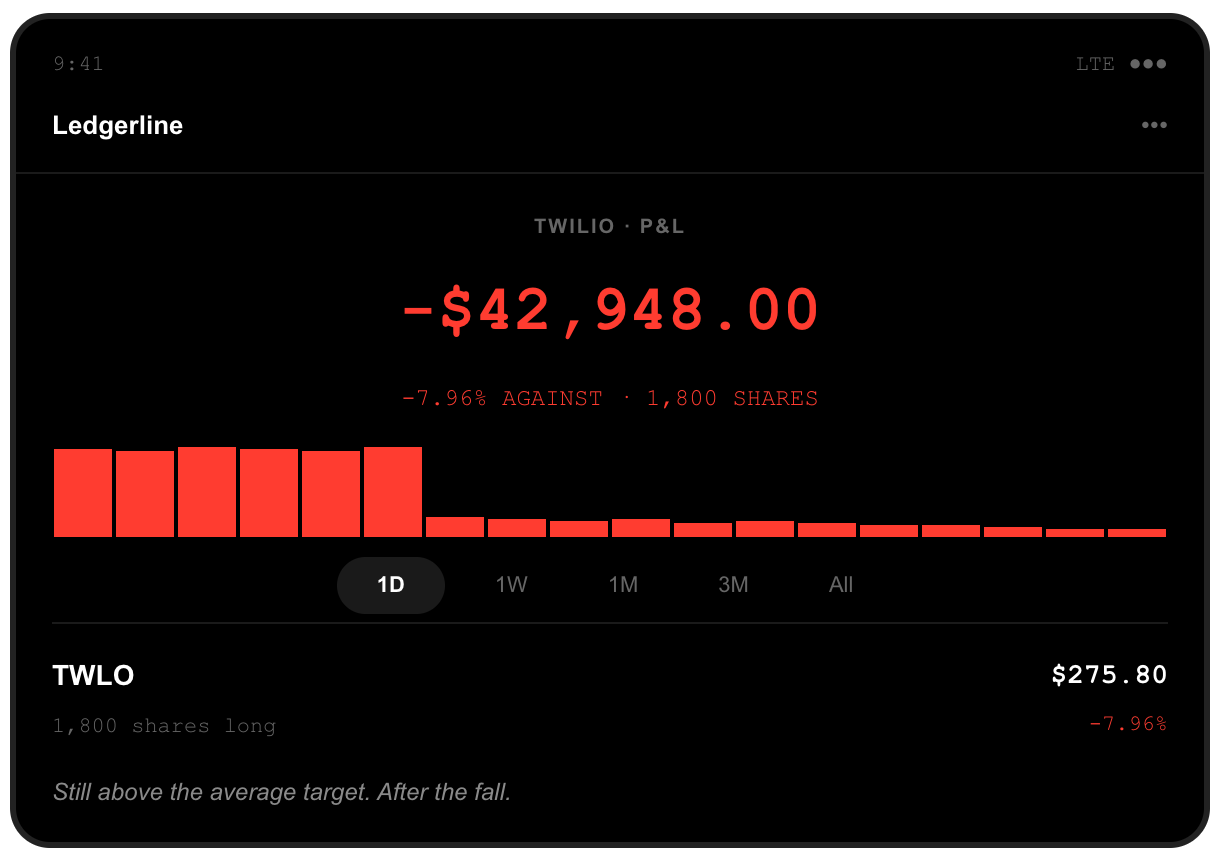
DARWIN AWARD OF THE WEEK 🏆 Every issue we crown the single worst financial decision on the internet. This week it goes to a man who owned a stock that was already worth more than anybody covering it thought it was worth. Here's the setup. u/the_target_says_higher owned 1,800 shares of Twilio, about $539,000 at Thursday's close of $299.66. He had every reason to feel clever. The shares are up about 182% over twelve months and had added roughly 30% since September 8 alone. On Friday HSBC's Sameer Lam cut the stock to Reduce from Hold with a $211 price target. The note was not really about the business. It argued the recent rally had gone too far, flagged competition from Bandwidth and Sinch, and called 45.3 times earnings hard to justify. Two other firms had gone the other way the same week, with Rosenblatt raising its target to $290 and TD Cowen to $300, both on Tuesday. Twilio closed at $275.80, down $23.86, or 7.96%, on a day the S&P 500 rose 0.51%. 1,800 shares, down $23.86 each, is $42,948. Here is the part that was visible from his own screen on Thursday morning. The average price target across 30 analysts is $263.04. After falling 7.96%, the stock is still 4.6% above it.
Here's the thing. When a share price passes the average of what the people paid to value it think it is worth, something specific has happened. The marginal buyer has stopped being somebody with a spreadsheet and started being somebody with a view on the direction. That is not automatically wrong. The spreadsheets are often slow, and the view is often right for months at a time. It does change what you are exposed to. Above the consensus you are no longer protected by a valuation argument, because there is not one left to make. That is the part worth understanding, and it cost him $42,948 to learn that the gap between the price and the target is the amount of optimism he was personally underwriting.
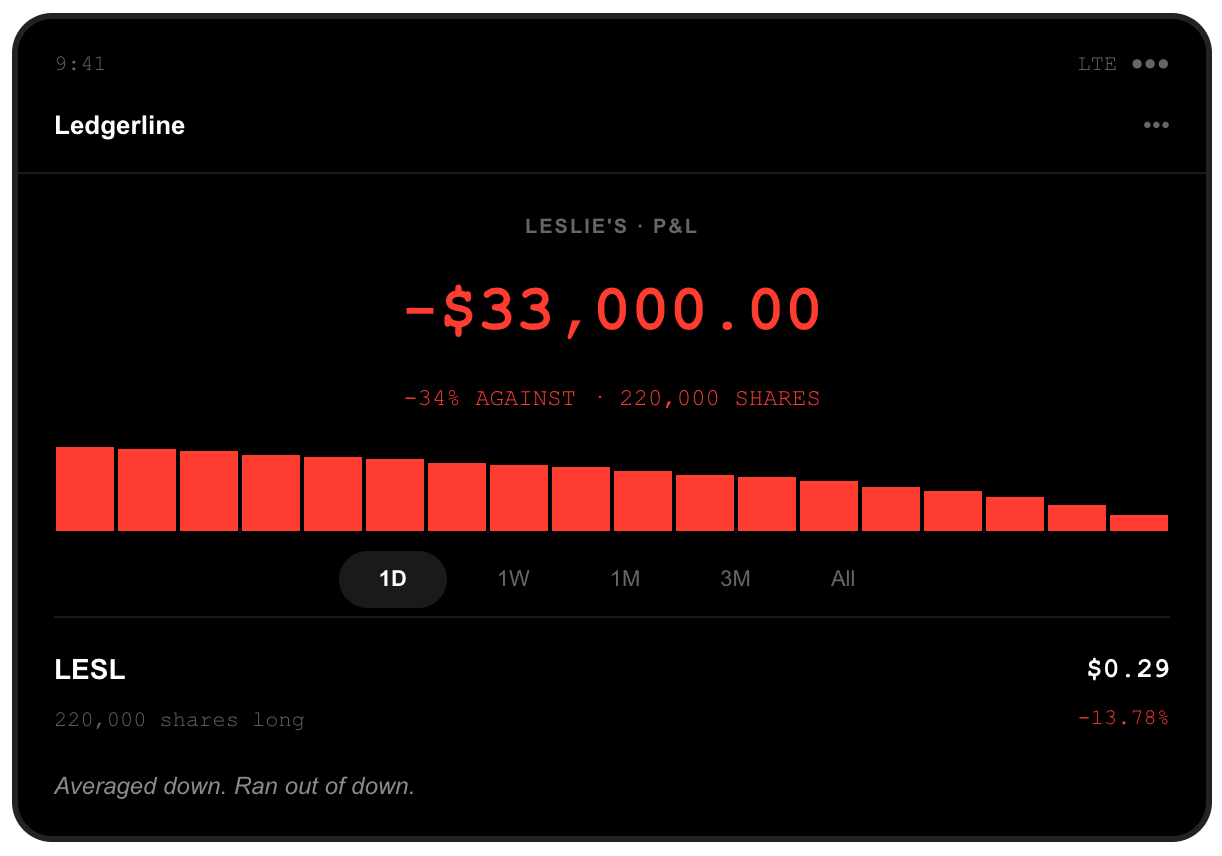
THIS WEEK'S CASUALTIES 💀 Not everybody can be Darwin Award of the week. These three gave it a real shot. Let's run through the tape. Casualty #1: The Man Who Averaged Down Into A Bankruptcy u/it_is_a_pool_business owned 220,000 shares of Leslie's, the pool and spa retailer, about $96,800 at Tuesday's close of $0.44. That position was not built in one go. It was built by buying more every time the price fell, which is how a small mistake becomes a large one with no single moment you can point at. The thesis was never stupid. Leslie's still does about $1.18 billion of revenue a year and people keep owning swimming pools. Bloomberg had already reported back in July that the company was weighing a Chapter 11. On Thursday it reported that the filing was actually coming. The Wall Street Journal followed the same evening with the shape of it, including roughly $100 million of debtor-in-possession financing and about $750 million of debt converting to equity. The stock fell 19.00% on Thursday and another 13.78% on Friday. Leslie's closed Friday at $0.29, down about 34% from Tuesday, and $12.24 below its 52-week high of $12.53. 220,000 shares, down about $0.15 each across those three sessions, is $33,000. The average analyst price target is $2.38. It comes from two analysts and was last updated in May, four months before any of this.
Here's the thing. Averaging down is a perfectly good technique attached to an assumption almost nobody checks. The assumption is that the price is falling faster than the value. In a company heading for a restructuring, the value is falling faster. There is also a structural problem with the equity of a distressed business that has nothing to do with whether the business is any good. It is last in the queue, and the queue is the entire point of a Chapter 11. That is the part worth understanding, and it cost him $33,000 in three sessions to learn that cheaper is a comparison to the last price, not to anything real.
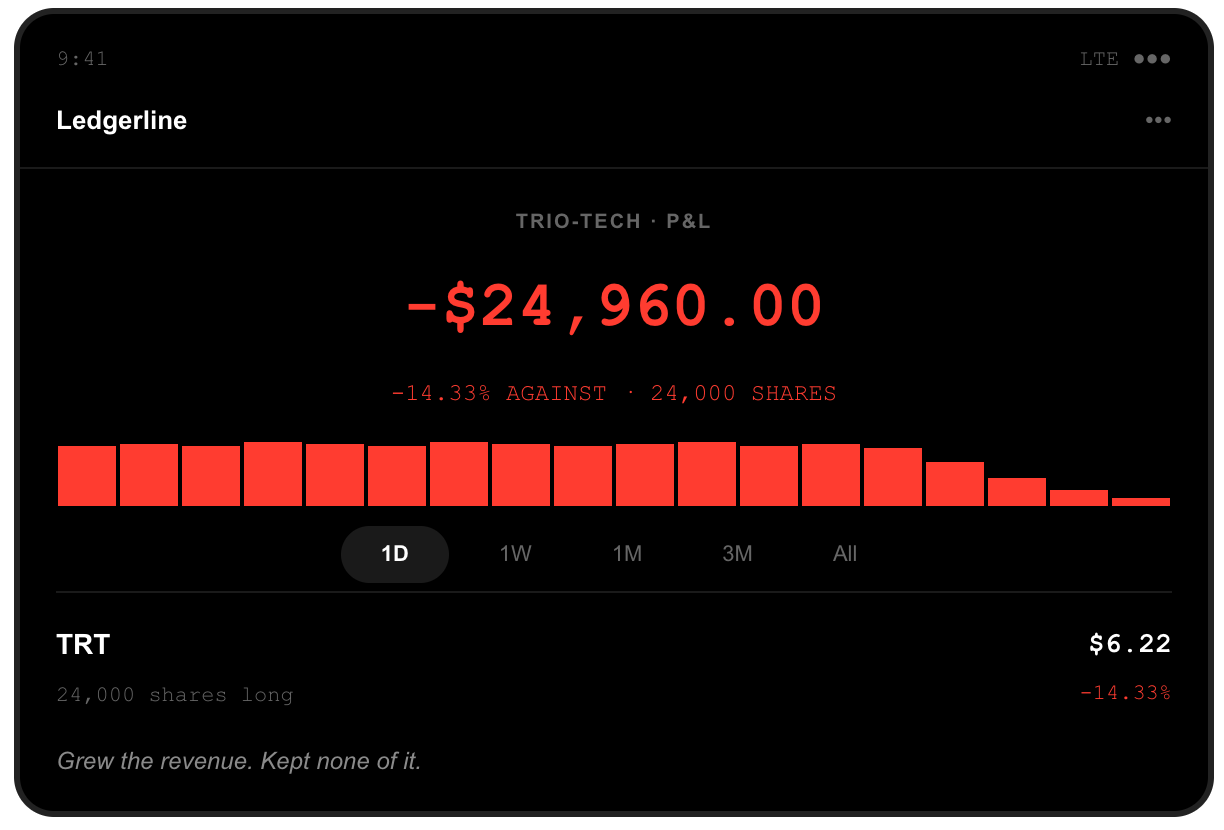
Casualty #2: The Man Who Held Through Day One u/seventy_two_percent_growth owned 24,000 shares of Trio-Tech, a semiconductor back-end testing company, which he had found the way people find these things, by screening for revenue growth. The growth was genuine. Fiscal 2026 revenue rose 71.65% to $62.61 million, on burn-in work for AI accelerator platforms and a three-year automotive contract with minimum billings of about $4.7 million. On Thursday morning the company published the full year. Revenue up almost 72%, and a net loss for the year of $34,000. That is not a large loss. It is a rounding error against $62.61 million of revenue, which is exactly what makes it informative. The stock fell 36.59% that day, to $7.26. He did not sell, because the contracts were real and the selloff looked like an overreaction. On Friday Trio-Tech fell another $1.04, or 14.33%, to close at $6.22. 24,000 shares, down $1.04 each, is $24,960, on top of what Thursday had already done. Revenue grew by $26.13 million over the year and the company converted none of it into profit.
Here's the thing. Revenue growth only means something in combination with what happens to the money further down the page. A company that adds $26 million of revenue and finishes the year at a loss has told you the incremental margin on that revenue is close to zero. That is a real piece of information about pricing power, and it is more durable than a growth rate, because growth rates are volatile and cost structures are sticky. It also tends to get worse rather than better with scale in a services business, because the largest customers are the ones with the most leverage over the price. That is the part worth understanding, and it cost him $24,960 on Friday alone to learn that a screen sorted by revenue growth is a list of companies selling things, not a list of companies making money.
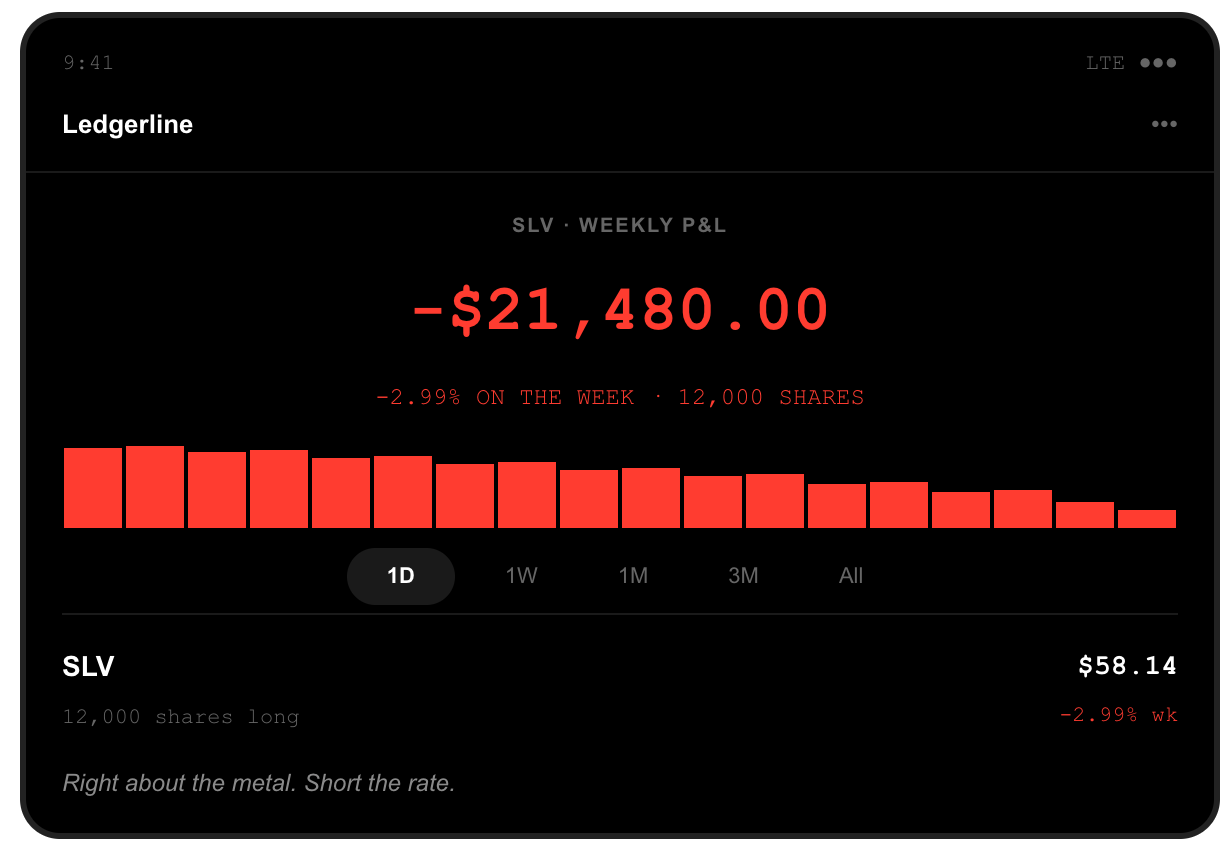
Casualty #3: The Man Who Was Right About The Deficit u/the_deficit_is_structural owned 12,000 shares of SLV, the silver trust, about $719,000 at the previous Friday's close of $59.93. His case was the good one, and it is genuinely true. Silver has run consecutive annual supply deficits driven by solar, electronics and grid demand, and none of that changed last week. What changed was the price of everything silver competes with. The ten-year Treasury yield reached about 5.10% on Wednesday, its highest since 2007. The dollar went to a two-month high, and business activity data came in at its strongest in more than five years. Silver fell 4.23% on Wednesday alone and did not get it back. SLV closed the week at $58.14, down $1.79, or 2.99%, from the previous Friday. 12,000 shares, down $1.79 each, is $21,480. Gold fell too, by rather less. That difference is the whole lesson.
Here's the thing. Silver is two assets wearing one ticker, and they do not always want the same weather. Part of it is a monetary metal, which competes with cash and therefore falls when the risk-free yield rises and the dollar strengthens. The other part is an industrial input, priced off manufacturing demand, which is why silver carries a growth discount that gold simply does not have. A week of rising real yields hits the first half, and a week of doubts about the cycle hits the second. Last week the first half did the damage, and the second half offered no shelter at all. That is the part worth understanding, and it cost him $21,480 to learn that a correct view about supply over ten years does not stop the price being set by the dollar on a Wednesday.
THIS WEEK BY THE NUMBERS 📊 We track the data because the data is funnier than anything we could make up.
The S&P 500 rose 0.51% on Friday, the Dow 0.93% and the Nasdaq 0.48%. It was the market's first winning week in three, and it ended within about 0.7% of the record set in August. Four numbers were quoted all week in defence of four positions. None of them were the ones doing the work.
BITE-SIZED COPIUM FOR THE ROAD 🍬 The best part of any loss thread isn't the screenshot. It's the comments section. Here are this week's greatest hits.
Translation: everybody had a number. Nobody had asked what it was holding.
DUMB MEMES 😑 Every newsletter needs a meme section. Ours just hits different when the research note was already on your own screen.
POV: you are the premium to fair value
u/it_is_a_pool_business, buying the dip four times If you laughed, you're coping. If you didn't laugh, open your largest position and check whether it sits above or below the average price target on it. See you next issue. There is always a number that supports the story, and a different one holding up the price. Traders and P&L screenshots are satirical composites. Market data, price moves and quotations are real and dated September 18 to September 25, 2026. Not financial advice. Obviously. Look at us. Stay liquid, |
Everybody quoted a number on Friday. None of them were the load-bearing one.
Twilio fell 7.96% and is still above its average price target. A pool retailer heading into Chapter 11 carries a $2.38 target last updated in May. Four traders lost $122,388 in the market's best week in three.