|
GM. This is The Financial Darwin Awards, the only financial newsletter with a 100% loss rate. On Wednesday the ten-year Treasury yield closed at 5.106%, which is the highest it has been since 2007. The five-year traded through 5% for the first time in nineteen years. The thirty-year closed at about 5.40%, up roughly eleven basis points. None of that is a market event in the way a crash is. It is an arithmetic event, and it reprices anything whose payoff is a long way away. Four traders lost $116,642 between them, and all four of them owned something that pays later rather than now. One of them owned a hamburger chain and thought that was a short-dated asset. The traders are composites. The moves are not. Here's what we've got today:
THIS WEEK'S DAMAGE REPORT 📊
The first number is the sum of the four stories below. The second is real: the ten-year Treasury yield rose about 14 basis points on Wednesday to 5.106%, its highest close since 2007.
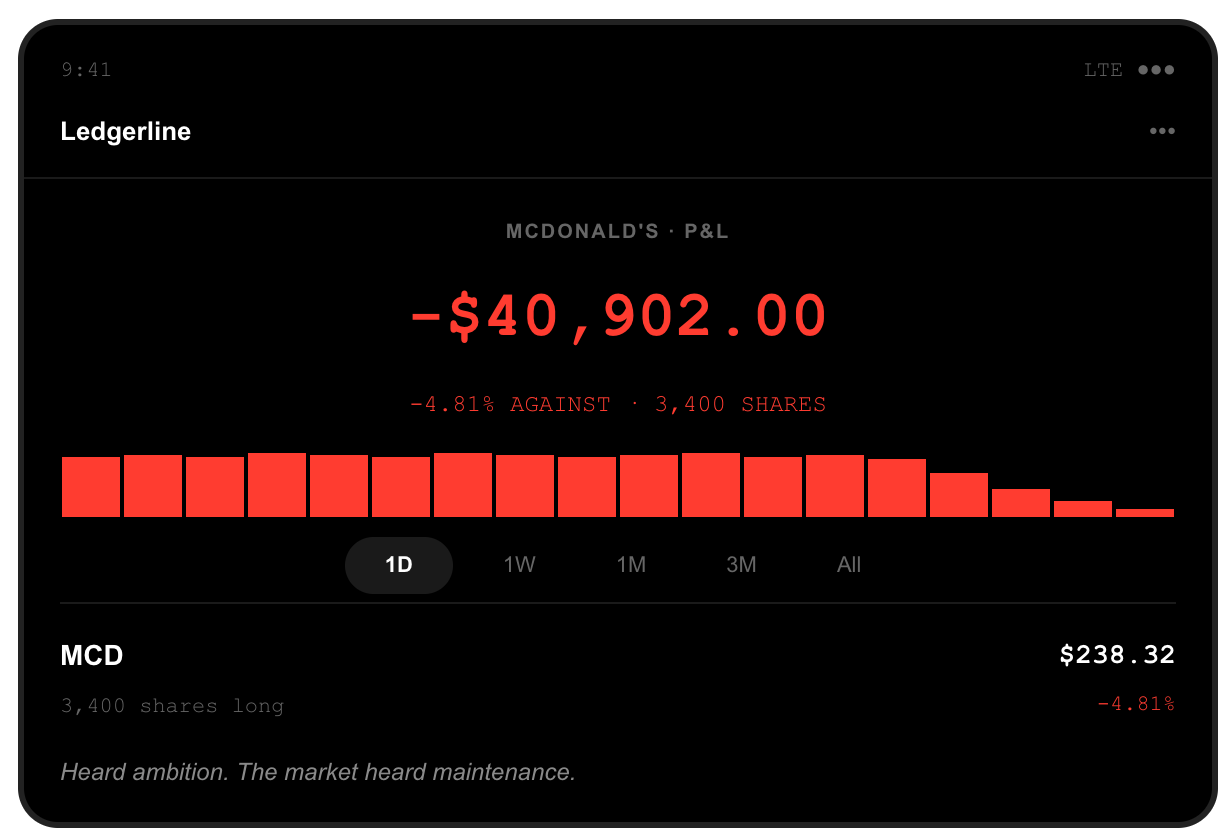
DARWIN AWARD OF THE WEEK 🏆 Every issue we crown the single worst financial decision on the internet. This week it goes to a man who heard a company promise to spend $8.5 billion and understood it as ambition. Here's the setup. u/the_arches_always_compound owned 3,400 shares of McDonald's, about $851,000 at Tuesday's close of $250.35. He had owned it for years, through everything, on the entirely reasonable view that it is the best business in restaurants and the share price would eventually agree. Two issues ago this newsletter noticed McDonald's sitting at 52-week lows ahead of its investor day and passed on it, because nothing had actually happened yet. On Wednesday something happened. The company held the investor day and laid out a plan called NEXT, targeting 1.5 percentage points of market share in chicken and in beverages by 2030. It also committed $8.5 billion of investment through 2036, for restaurant modernisation and franchisee support. And in the same presentation the chief executive, Chris Kempczinski, said the company expects industry traffic growth in its wholly owned markets to be flat while inflation stays elevated. McDonald's closed at $238.32, down $12.03, or 4.81%, on a day the S&P 500 fell 0.76%. 3,400 shares, down $12.03 each, is $40,902. He heard a company announce a decade of spending. The market heard a company announce the price of staying where it is.
Here's the thing. A large capital programme is either an investment or a repair bill, and the press release is written so that both readings fit. The way to tell them apart is to look at what the same company says about demand in the next paragraph. Spending that arrives alongside a rising volume forecast is growth, because the money buys capacity that somebody has already asked for. Spending that arrives alongside a flat volume forecast is maintenance, because the money buys the right to keep the volume you already have. That is the part worth understanding, and it cost him $40,902 to learn that $8.5 billion and "traffic will be flat" in the same deck is not a growth plan, it is a quote.
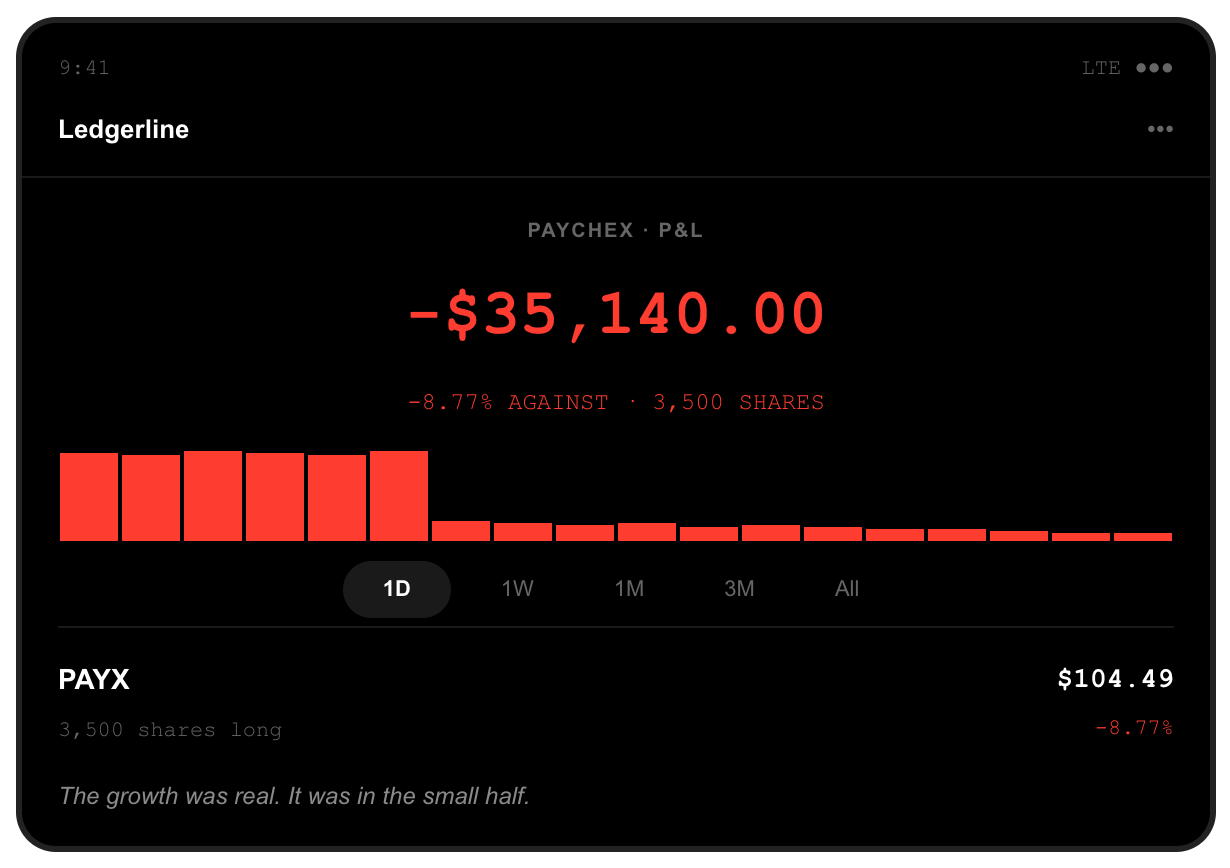
THIS WEEK'S CASUALTIES 💀 Not everybody can be Darwin Award of the week. These three gave it a real shot. Let's run through the tape. Casualty #1: The Man Who Owned The Wrong Half Of A Good Quarter u/payroll_is_recession_proof owned 3,500 shares of Paychex, about $401,000 at Tuesday's close of $114.53. The thesis was solid and slightly boring, which is how he liked it. Companies run payroll in every weather, the revenue is contractual, and the shares were yielding just over four percent at Tuesday's close. On Wednesday the company reported its first quarter and the good part of the business was excellent, with revenue in the professional employer and insurance segment up 12% to $367.6 million. Then came the sentence that did the damage, which was that management solutions, at $1.21 billion of the quarter's $1.63 billion, is trending towards the low end of its range. Paychex closed at $104.49, down $10.04, or 8.77%. 3,500 shares, down $10.04 each, is $35,140. JPMorgan upgraded the stock to neutral the following morning, calling the decline overdone, which is a slightly uncomfortable kind of vindication.
Here's the thing. A company is not one growth rate, it is a weighted average of several, and the weights are the entire argument. A segment growing at double digits off a small base moves the total very little, while the largest segment drifting to the bottom of its range moves it a great deal. That arithmetic is dull enough that people skip it, which is how a genuinely good quarter can produce a genuinely bad print. It matters more at a high multiple, because a high multiple is a claim about the blended rate rather than about the best part of the business. That is the part worth understanding, and it cost him $35,140 to learn that the headline growth rate is a sales figure and the segment table is the accounts.
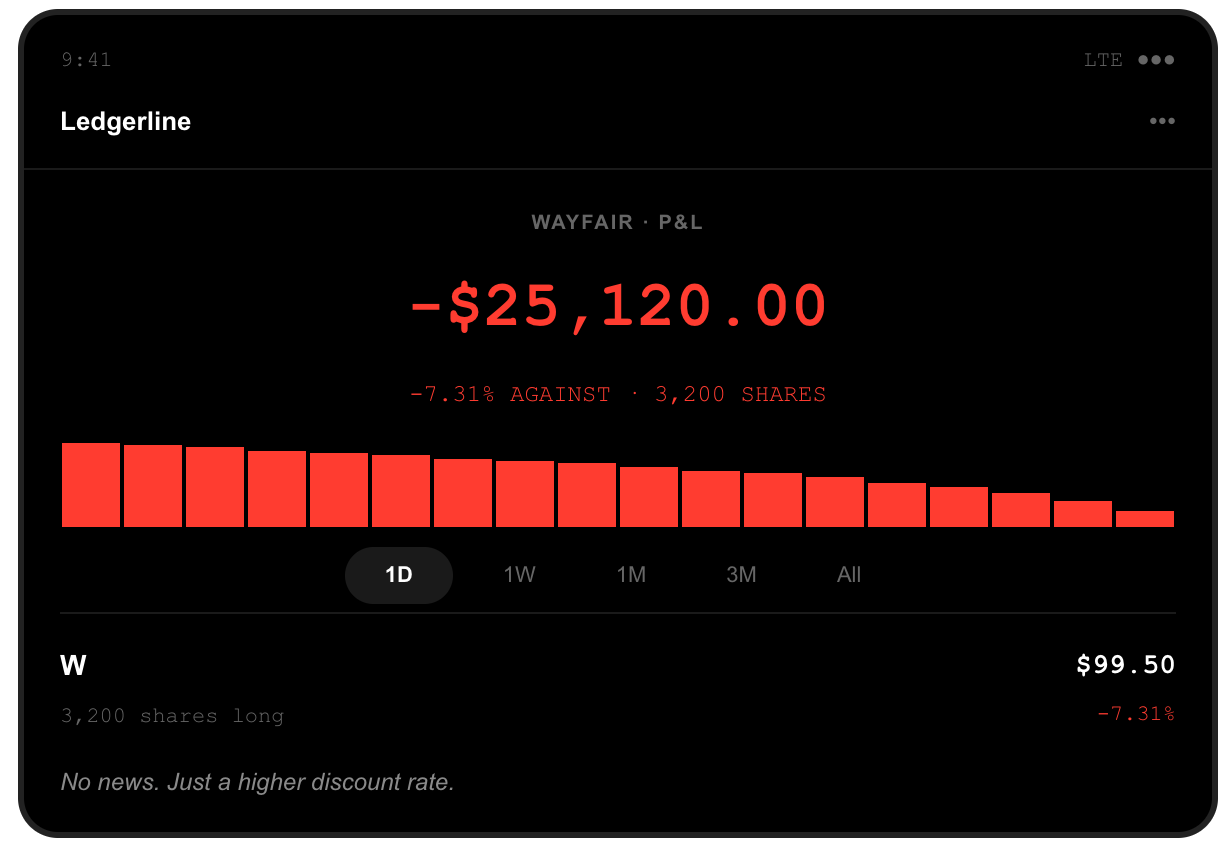
Casualty #2: The Man Who Thought Beta Was Just A Greek Letter u/beta_is_just_a_greek_letter owned 3,200 shares of Wayfair, about $344,000 at Tuesday's close of $107.35. He had been right, too. The company had reported its strongest free cash flow since 2020 and the American business was growing. On Wednesday it announced nothing at all. There was no guidance, no filing and no downgrade that anybody could point to. What there was instead was a Treasury market repricing the cost of money to a nineteen-year high, after a purchasing managers survey came in at 58.4 against expectations near 55. Wayfair has a beta of about three, which is a polite way of saying it is the part of the market that moves most when the market moves at all. Wayfair closed at $99.50, down $7.85, or 7.31%, on a session in which the S&P 500 fell 0.76% and the Nasdaq 1.13%. 3,200 shares, down $7.85 each, is $25,120.
Here's the thing. Every share price is a stack of future cash flows divided by a rate, and on most days the market argues about the top of that fraction. On days like Wednesday it argues about the bottom instead, and the bottom applies to every company at once. The businesses that move most are the ones whose value sits furthest out in time, because a higher discount rate compounds against a distant payoff much harder than a near one. That is the real content of a high beta. It is not a personality trait of the stock, it is a statement about when the money is supposed to arrive. That is the part worth understanding, and it cost him $25,120 to learn that doing excellent work on a company does not exempt you from owning a duration.
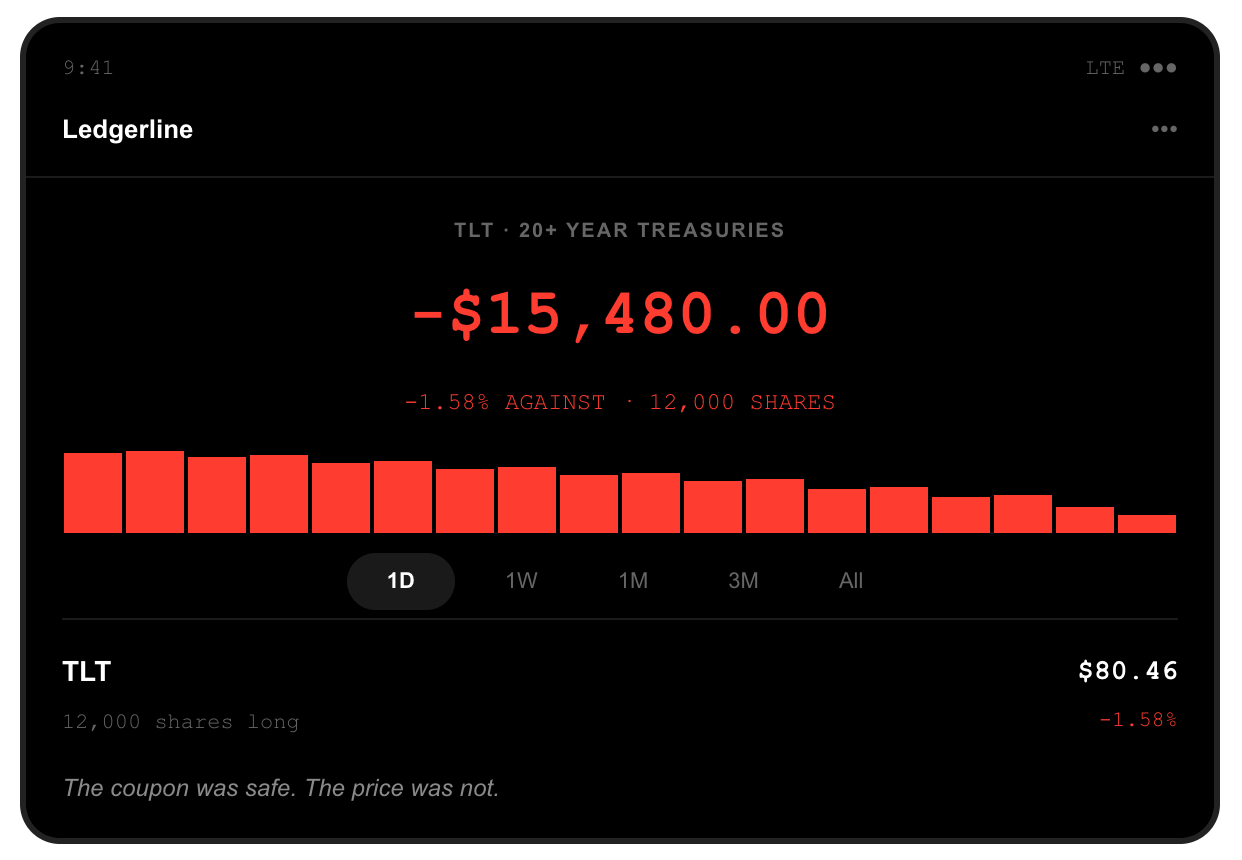
Casualty #3: The Man Who Was Getting Paid To Wait u/you_get_paid_to_wait owned 12,000 shares of TLT, the iShares fund that holds Treasury bonds with more than twenty years left to run, about $981,000 at Tuesday's close of $81.75. This was not a punt. It was a retirement account moved deliberately out of equities and into government bonds, on the reasonable view that yields near five percent were generous and could not go much higher. The fund does pay him. It distributes monthly and the yield is around 4.8%, which is the part he had been looking at. On Wednesday the purchasing managers survey landed hot, crude rose, and Federal Reserve governor Michael Barr said that in his base case further policy adjustments are likely to be needed to bring inflation back to target in a timely fashion. Traders moved to pricing roughly a seventy percent chance of another increase in October, and the whole curve went with it. TLT closed at $80.46, down $1.29, or 1.58%, which is the lowest close in the fund's history. 12,000 shares, down $1.29 each, is $15,480. It is the smallest loss on this page and it is the one that should worry you most, because the position was chosen for safety.
Here's the thing. A Treasury bond has essentially no credit risk and an enormous amount of the other kind. The government will pay you. What nobody guarantees is what the bond is worth on any given Wednesday between now and the day it matures. A fund of twenty-year-plus bonds never matures at all, because it sells the shorter ones and buys longer ones to keep the duration constant. So the reassuring sentence about holding to maturity, which is genuinely true of an individual bond, does not apply to the thing he actually owns. That is the part worth understanding, and it cost him $15,480 in a session to learn that safe from default and safe from loss are two completely different promises.
THIS WEEK BY THE NUMBERS 📊 We track the data because the data is funnier than anything we could make up.
The S&P 500 fell 0.76% on Wednesday to 7,706.03, the Nasdaq 1.13% and the Russell 2000 1.77%. Three of the four people on this page believed they owned a company. All four of them owned a discount rate.
BITE-SIZED COPIUM FOR THE ROAD 🥨 The best part of any loss thread isn't the screenshot. It's the comments section. Here are this week's greatest hits.
Translation: four different companies, one denominator.
DUMB MEMES 😵 Every newsletter needs a meme section. Ours just hits different when nothing happened to any of the businesses.
POV: you heard ambition and they said upkeep
u/you_get_paid_to_wait, reading the statement If you laughed, you're coping. If you didn't laugh, work out how much of your portfolio only pays off more than five years from now, and then look at what the five-year yields. See you next issue. Duration is not a bond word. It is how long you agreed to be patient. Traders and P&L screenshots are satirical composites. Market data, price moves and quotations are real and dated September 22 to September 23, 2026. Not financial advice. Obviously. Look at us. Stay liquid, |
Wednesday the price of waiting went up. Four people were waiting.
The ten-year Treasury yield closed at 5.106%, the highest since 2007. McDonald's promised to spend $8.5bn through 2036 and fell 4.81%, Paychex fell 8.77%, and the largest long-bond fund printed the lowest close in its history.