|
GM. This is The Financial Darwin Awards, the only financial newsletter with a 100% loss rate. Monday was an unpleasant day in a quiet sort of way. The S&P 500 fell 0.77%, the Nasdaq 0.92%, and the ten-year Treasury yield reached its highest level since 2007. December gold fell $152.80 an ounce, or 3.54%, to its lowest settlement since 5 August. It is also the smallest percentage on this page. Four traders lost $134,534 between them, and the index they were all measured against fell less than one percent. That gap is the whole issue. An index is an average, and nobody actually owns the average. The traders are composites. The moves are not. Here's what we've got today:
THIS WEEK'S DAMAGE REPORT 📊
The first number is the sum of the four stories below. The second is real: MongoDB closed Monday at $334.68, down 18.46%, after its chief executive left to take a job at Meta.
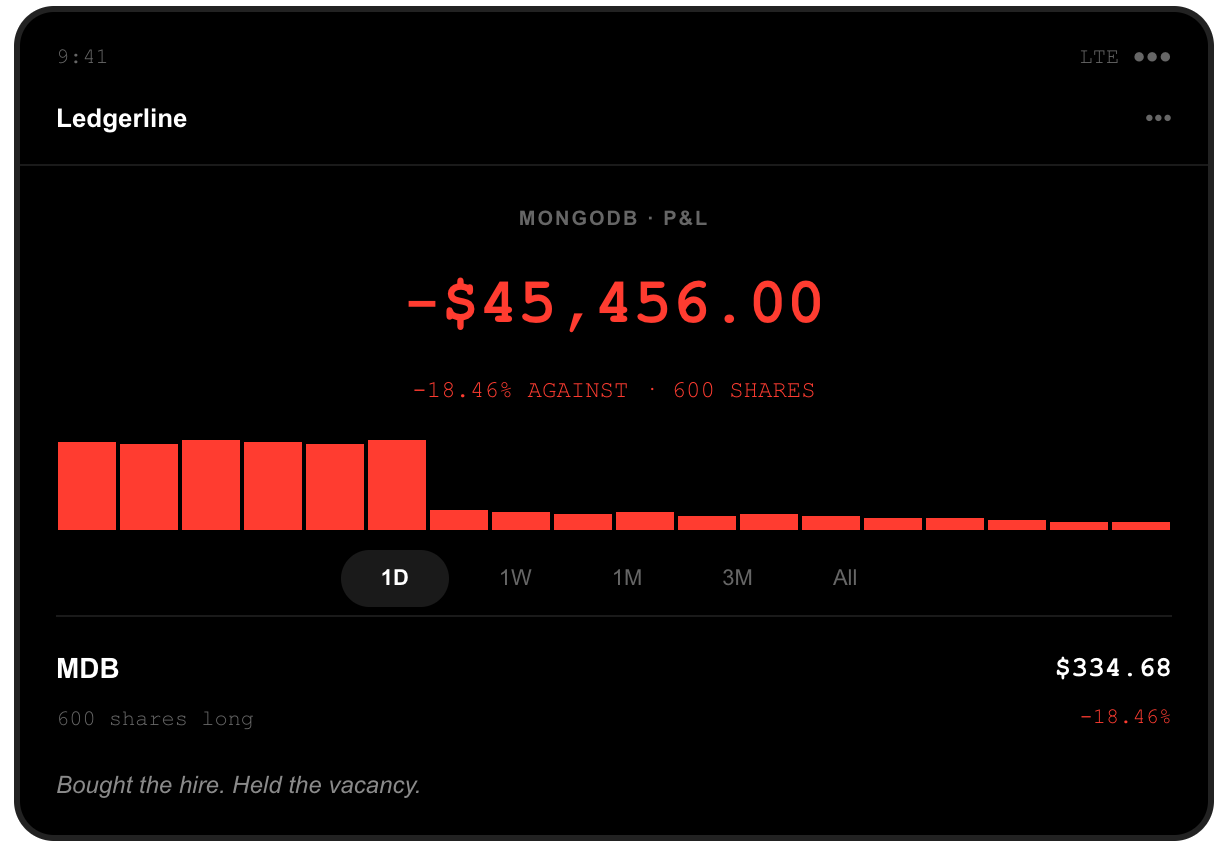
DARWIN AWARD OF THE WEEK 🏆 Every issue we crown the single worst financial decision on the internet. This week it goes to a man who bought a company because of who had just been hired to run it. Here's the setup. u/i_bought_the_new_ceo owned 600 shares of MongoDB, about $246,000 at Friday's close of $410.44. The thesis was tidy and easy to repeat at dinner. A strong database business had brought in a well-regarded operator, Chirantan Desai, and the turnaround would follow. On Monday MongoDB announced that Desai was stepping down with immediate effect for a senior role at Meta, which Meta then described as chief enterprise platform officer. He had started on 10 November 2025, so he lasted ten months and eighteen days. Dev Ittycheria, who ran the company before him, came back as interim chief executive. The same release reaffirmed the company's third-quarter and full-year guidance, and the announcement landed the day before MongoDB's investor day. William Blair's Jason Ader said the announcement creates more questions than answers, which is a polite way to describe a chief executive leaving the night before he was due on stage. MongoDB closed at $334.68, down $75.76, or 18.46%, on a day the S&P 500 fell 0.77%. 600 shares, down $75.76 each, is $45,456. No customer left, no number was revised and no product changed. One person accepted a different job and a fifth of the company went with him.
Here's the thing. A chief executive is not worth a fifth of a company, and that is not what the market repriced. What it repriced was everything that had been deferred into the future on the strength of his being there. When a turnaround is attached to a named person, the share price contains a plan nobody has seen, credited to somebody specific, with no timetable attached. The departure does not disprove the plan. It removes the only evidence anybody had for it, which in a stock trading well above its book value is most of what was holding the price up. That is the part worth understanding, and it cost him $45,456 to learn the difference between buying a company and buying an appointment.
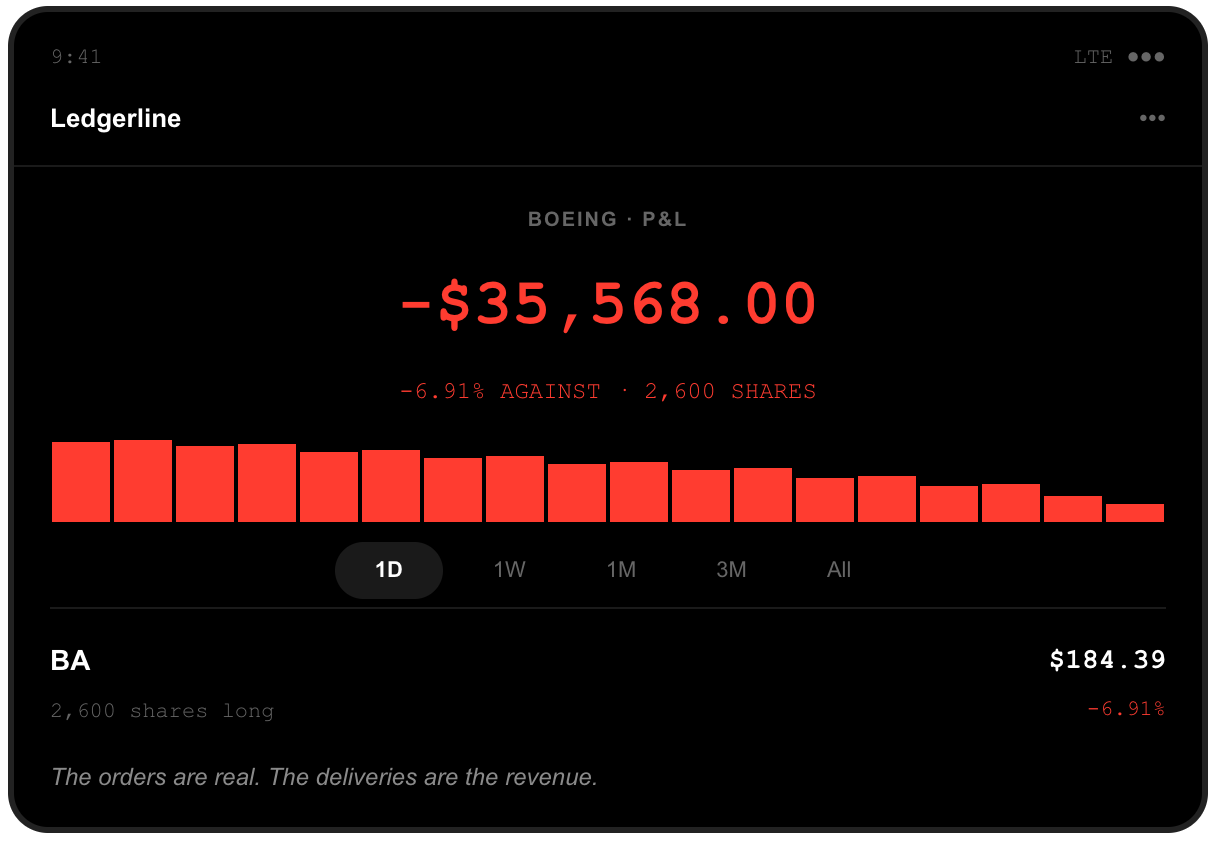
THIS WEEK'S CASUALTIES 💀 Not everybody can be Darwin Award of the week. These three gave it a real shot. Let's run through the tape. Casualty #1: The Man Who Owned Half Of A Duopoly u/only_two_planemakers owned 2,600 shares of Boeing, about $515,000 at Friday's close of $198.07. The argument is one of the best-known in the market. There are two companies on earth that build large commercial aircraft, the order book runs for years, and airlines cannot simply buy somewhere else. All of that is true and none of it helped on Monday. Late last week Boeing told airlines about a fault in GE Aerospace flight-management software on the 737 MAX. The fault can leave pilots without some autopilot functions after a missed approach, which is the go-around rather than the landing itself. On Monday the Federal Aviation Administration's administrator, Bryan Bedford, said the agency would delay the MAX 10 until it is satisfied there is no issue, and that it has not yet decided whether the fault is a safety risk. Boeing closed at $184.39, down $13.68, or 6.91%, which is $7.62 above its 52-week low of $176.77. 2,600 shares, down $13.68 each, is $35,568. The analyst consensus is a strong buy with an average target of $273.50, roughly 48% above where the stock finished.
Here's the thing. A backlog is not revenue, it is a queue, and the queue only pays when an aircraft is handed over. Most of the money in a commercial aircraft order arrives at delivery, which means a slipped certification does not reduce the total, it pushes it into a later year. For a company carrying a great deal of debt, a year of delay is expensive even when the underlying business is untouched, because the interest does not slip with it. That is why the market can take seven percent off a genuine duopoly on a problem that nobody thinks is permanent. That is the part worth understanding, and it cost him $35,568 to learn that being one of two suppliers protects you from competition and not from a regulator.
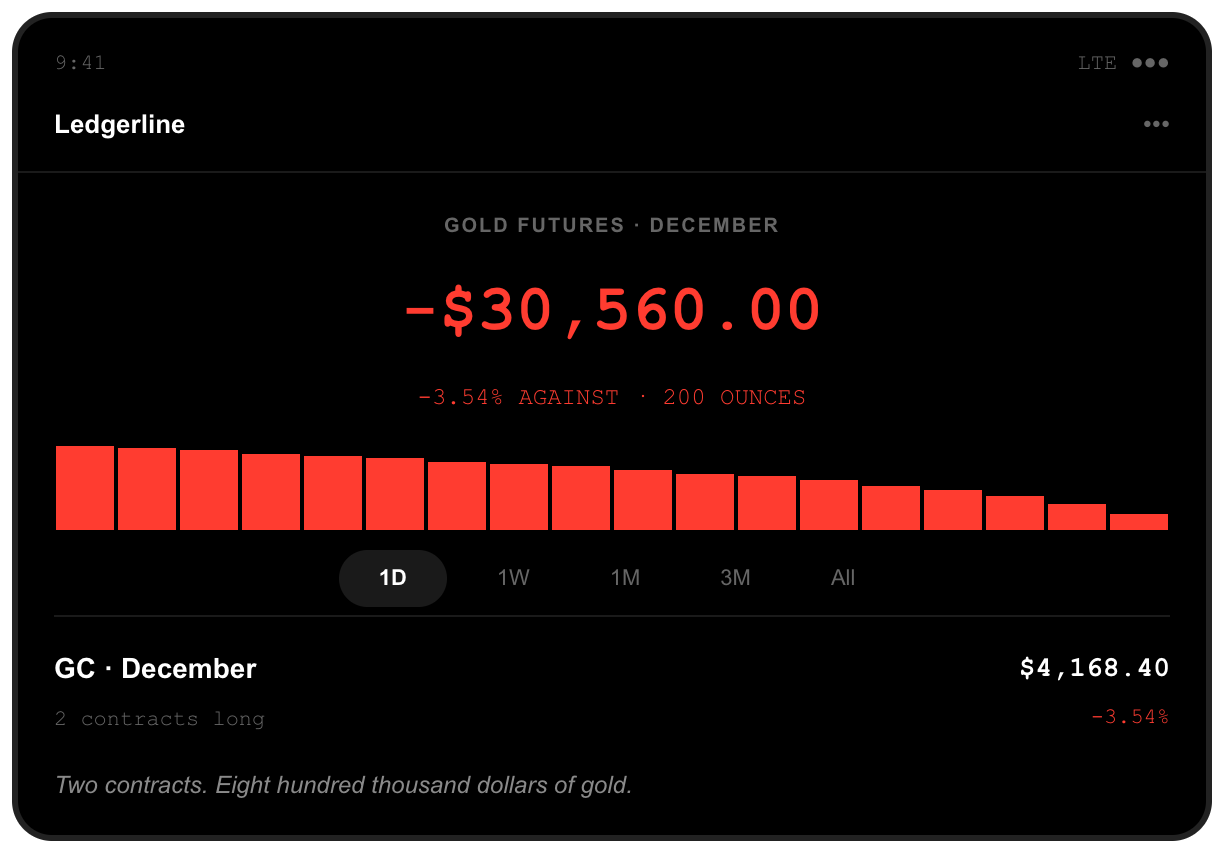
Casualty #2: The Man With Only Two Contracts u/two_contracts_is_not_leverage was long two December gold contracts, which is 200 ounces, from Friday's settlement of $4,321.20. He did not think of it as a large position. It is two contracts, and he had described it to himself as a hedge against everything else he owned. Two contracts is 200 ounces of gold. At Friday's settlement that is about $864,000 of metal, against a deposit that was a small fraction of it. On Monday the ten-year Treasury yield reached 5.24%, its highest since 2007, and the dollar firmed. Gold does not pay anything, so when the risk-free yield rises the cost of holding it rises with no change in the gold. December gold settled at $4,168.40, down $152.80 an ounce, or 3.54%. Spot silver fell about 4.4%. 200 ounces, down $152.80 each, is $30,560. That is a 3.54% move in the metal and a very much larger percentage of what he had actually put up.
Here's the thing. A futures contract is a quantity of something, and the deposit you put up is not the size of the position. Counting in contracts is comfortable because the numbers are small, and it quietly detaches the position from the amount of the underlying you have agreed to own. The percentage that matters is not the move in the commodity. It is the move measured against the money you actually have at risk, and those two numbers can differ by an order of magnitude. None of this is an argument against futures, which are a precise and efficient way to take a view. It is an argument against describing a position by the number of tickets. That is the part worth understanding, and it cost him $30,560 to learn that two of something is only a small position if you know what the something is.
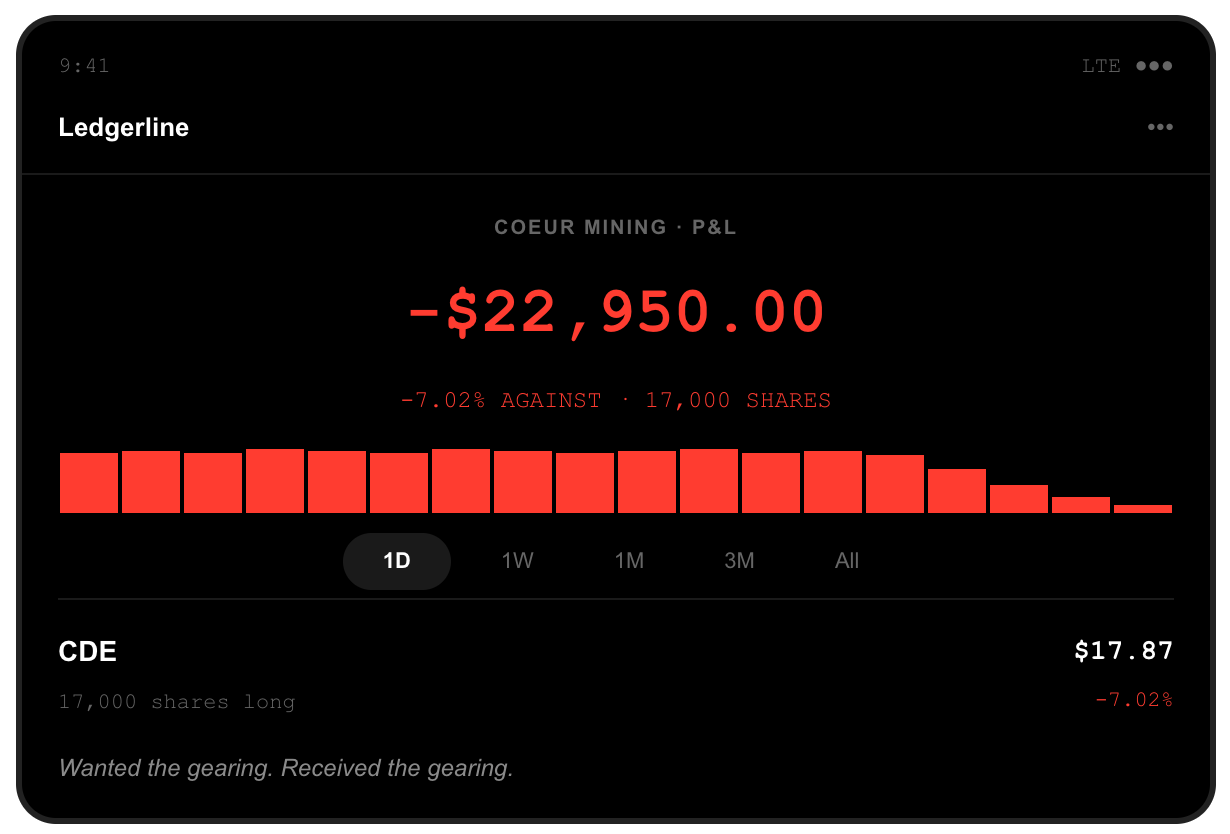
Casualty #3: The Man Who Wanted The Torque u/the_miner_has_the_torque owned 17,000 shares of Coeur Mining, about $327,000 at Friday's close of $19.22. He did not want gold. He wanted the gearing, and the argument for a miner is genuinely a good one. A mine's costs are largely fixed, so when the metal price rises, most of the increase falls straight through to profit. Coeur is the proof. Revenue rose 96% in 2025 to $2.07 billion and net income rose nearly 900% to $585.87 million, on a metal price that did nothing remotely like that. The company was added to the S&P MidCap 400 in June and posted record second-quarter revenue of $1.1 billion. On Monday gold fell 3.54% and Coeur closed at $17.87, down $1.35, or 7.02%. 17,000 shares, down $1.35 each, is $22,950. The gearing that produced 900% earnings growth is the same gearing that doubled a bad day in the metal.
Here's the thing. A miner is not a way to own a metal, it is a way to own the difference between the metal price and the cost of getting it out of the ground. That difference is a small number sitting between two large ones, which is the definition of a geared position even when there is no borrowing anywhere near it. If costs are $1,800 an ounce and the metal is $4,300, the margin is $2,500, and a $150 move in the metal is a 6% move in the margin while being a 3.5% move in the gold. That is why mining shares rise faster in a bull market and fall faster in a bad session, and it is not a flaw. It is the product working. That is the part worth understanding, and it cost him $22,950 to be reminded that operating leverage has no opinion about which direction you wanted.
THIS WEEK BY THE NUMBERS 📊 We track the data because the data is funnier than anything we could make up.
The S&P 500 fell 0.77% on Monday, the Dow 0.67%, the Nasdaq 0.92% and the Russell 2000 0.69%. Every loss on this page is between four and a half and twenty four times the move in the index the owner would have quoted if you had asked how the market did.
BITE-SIZED COPIUM FOR THE ROAD 🥐 The best part of any loss thread isn't the screenshot. It's the comments section. Here are this week's greatest hits.
Translation: two of them owned leverage on purpose and two of them owned it by accident.
DUMB MEMES 🙄 Every newsletter needs a meme section. Ours just hits different when the index only fell three quarters of a percent.
POV: the thesis had a name on it
u/two_contracts_is_not_leverage, counting tickets If you laughed, you're coping. If you didn't laugh, work out the notional value of everything you own that is not a share, and then compare it to your account. See you next issue. An index is the average of what happened to other people. Traders and P&L screenshots are satirical composites. Market data, price moves and quotations are real and dated September 25 to September 28, 2026. Not financial advice. Obviously. Look at us. Stay liquid, |
Gold fell 3.54% on Monday. It was the smallest number on this page.
MongoDB lost 18.46% because its chief executive took a job at Meta. Boeing lost 6.91% on a software bug. December gold lost $152.80 an ounce, and a miner lost twice that in percentage terms.