|
GM. This is The Financial Darwin Awards, rounding up the internet's biggest Ls so you don't make them yourself. Two inflation prints landed in two days, and the Fed decides on Wednesday. Producer prices ran hot on Thursday and the 30-year Treasury closed at 5.367%. Core consumer prices ran hot on Friday and the S&P 500 rose 0.86%. Three people lost $66,806 between them. Each of them was right about the fact he was trading. None of them was right about which fact sets the price. The traders are composites. The moves are not. Here's what we've got today:
THIS WEEK'S DAMAGE REPORT 📊
The first number is the sum of the three stories below. The second is real: the 30-year closed Thursday at 5.367%, up 8.1 basis points on a hot producer price print, with the 10-year at 4.954%.
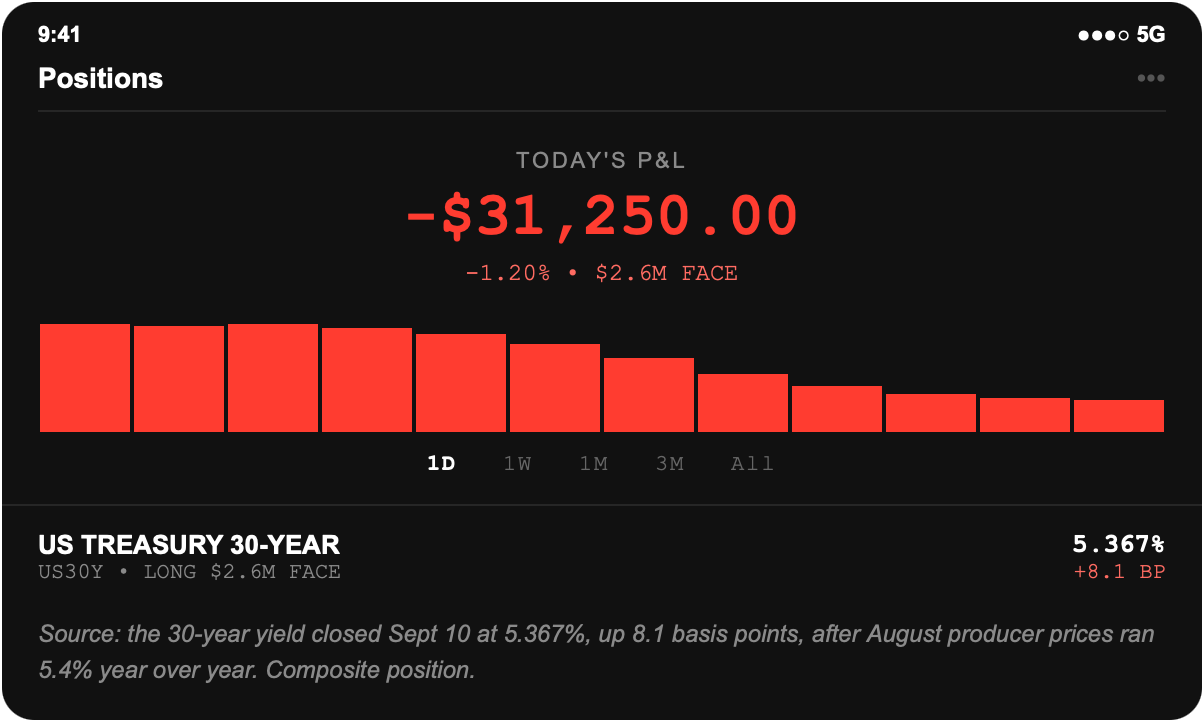
DARWIN AWARD OF THE WEEK 🏆 Every issue we crown the single worst financial decision on the internet. This week it goes to a man who bought the safest bond in the world and found out what the word safe was doing there. Here's the setup. u/locked_in_for_thirty put $2.6 million of face into the 30-year Treasury at par, yielding 5.28%. His logic is the most reasonable logic that has ever appeared in this newsletter. A nineteen-year high in the long bond, $137,280 of coupon a year, and the US Treasury behind every payment. All of it is true, and he has to still be holding in 2056 for any of it to be the relevant fact. On Thursday morning, August producer prices came in at 5.4% year over year, the hottest twelve-month reading of 2026, driven by a 24.1% jump in diesel. The 30-year closed at 5.367%, up 8.1 basis points. The 2-year rose 14 in the same session. A 30-year bond at that yield has a duration of about fifteen, so each basis point takes roughly 0.15% off the price. Eight point one of them is a fall of just over 1.2%. $2.6 million of face, down just over 1.2%, is $31,250. His coupon is $11,440 a month. Thursday cost him close to three months of it, before lunch. The bond is risk-free. The price of the bond is a different product.
Here's the thing. A Treasury guarantees the cash flows, not the market value of them, and those are two different products sharing one certificate. That is the part worth understanding, and it cost him $31,250 to learn that the word risk in risk-free means default risk and nothing else.
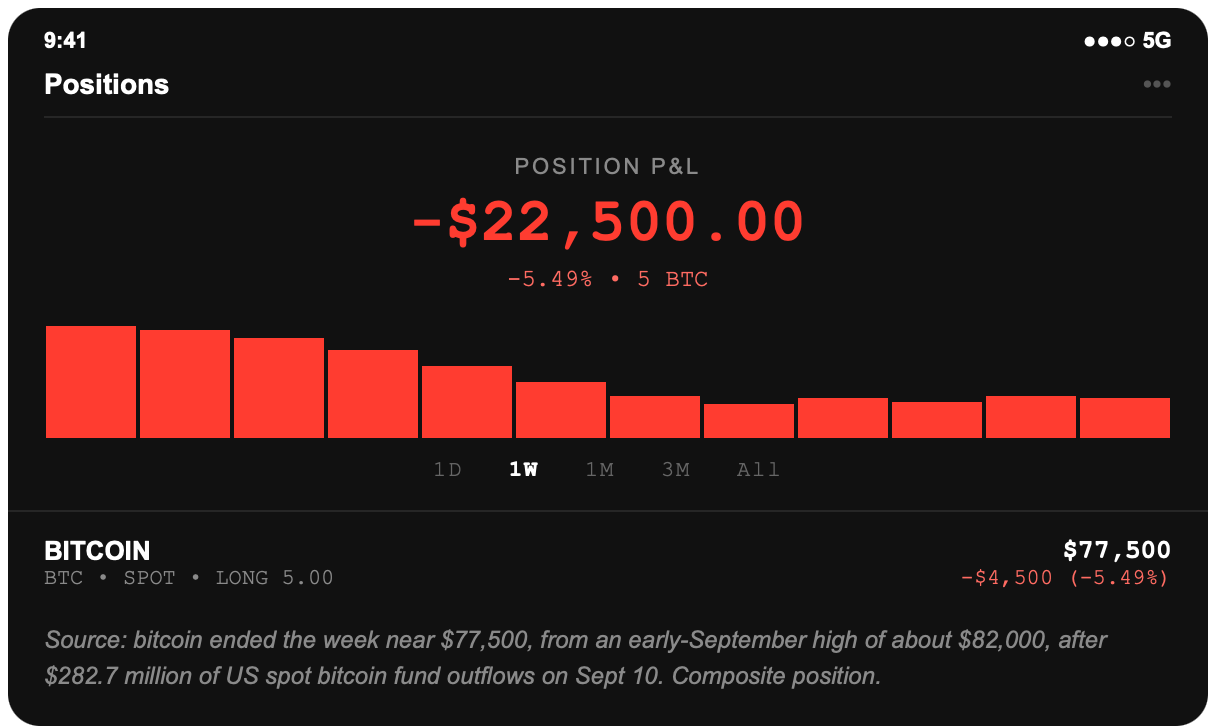
THIS WEEK'S CASUALTIES 💀 Not everybody can be Darwin Award of the week. These two also had their facts straight. Casualty #1: The Man The ETF Made Safe u/the_etf_made_it_safe owned 5 bitcoin, bought near the early-September high of about $82,000, roughly $410,000 of it. What changed his mind about size was the ETF complex. Bitcoin was no longer a thing you kept on a laptop and hoped about. It was a line item in other portfolios, held through funds with daily flow reports. That is entirely true, and it is also the problem. On Thursday, the day producer prices ran hot, the US spot bitcoin funds posted net outflows of $282.7 million. ARK 21Shares accounted for $164.3 million of it on its own, with Grayscale at $36.4 million. Those sellers were not selling a view on bitcoin. They were cutting risk on a day the 10-year closed at 4.954%. Bitcoin touched $76,651 that day, and long positions were roughly three quarters of everything liquidated. The week ended near $77,500, down from about $82,000. 5 coins, down about $4,500 each, is $22,500.
Here's the thing. Putting an asset in a regulated wrapper does not change the asset, it changes who owns it, and the owner decides why it gets sold. That is the part worth understanding, and it cost him $22,500 to learn that institutional adoption is a correlation trade running in both directions.
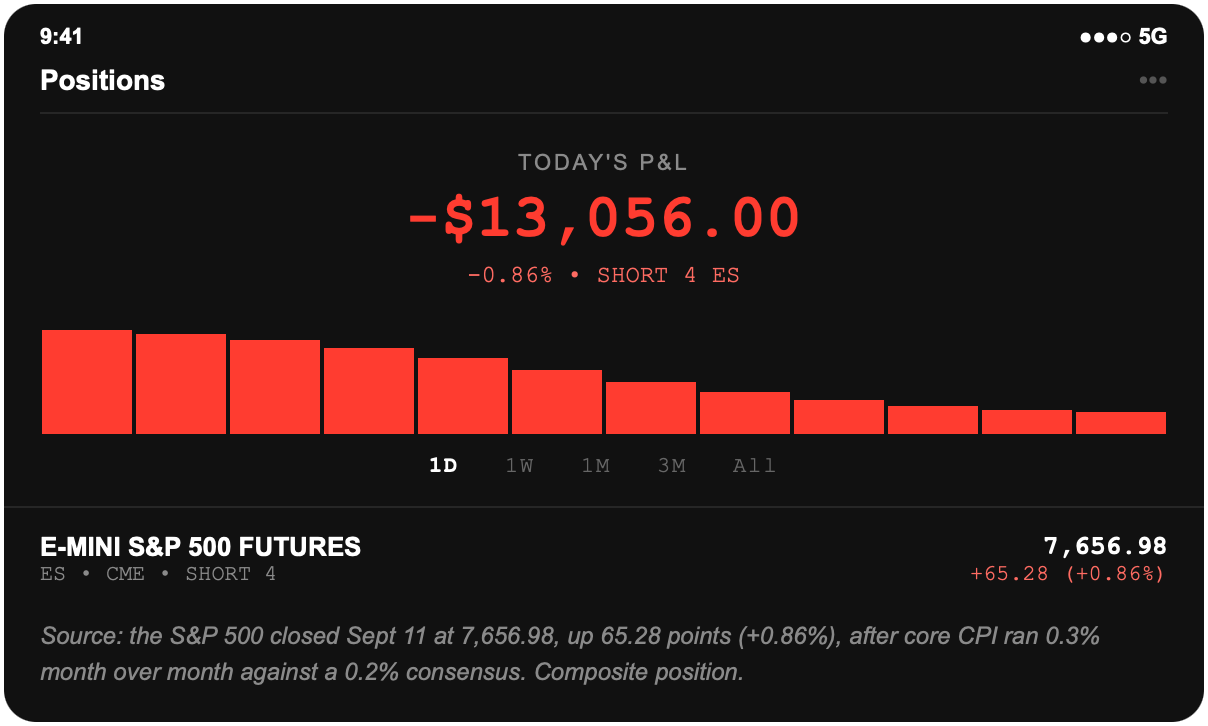
Casualty #2: The Man Who Called It u/right_about_the_number was short 4 e-mini S&P 500 futures into Friday's consumer price report, about $1.53 million of notional. He had the print right. Core CPI came in at 0.3% month over month against a 0.2% consensus, an acceleration from July. Odds of a 25 basis point hike at Wednesday's meeting went from roughly 70% to nearly 90%. EY-Parthenon's Greg Daco changed his call from a hold to a hike that morning. Everything he had predicted happened, in the order he predicted it. The S&P 500 closed at 7,656.98, up 65.28 points, or 0.86%. 4 contracts, against him by 65.28 points at $50 a point, is $13,056. The index had fallen four sessions running into that print, and Brent fell nearly 3% on Friday. A hike at 90% is a hike that has stopped being a question.
Here's the thing. Markets do not pay out on whether news is good or bad, they pay out on the distance between the news and what was already feared. That is the part worth understanding, and it cost him $13,056 to learn that a bad number arriving on schedule can land as a relief.
THIS WEEK BY THE NUMBERS 📊 We track the data because the data is funnier than anything we could invent.
The S&P 500 still fell 0.8% on the week, the Dow 1.6% and the Russell 2000 2.4%. Friday was a good day inside a bad week, which is the shape most of these stories have.
BITE-SIZED COPIUM FOR THE ROAD 🍪 The best part of any loss thread is the comments.
Translation: three statements that were true and did not pay.
DUMB MEMES 🤣 Ours hits different when you were right about the facts.
POV: you locked in the rate and the rate kept going
u/right_about_the_number, correct to the decimal If you laughed, you're coping. If you didn't, go and check whether the fact your largest position rests on is the fact that moves it. See you next issue. Three true premises. Three wrong trades. Traders and P&L screenshots are satirical composites. Market data, inflation releases and price moves are real and dated September 10 and 11, 2026. Not financial advice. Stay liquid, |
Three true premises. Three wrong trades.
A man who locked in 5.28% on the thirty-year lost three months of coupon in one afternoon, a bitcoin holder found out that the ETF which made it institutional is also the pipe the money leaves through, and a man who called the inflation print to the decimal watched the S&P 500 rally 0.86% on it.