|
GM. This is The Financial Darwin Awards, the newsletter that tracks how regular people light their savings on fire so you can learn from their mistakes. Markets are shut today for Labor Day, so nothing can go wrong for one entire session. Last week managed enough for two. On Thursday, Fed governor Christopher Waller said he saw disinflation and would be inclined to support holding rates. September hike odds fell from 63% to about 50% and the S&P 500 had its best day in a month. On Friday, the August jobs report came in at 162,000 against a consensus of 55,000, and the odds went straight back up. Four traders lost $79,419 across those two sessions. Every one of them had bought a continuation. The traders are composites. The moves are not. Here's what we've got today:
THIS WEEK'S DAMAGE REPORT 📊
The first number is the sum of the four stories below. The second is real: the economy added 162,000 jobs in August against a consensus of 55,000, with June and July revised up by a combined 55,000, and the unemployment rate held at 4.1%.
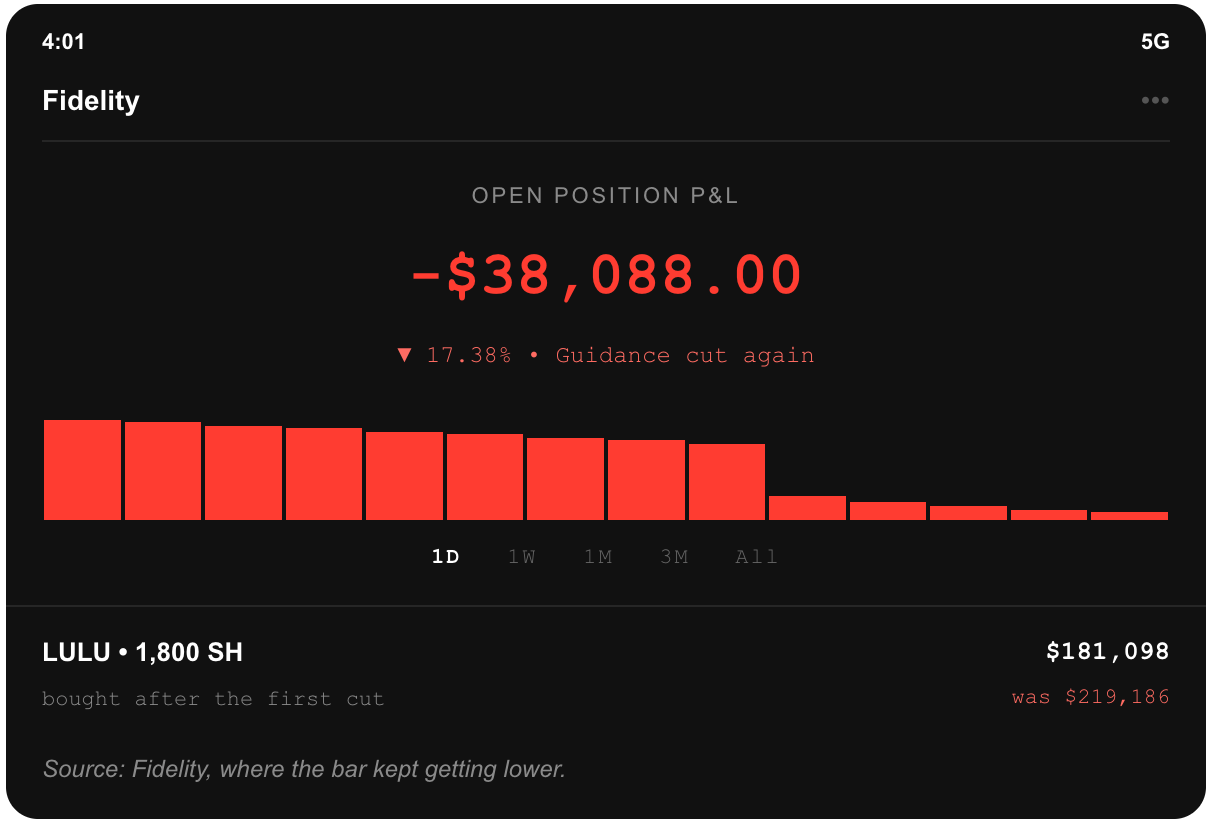
DARWIN AWARD OF THE WEEK 🏆 Every issue we crown the single worst financial decision on the internet. This week it goes to a man who treated a company cutting its forecast as the end of the bad news rather than the middle of it. Here's the setup. u/the_bar_was_already_reset owned 1,800 shares of Lululemon, about $219,186 at Thursday's close of $121.77. He had bought after the company's earlier guidance cut this year, on the reasoning that a management team which has just been embarrassed sets the next bar low enough to clear. It is a genuinely popular thesis and it has a name. Kitchen-sinking, where a company empties every problem into one quarter so the following ones look clean. On Thursday evening Lululemon reported second-quarter revenue of $2.42 billion, below estimates, with comparable sales down 10% and North American comps down 12%. Leggings sales, which is the product the entire company is known for, fell 20%. Then it cut full-year earnings guidance again, from a range of $10.95 to $11.15 down to $9.48 to $9.73. Lululemon closed Friday at $100.61, down $21.16, or 17.38%. 1,800 shares, down $21.16 each, is $38,088. The stock is down about 41% for the year and trading at roughly an eight year low. The gross margin of 60.5% actually looked respectable, which is worth a second look, because it included an 86 cent per share benefit from a one-time tariff refund. The bar had not been reset. It had been lowered once and was on its way down again.
Here's the thing. A guidance cut is not an event. It is a piece of evidence about how well a management team understands its own business. A team that misjudged the year badly enough to cut once is, on the balance of probability, still misjudging it. That is why cuts arrive in clusters rather than singly, and why the first one is a poor entry point. The tell was available in the release. Comparable sales falling 10% is a demand problem, and demand problems are not fixed inside a quarter by anyone's forecasting discipline. That is the part worth understanding, and it cost him $38,088 to learn that the bottom of the bad news is not announced in advance.
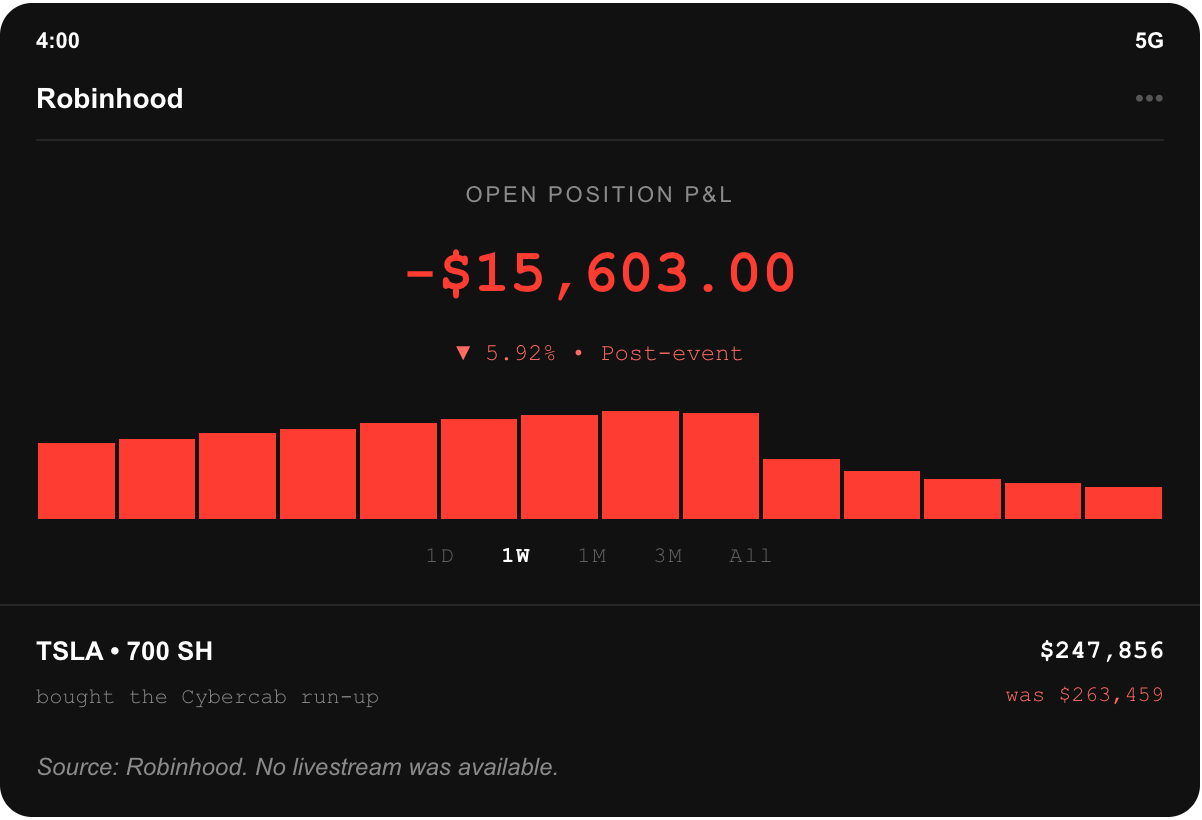
THIS WEEK'S CASUALTIES 💀 Not everybody can be Darwin Award of the week. These three gave it a real shot. Let's run through the tape. Casualty #1: The Man Who Bought The Event u/no_livestream_no_problem owned 700 shares of Tesla, about $263,459 at Thursday's close of $376.37. He had bought into the run-up. Tesla rose about 7% on Thursday purely on anticipation of Friday's Cybercab launch. The event then happened, which is the part that did the damage. Elon Musk did not attend. Attendance was limited to shareholders and content creators under nondisclosure agreements, and it was not livestreamed, which is a departure from how Tesla normally does this. RBC Capital Markets noted the event left key questions on pricing, production cadence and regulatory approvals unanswered. The next morning the National Highway Traffic Safety Administration opened an audit query into how Tesla self-certified the Cybercab as compliant, including its exemption from steering wheels, pedals and mirrors. Tesla closed Friday at $354.08, down $22.29, or 5.92%. 700 shares, down $22.29 each, is $15,603. The stock trades on a price to earnings ratio above 320, which is a number that only makes sense as a bet on things that have not happened yet.
Here's the thing. A scheduled event is not a catalyst. Information is the catalyst, and an event is only the container it sometimes arrives in. When a company is valued on a multiple above 320, essentially the whole price is a claim about proof that has not been delivered yet. An event that delivers no proof does not leave that price where it was. It removes one of the dates on which the proof was expected. The nondisclosure agreements and the missing livestream were the most informative details available, because both are choices about how much of the event a company wants examined. That is the part worth understanding, and it cost him $15,603 to learn that an empty announcement is not neutral news for a stock that has been paid in advance.
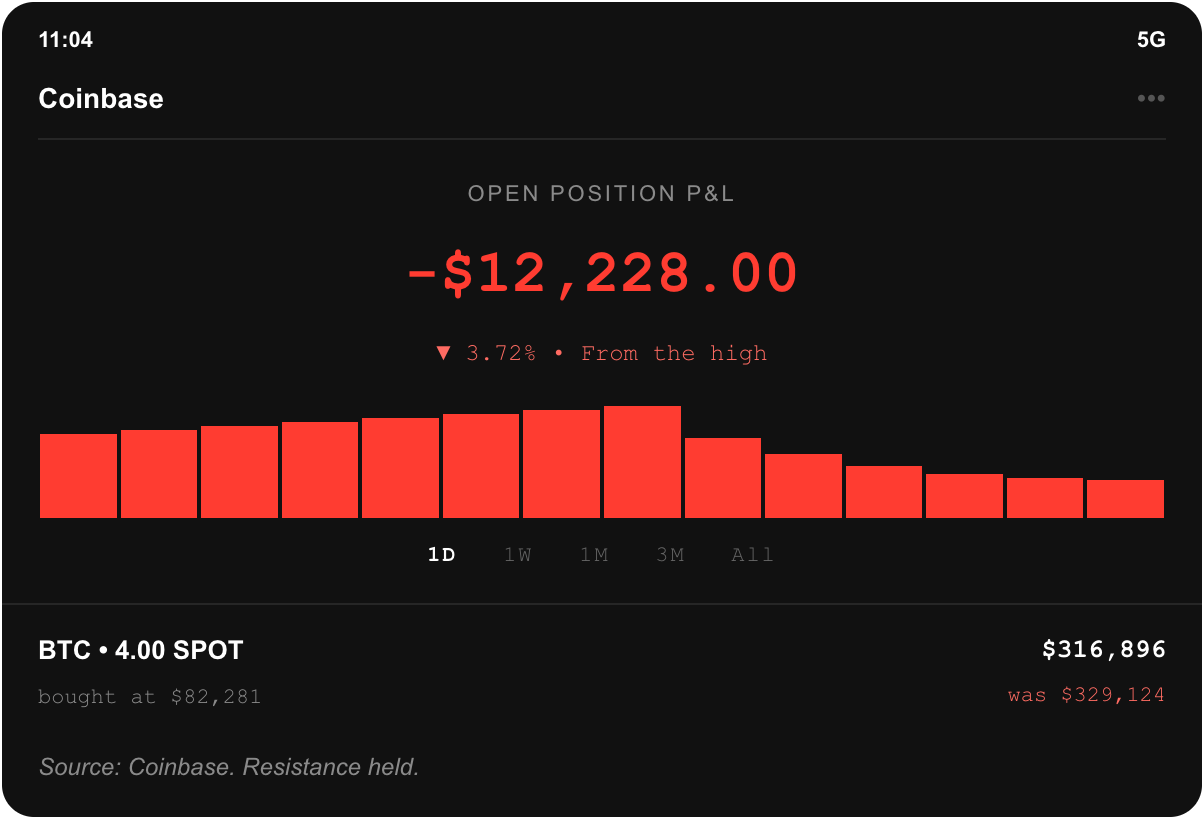
Casualty #2: The Man Who Bought The Breakout u/it_cleared_resistance bought 4 bitcoin on Friday morning as the price printed $82,281. That is about $329,124, and the reasoning was the oldest one in technical analysis. The level had been rejected repeatedly, so clearing it was supposed to mean the sellers there had finally been used up. Then the jobs report landed, and it was not close. 162,000 jobs against a consensus of 55,000. The implied probability of a September rate rise jumped to about 65% on one tracker's count, and the ten year Treasury yield moved up to about 4.77%. Bitcoin fell to $79,224 and closed the session near $79,560, down about 2.1%. $82,281 was not the start of the breakout. It was the high of the day. 4 bitcoin, down $3,057 each from where he bought, is $12,228. The asset that is supposed to be uncorrelated spent the afternoon trading as a pure interest rate instrument.
Here's the thing. A resistance level is a description of where people have previously wanted to sell, which is useful, and it is not a forecast. Clearing it says the sellers who were resting there have been absorbed. It says nothing whatsoever about sellers who have not arrived yet. On a morning with a scheduled macro release, the sellers who have not arrived yet are the entire market, waiting for one number. Bitcoin has spent this year responding to the rate path like a long duration asset, because a higher risk-free yield raises the bar every non-yielding asset has to clear. That is the part worth understanding, and it cost him $12,228 to learn that a breakout into a data release is a bet on the data, whatever the chart is doing.
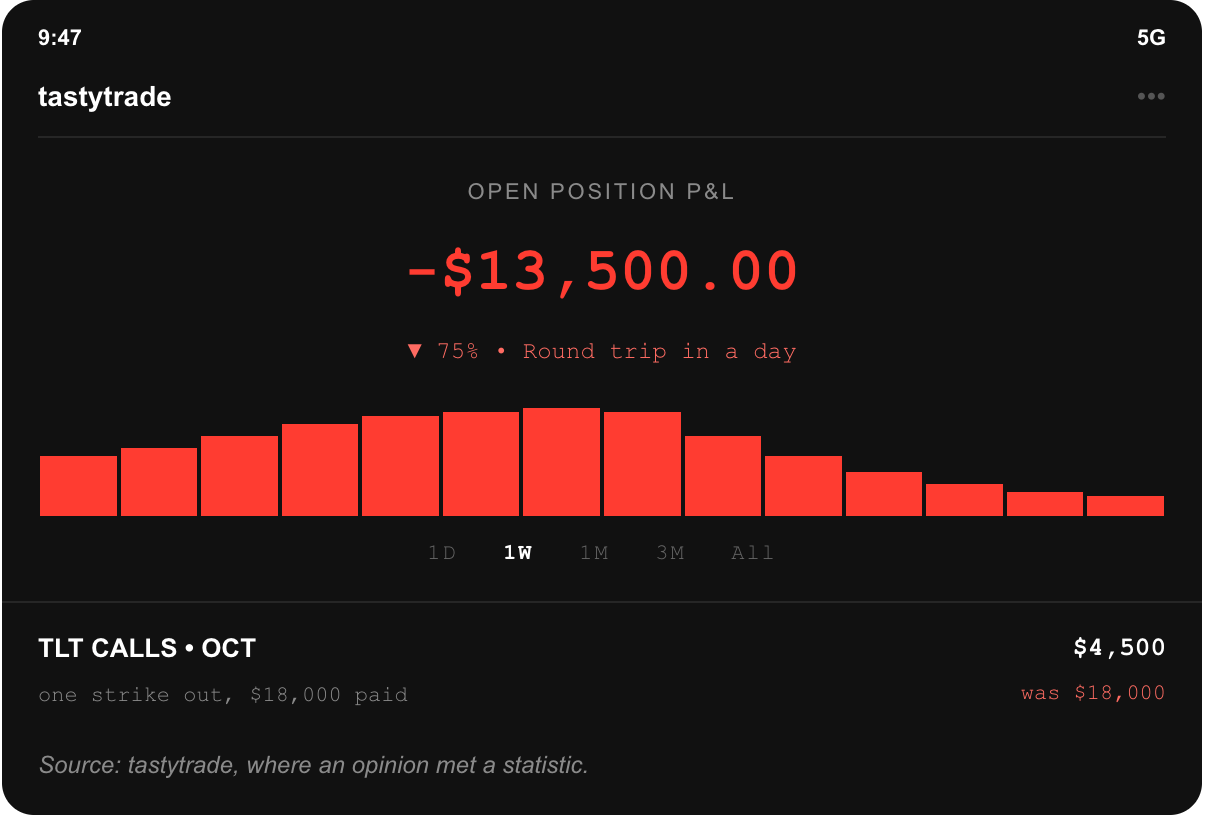
Casualty #3: The Man Who Traded A Governor u/a_governor_said_so bought $18,000 of call options on a long dated Treasury fund on Thursday afternoon, one strike out of the money. The trigger was a specific sentence. Fed governor Christopher Waller said he saw disinflation in the data and added that if it continued, he would be inclined to support holding the target. The market took him seriously and repriced immediately. September hike odds fell from 63% to roughly 50%, the ten year yield eased to about 4.74%, and the S&P 500 and Dow had their best session since August 4. So far the trade was working exactly as intended. Then Friday morning arrived with 162,000 jobs against a consensus of 55,000, plus a combined 55,000 of upward revisions to June and July. The odds went back up. Estimates of where they landed varied between about 58% and 65%, depending on whose tracker you read, and the ten year yield ticked up to 4.77%. His calls are down $13,500, three quarters of the premium, inside 24 hours. He was not wrong about what Waller said. He was wrong about what a Waller sentence is worth.
Here's the thing. A central banker's speech and an economic release are not the same category of object, even when they move the same market by the same amount. A speech is one voting member's reading of data that already exists, and Waller was careful to make his conditional on the next two weeks of it. A payrolls print is the data itself, and it outranks every opinion about the data, including the opinions of the people who will vote. The tell was inside the quote. He said he would be inclined to support holding if the disinflation continued in the data due over the next two weeks. That is the part worth understanding, and it cost him $13,500 to learn that a conditional sentence is not a policy, and the condition arrives on a published schedule.
THIS WEEK BY THE NUMBERS 📊 We track the data because the data is funnier than anything we could make up.
The S&P 500 had its best day in a month on Thursday and gave part of it back on Friday. Four people managed to be positioned for the first half of that and still holding for the second.
BITE-SIZED COPIUM FOR THE ROAD 🍪 The best part of any loss thread isn't the screenshot. It's the comments section. Here are this week's greatest hits.
Translation: every one of them bought a trend on the last day of it.
DUMB MEMES 🤣 Every newsletter needs a meme section. Ours just hits different when the reversal was on the calendar the whole time.
POV: the Fed governor and the payrolls print disagreed
u/it_cleared_resistance, at exactly $82,281 If you laughed, you're coping. If you didn't laugh, go and check whether your largest position is a continuation bet you have stopped noticing. See you next issue. Two sessions. One reversal. Traders and P&L screenshots are satirical composites. Market data, price moves and quotations are real and dated September 3 to 4, 2026. Not financial advice. Obviously. Look at us. Stay liquid, |
Thursday said hold. Friday said hike. Four people had already committed.
Another guidance cut and an eight year low, an event whose news was the absence of news, a breakout that stopped at the exact level everyone was watching, and 162,000 jobs against a consensus of 55,000.