|
GM. This is The Financial Darwin Awards, rounding up the internet's biggest Ls so you don't make them yourself. The Fed decides at two this afternoon. Yesterday the market got on with repricing anyway. The 10-year closed above 5% for the first time since 2007. Three numbers underneath that turned out not to mean what they said. Three people lost $72,537 between them. Each of them read a headline figure and skipped the price attached to it. The traders are composites. The moves are not. Here's what we've got today:
THIS WEEK'S DAMAGE REPORT 📊
The first number is the sum of the three stories below. The second is real: the 10-year closed Tuesday at 5.006%, up 4.5 basis points and past its 2023 peak.
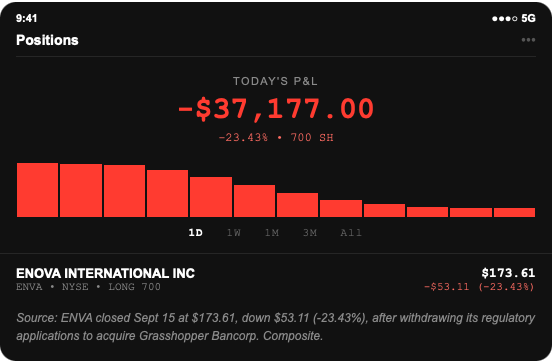
DARWIN AWARD OF THE WEEK 🏆 Every issue we crown the single worst financial decision on the internet. This week it goes to a man who owned a lender for a reason the lender told him not to care about. Here's the setup. u/cheap_deposits_incoming owned 700 Enova shares, about $158,704, at Monday's close of $226.72. Enova lends to people banks will not. It funds those loans in the credit markets, which is expensive, and it had a plan. Late last year it agreed to buy Grasshopper Bancorp for roughly $369 million. A bank charter would have let it fund those loans with insured deposits instead. For a lender that is not a nice-to-have. The cost of money is the raw material, so the charter was most of the thesis. On Tuesday Enova withdrew its applications to the Office of the Comptroller of the Currency and the Federal Reserve Board. A coalition of state attorneys general had urged regulators to reject it. Chief executive Steve Cunningham said the process lacked clear standards for nonbanks and was open to political pressure. He also said this, which is the part worth reading twice: "Our future growth and success do not depend on becoming a bank." Enova reaffirmed guidance the same morning: third-quarter revenue growth around 25%, adjusted earnings growth around 30%, and an accelerated buyback. Enova closed at $173.61, down $53.11, or 23.43%. 700 shares, down $53.11 each, is $37,177. The business did everything it promised. The 23% came out of a licence that never arrived.
Here's the thing. When a valuation rests on a pending approval, the position is not in the business, it is in a decision taken by people who owe you nothing. That is the part worth understanding, and it cost him $37,177 to learn that a nine-month-old application is not a licence.
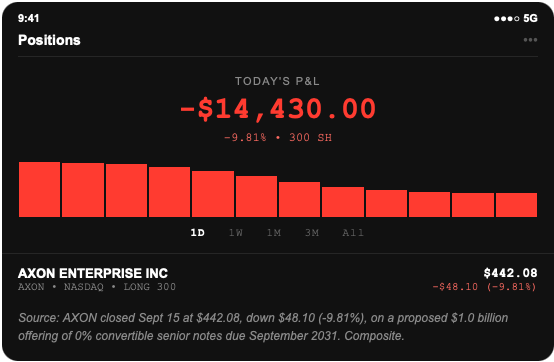
THIS WEEK'S CASUALTIES 💀 Not everybody can be Darwin Award of the week. These two also took a number at face value. Casualty #1: The Man Who Read A Coupon u/zero_percent_is_free owned 300 Axon Enterprise shares, about $147,054, at Monday's close of $490.18. On Tuesday Axon announced a proposed offering of $1.0 billion of convertible senior notes due 2031, with a further $150 million option for the underwriters. The coupon is zero percent. He read that as free money, on the day the US government was paying 5.006% to borrow for ten years. It is not free money. A convertible is a bond plus a call option on your own stock, sold to the lender. The coupon is zero because that option pays for it, and the shareholders are the ones who wrote it. Axon knows this. It plans to spend part of the billion on capped call transactions, buying back some of the dilution it has just sold. So the money costs an option and then some cash. It is free only in the interest line. Axon closed at $442.08, down $48.10, or 9.81%. 300 shares, down $48.10 each, is $14,430.
Here's the thing. A financing cost that does not appear in the interest line has not been avoided, only moved somewhere the income statement does not show. That is the part worth understanding, and it cost him $14,430 to learn that the cheapest coupon in the building was being paid in his shares.
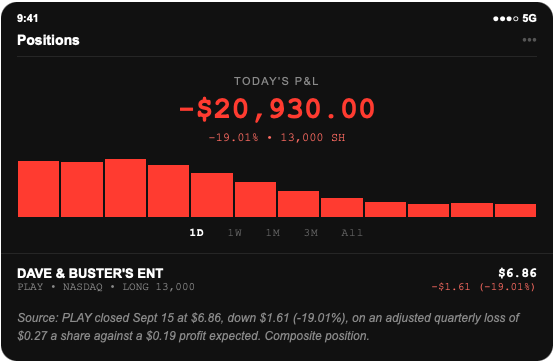
Casualty #2: The Man Who Bought The Second Derivative u/the_trend_improved owned 13,000 Dave & Buster's shares, about $110,110, at Monday's close of $8.47. His case was a sentence from the company. Comparable sales fell 1.6% in July, against a 5.0% decline in June. The quarter as a whole came in at minus 2.9%. That is a real improvement, and it is also still a decline. He bought the direction and ignored the sign. Then the quarter arrived. Revenue of $544.1 million, down 2.4% and short of the $556.8 million expected. Wall Street wanted a 19 cent profit. The company posted an adjusted loss of 27 cents. Dave & Buster's closed at $6.86, down $1.61, or 19.01%. 13,000 shares, down $1.61 each, is $20,930.
Here's the thing. A rate of change tells you about momentum and nothing about position, and a business can improve every month while running out of money the whole time. That is the part worth understanding, and it cost him $20,930 to learn that less bad is a direction, not a destination.
THIS WEEK BY THE NUMBERS 📊 We track the data because the data is funnier than anything we could invent.
The S&P 500 fell 0.45%, its sixth decline in seven sessions, with the Russell 2000 down 0.86%. Small caps borrow at the short end, which is exactly where the repricing has been happening.
BITE-SIZED COPIUM FOR THE ROAD 🍪 The best part of any loss thread is the comments.
Translation: three numbers read forwards, none read for what it cost.
DUMB MEMES 🤣 Ours hits different when the number was right there.
POV: the CEO says you never needed the bank
u/zero_percent_is_free, reading a coupon If you laughed, you're coping. If you didn't, go and find the number in your thesis that nobody has signed off yet. See you next issue. Zero percent is not free. Down 1.6% is not up. Traders and P&L screenshots are satirical composites. Market data, company statements and price moves are real and dated September 15, 2026. Not financial advice. Stay liquid, |
Zero percent is not free, and down 1.6% is not up.
A lender told its shareholders it did not need to become a bank and lost 23.43% anyway, a company borrowed a billion dollars at a 0% coupon and fell 9.81%, and an arcade chain called a 1.6% sales decline an improvement. The 10-year closed above 5% for the first time since 2007.